

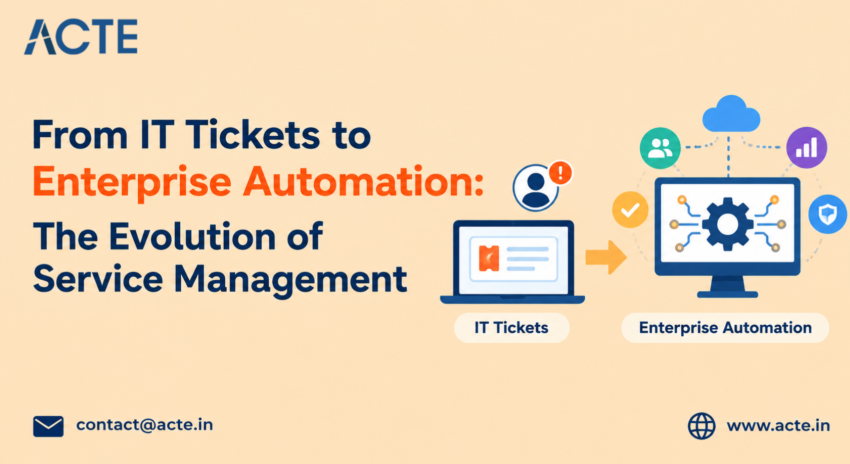
Service management has moved far beyond the traditional IT help desk. What began as a system for recording technical problems and tracking support tickets has developed into a broader approach for managing digital services, business processes, and employee experiences. Organizations now use service management platforms to ServiceNow Course in Chennai combine workflows, automation, self-service, analytics, integrations, and artificial intelligence. This evolution is helping businesses reduce manual effort, improve service consistency, and respond more effectively to changing operational requirements.
The Beginning of Ticket-Based IT Support
In the traditional IT environment, the service desk was primarily responsible for handling employee-reported problems. Users created tickets for issues involving applications, hardware, networks, passwords, or system access, while support professionals investigated and resolved them. Ticketing systems introduced a structured method for recording requests, assigning responsibilities, tracking progress, and maintaining resolution histories. Although this improved visibility, the process remained largely reactive and required employees and support teams to participate manually in many routine activities.
Service Management Expands Its Role
As technology became more deeply connected to business operations, organizations recognized that service management needed to address more than individual incidents. New practices emerged around problem management, change management, service requests, configuration management, asset management, and knowledge management. These capabilities allowed teams to examine the complete service lifecycle and understand how technical issues could affect business outcomes. The focus gradually shifted toward preventing recurring problems and delivering services through consistent, well-defined processes.
Self-Service Becomes Part of Everyday Operations
Self-service has changed how employees obtain support and access business services. Instead of raising a ticket for every basic requirement, users can search knowledge bases, browse service catalogs, submit standardized requests, and follow guided processes. Routine activities such as requesting software, seeking system access, finding information, or checking request status can often be handled digitally. This approach can reduce repetitive work for service teams while giving employees greater control over common service interactions.
Automation Reduces Manual Dependencies
Automation has become one of the defining characteristics of modern service management. Workflows can automatically classify requests, assign tasks, obtain approvals, send notifications, update records, and initiate actions in connected systems. For instance, an employee onboarding process can automatically coordinate ServiceNow Course in Bangalore account creation, application access, device allocation, and other tasks across multiple teams. Instead of using service management simply to record work, organizations can use it to execute and coordinate work.

AI Adds Intelligence to Service Delivery
Artificial intelligence is introducing new possibilities for service operations. AI-enabled tools can help classify tickets, summarize incidents, recommend knowledge resources, identify recurring patterns, and support service agents during investigations. Conversational assistants can also help employees explain their requirements in ServiceNow Course in Hyderabad natural language and receive relevant guidance. AI does not eliminate the need for service professionals, but it can support routine interactions and provide information that helps teams work more efficiently.
Enterprise Service Management Connects Functions
The principles of service management are increasingly being applied across departments. HR, finance, facilities, procurement, legal, and other teams can use service platforms to manage requests, approvals, tasks, and workflows. Enterprise service management creates opportunities to connect processes that previously operated separately. For example, a workplace or employee request may require contributions from HR, IT, facilities, and finance, and a shared workflow can coordinate those activities more effectively.
The Service Management Professional Is Changing
The expanding scope of service management is influencing the skills professionals need. Modern roles can involve service design, workflow automation, platform configuration, analytics, cloud technologies, system integrations, AI capabilities, and process improvement. Technical troubleshooting remains valuable, but professionals are increasingly expected to understand business requirements and identify opportunities for better service delivery. This ServiceNow Online Course combination of technology and process knowledge can support careers in modern service operations and digital transformation.
Conclusion
The evolution from IT tickets to enterprise automation represents a significant change in how organizations deliver internal services. Traditional ticketing established a foundation for organized support, while self-service, structured processes, automation, AI, and cross-department workflows have expanded the role of service management. Today, service management is increasingly focused on orchestrating complete services and business processes rather than simply resolving individual problems. As enterprises continue to automate their operations, this evolution is likely to remain an important part of digital transformation.