
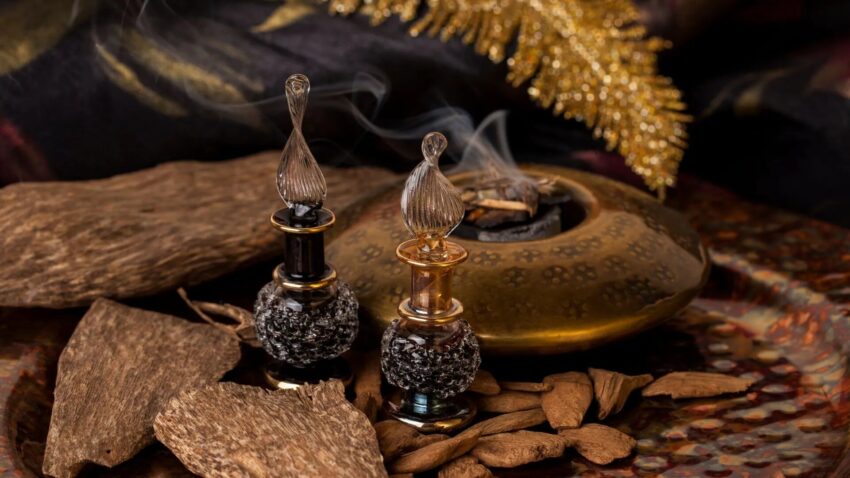
Oud oil is often described as one of the most precious materials in the world of fragrance, but the small bottle sitting on a perfume shelf represents a remarkably long journey. Before authentic oud oil reaches a customer, it begins with agarwood, a resinous material associated primarily with trees from the Aquilaria and Gyrinops genera. The formation, harvesting, processing, distillation, and final maturation of this material all influence the character and value of the finished oil.
1. Where Does Oud Oil Come From?
The journey starts with agarwood-producing trees, particularly species of Aquilaria. A healthy tree does not simply contain large quantities of fragrant oud resin from the moment it grows. Instead, resin formation is associated with the tree responding to injury, stress, or microbial activity. Over time, aromatic compounds accumulate within affected parts of the wood, creating the dark, resin-rich material prized for fragrance and incense.
This biological process is one reason genuine oud is so difficult to produce. Resin formation is neither uniform nor guaranteed, and the quantity and character of the resin can vary considerably between trees, species, locations, and production methods.
2. Growing the Agarwood Tree
The next stage is cultivation and responsible management. Agarwood trees can be grown in plantations, where producers can monitor their development and use controlled methods to encourage resin formation. Modern research has explored mechanical, biological, and other induction techniques as alternatives to relying exclusively on naturally occurring resin in wild trees.
Cultivation is particularly important because wild agarwood resources have faced pressure from intensive harvesting. CITES documents note that agarwood-producing taxa are regulated under Appendix II, making responsible sourcing and legal trade important considerations throughout the supply chain.
3. Creating the Precious Resin
Once a tree reaches an appropriate stage, resin formation becomes the central part of the oud-making process. Producers may use controlled methods to stimulate the tree’s natural defense response. The resulting resin gradually changes the characteristics of the wood, increasing its aromatic value.
This is where patience becomes essential. The chemistry of agarwood is complex, and research continues to investigate how biological interactions and stress contribute to the production of its characteristic aromatic compounds.
The result is not simply ordinary fragrant wood. Agarwood is valuable because of the resin-rich material that develops inside it.
4. Harvesting and Selecting the Wood
Harvesting is another critical stage. Producers must identify and separate suitable resinous material from less valuable wood. Historically, inefficient harvesting could involve cutting down entire trees without knowing how much valuable agarwood they contained, creating substantial waste.
Research and field studies have also documented harvesting approaches in which only resin-bearing portions are removed, allowing certain trees to survive. These examples demonstrate why traceability, local knowledge, forest conservation, and careful harvesting practices matter in the oud industry.
For buyers, this also highlights an important point: the story behind oud oil matters just as much as the fragrance inside the bottle.
5. Preparing Agarwood for Distillation
After harvesting, suitable wood is prepared for extraction. Depending on the production tradition and producer, the material may be chipped, ground, soaked, fermented, or otherwise prepared before distillation.
The preparation stage can significantly influence the eventual oil. Factors such as the type of wood, resin concentration, preparation method, water quality, fermentation conditions, and distillation technique can all affect the aromatic profile.
There is no single universal production formula for every oud-producing region. Distillation practices are often closely guarded because small changes in processing can influence both yield and fragrance quality. CITES documentation identifies hydro-distillation, pressured steam distillation, and supercritical CO₂ extraction among reported approaches, although traditional oud oil production commonly relies on distillation of agarwood.
6. The Distillation Process
Distillation is where the journey from wood to oil becomes particularly fascinating. Prepared agarwood is processed so that its volatile aromatic compounds can be collected and concentrated.
In traditional water-based distillation, the aromatic material is heated with water, allowing volatile compounds to travel with the vapor. The vapor is subsequently condensed, producing a mixture from which the precious aromatic oil can be collected.
The process requires patience and technical knowledge. Temperature, duration, preparation, equipment, and the characteristics of the raw material can all affect the final result.
Unlike ordinary fragrance manufacturing, the objective is not simply to create a pleasant smell. Authentic oud production aims to preserve and concentrate the distinctive aromatic character created naturally within the agarwood.
7. Why Every Oud Oil Smells Different
One of the most fascinating characteristics of genuine oud oil is its complexity. Two oils can originate from different regions or trees and smell remarkably different.
One may have a deep woody character, while another can reveal sweet, smoky, leathery, earthy, medicinal, spicy, or slightly animalic facets. These differences can result from species, geography, resin development, harvesting conditions, preparation, distillation, and maturation.
This natural variation is part of what makes oud fascinating to experienced fragrance enthusiasts. Rather than expecting every bottle to smell identical, oud lovers often explore different origins and distillation styles to discover distinctive aromatic personalities.
8. From Distillation to Maturation
The journey does not necessarily end when the oil leaves the still. Some producers allow oud oil to rest or mature before bottling. During this period, its aromatic profile may become more integrated and rounded.
Maturation practices vary considerably between producers, so there is no universal aging period that automatically defines quality. Instead, experienced producers evaluate the oil according to its aroma, balance, clarity, development, and intended use.
For consumers, this explains why the character of a carefully produced oud can feel significantly more complex than a simple synthetic woody fragrance.
9. Authenticity Matters
The popularity and high value of oud have also created opportunities for adulteration and mislabeling. Scientific literature has highlighted authentication challenges and the need for improved methods to distinguish species, verify materials, and reduce adulteration.
A responsible buyer should therefore consider more than an attractive label. Questions about origin, sourcing, production method, ingredients, and traceability can provide useful information when evaluating an oud product.
Price alone is not a perfect authenticity test either. Extremely expensive does not automatically mean authentic, while a lower price does not automatically prove that a product is synthetic. Quality assessment requires consideration of the raw material and production process as a whole.
10. Sustainability Is Part of the Journey
The future of oud depends on protecting the trees that make it possible. Wild agarwood populations have experienced significant pressure from harvesting, and conservation organizations have emphasized the importance of sustainable production, traceability, plantation development, and legal trade.
For this reason, modern oud production increasingly involves more than fragrance craftsmanship. Sustainable cultivation, controlled resin induction, responsible harvesting, accurate documentation, and supply-chain traceability can all contribute to a more responsible industry.
This is also where consumers can make informed choices. Understanding where an oud product comes from and how it was produced encourages greater transparency throughout the fragrance market.
11. From Oud Oil to a Finished Fragrance
Once the oil has been prepared and evaluated, it can become the foundation of many fragrance products. Oud oil may be worn directly as a concentrated fragrance, incorporated into attars and mukhallats, or blended with other aromatic materials.
Oud can also be experienced through incense traditions. Agarwood chips, powder, and related materials are used in incense and bakhoor, while the exhausted powder remaining after distillation can also have applications in incense production.
For readers exploring incense alongside concentrated fragrance, the guide to the best bakhoor in pakistan can provide additional information about selecting bakhoor for different home environments.
12. The Role of a Specialist Oud Brand
The final stage is bringing the finished fragrance to people who appreciate its character. A specialist brand such as Saby Saeed Anwar can help introduce customers to different expressions of oud, from concentrated oils to carefully developed fragrance collections.
The value of an oud product ultimately extends beyond the liquid inside the bottle. It reflects the raw material, the biological process that created the resin, the skill involved in harvesting and distillation, and the care taken throughout the supply chain.
The Journey Behind Every Drop
From a living agarwood tree to a finished bottle, authentic oud oil passes through a journey shaped by nature, time, craftsmanship, and increasingly, conservation. The tree must develop valuable resin, the right material must be identified and harvested, the agarwood must be prepared and distilled, and the resulting oil must be evaluated before it reaches the fragrance market.
That long journey explains why oud has remained one of the most fascinating materials in perfumery. A small bottle represents far more than fragrance—it represents a remarkable transformation from resinous wood into one of the world’s most distinctive natural aromatic materials.