

Geopolymer Market to Reach USD 38.73 Billion by 2032 as Low-Carbon Construction Accelerates
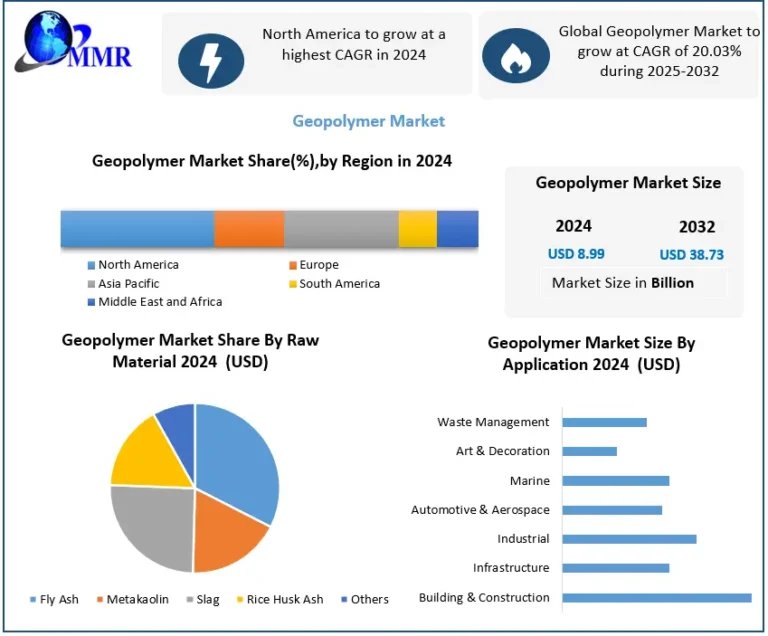
The Geopolymer Market is entering a high-growth phase as construction companies, infrastructure developers, and industrial manufacturers increasingly seek alternatives to conventional Portland cement. According to Maximize Market Research, the global Geopolymer Market was valued at USD 8.99 billion in 2024 and is expected to grow at a CAGR of 20.03% from 2025 to 2032, reaching nearly USD 38.73 billion by 2032. The rapid expansion reflects growing environmental awareness, demand for durable construction materials, increasing infrastructure development, and the need to reduce carbon emissions associated with conventional cement production.
Market Estimation, Growth Drivers and Opportunities
Geopolymers are gaining attention because they can provide high strength, chemical resistance, thermal stability, durability, and lower environmental impact compared with traditional cement-based materials. The technology can use industrial by-products such as fly ash and slag as raw materials, creating an opportunity to convert waste streams into higher-value construction inputs.
The construction sector represents a major opportunity because governments and developers are increasingly incorporating sustainability criteria into infrastructure projects. Geopolymer-based cement and concrete can be used in roads, bridges, buildings, industrial facilities, marine structures, and rehabilitation projects. Beyond construction, opportunities are emerging in oil and gas well cementing, aerospace, automotive components, fire-resistant materials, waste management, and high-temperature applications.
The market is also benefiting from innovation in alkali-activated materials, alternative binders, low-carbon concrete formulations, and geopolymer composites. As production technologies mature and standards become more supportive, the commercialization of geopolymer products is expected to accelerate.
Get a Free Sample Market Report Link : https://www.maximizemarketresearch.com/request-sample/81356/
United States Market: 2025 Trends and Investment
The United States emerged as an important market for low-carbon cement and concrete technologies in 2025, supported by federal investment, procurement policies, and industrial decarbonization initiatives. In April 2025, the U.S. General Services Administration published low-embodied-carbon requirements for concrete and cement under Inflation Reduction Act programs, establishing greenhouse-gas-performance limits for concrete used in federally supported projects. This creates additional demand for materials capable of meeting stringent embodied-carbon thresholds.
U.S. investment is also moving toward next-generation cement technologies. The Department of Energy’s industrial demonstration initiatives include major projects focused on alternative cement production, calcined-clay cement, carbon capture, and other low-carbon technologies. In 2025, DOE also highlighted a potential requirement for approximately USD 5 billion to USD 20 billion of cumulative investment by 2030 across emerging low-carbon cement approaches to accelerate commercialization.
Largest Market Segments
By Product Type, Cement and Concrete dominated the Geopolymer Market in 2024 and is expected to retain the largest share through the forecast period. Demand is being driven by the construction industry’s search for sustainable alternatives to Portland cement, together with geopolymer concrete’s strength, durability, chemical resistance, and lower carbon potential.
By End-User, Building Construction is expected to dominate toward the end of the forecast period. Geopolymers’ thermal performance, fire resistance, durability, and suitability for structural applications support their increasing adoption in residential, commercial, and infrastructure-related construction.
Competitive Analysis
The competitive landscape includes established construction-material companies, specialized geopolymer developers, engineering organizations, and advanced-material manufacturers. Among the prominent companies identified in the MMR competitive landscape are CEMEX SAB de CV, Wagners, Schlumberger Limited, Zeobond Pty Ltd, and ClockSpring|NRI. MMR’s public report does not provide enough information to assign reliable company-specific percentage shares to these five companies, so ranking them by exact market share would be speculative.
CEMEX is strengthening its low-carbon materials portfolio through investment in alternative cement technologies. In March 2025, CEMEX Ventures announced an investment in Terra CO2, whose OPUS SCM technology uses silicate-rock feedstocks to produce lower-carbon supplementary cementitious material and can reduce emissions when replacing conventional cementitious products.
Wagners continues to commercialize Earth Friendly Concrete, a geopolymer concrete technology developed using industrial by-products including fly ash and slag. The company has demonstrated applications across structural, residential, infrastructure, and marine projects, reinforcing the commercial potential of cement-free concrete technologies.
Schlumberger Limited, now operating as SLB, has expanded geopolymer applications into oil and gas well construction. Its OmniCem geopolymer-based cementing system is designed to provide rapid strength development, low permeability, and reduced embodied carbon, while its EcoShield technology targets lower-carbon, cement-free wellbore isolation.
Zeobond Pty Ltd specializes in geopolymer and alkali-activated technology, developing binders that use industrial by-products such as fly ash and slag. Its technology is positioned as a lower-carbon alternative to conventional Portland cement with potential reductions in embodied carbon.
ClockSpring|NRI participates in the broader advanced infrastructure-materials landscape identified by MMR, where corrosion-resistant, durable, and rehabilitation-oriented materials can create additional applications for geopolymer technologies.
Regional Analysis
China is identified by MMR as a potential leading market for geopolymers. Strong construction activity, infrastructure development, urbanization, and demand for lower-carbon building materials create favorable conditions for market expansion. The country’s large industrial base also provides significant volumes of fly ash, slag, and other potential raw materials for alternative binders.
The United States remains strategically important because federal low-embodied-carbon procurement requirements and industrial decarbonization investments are creating demand for alternative cement technologies. The GSA’s Inflation Reduction Act programs include substantial funding for low-embodied-carbon construction materials, supporting technology adoption and commercialization.
Key Players
Key companies identified in the Geopolymer Market include Banah UK Ltd, CEMEX SAB de CV, Českých Lupkových Závodech AS, ClockSpring|NRI, Geopolymer Solutions LLC, IPR, Murray & Roberts, PCI Augsburg GMBH, Rocla Pty Limited, Schlumberger Limited, Wagners, Zeobond Pty Ltd, INOMAT GmbH, Alchemy Geopolymer, and Pyromeral Systems.
Why This Market Matters Now
The Geopolymer Market matters now because the construction industry is under increasing pressure to deliver stronger infrastructure while reducing carbon intensity. Conventional cement remains essential to global development, but its energy requirements and emissions have intensified the search for alternative binders.
Geopolymers offer an opportunity to combine waste utilization, material performance, infrastructure durability, and carbon reduction within a single technology platform. Government procurement standards, private-sector sustainability commitments, infrastructure modernization, and advances in material science are collectively moving geopolymers from research-driven applications toward broader commercial adoption. With the market projected to expand from USD 8.99 billion in 2024 to USD 38.73 billion by 2032, investment in scalable production, standards, supply chains, and application-specific innovation will be critical to unlocking the next stage of growth.
Explore More Related Reports
Fiberglass Doors Market https://www.maximizemarketresearch.com/market-report/fiberglass-doors-market/168370/
Global Dope-Dyed Fibers Market https://www.maximizemarketresearch.com/market-report/global-dope-dyed-fibers-market/83481/
About Maximize Market Research
Maximize Market Research Pvt. Ltd. (MMR) is a global market research and consulting company that provides reliable, data-focused, and practical business insights. The firm serves a wide range of industries, including healthcare, pharmaceuticals, technology, automotive, electronics, chemicals, personal care, and consumer goods. Through market forecasts, competitive analysis, strategic consulting, and industry impact assessments, MMR helps organizations understand changing market conditions, identify growth opportunities, and make informed business decisions for long-term success.
Contact Us
Maximize Market Research Pvt. Ltd.
2nd Floor, Navale IT Park Phase 3
Pune Banglore Highway, Narhe
Pune, Maharashtra 411041, India
Phone: +91 9607365656
Email: sales@maximizemarketresearch.com