
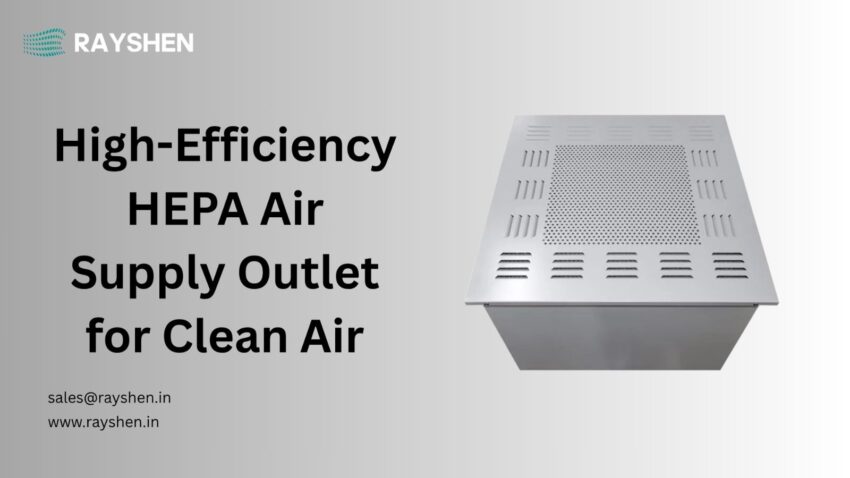
In today’s world, where air quality directly impacts health, safety, and productivity, HEPA filtration has become an essential technology across multiple industries. From hospitals and pharmaceutical cleanrooms to homes and laboratories, HEPA filters play a critical role in removing harmful airborne particles and ensuring clean, breathable air.
But what exactly is HEPA, how does it work, and why is it so important? This guide by Rayshen explains everything you need to know about High-Efficiency Particulate Air filters and their real-world applications.
What Is HEPA?
HEPA stands for High-Efficiency Particulate Air. It refers to a type of air filter designed to trap extremely small particles with very high efficiency.
To qualify as a true HEPA filter, it must remove at least 99.97% of particles that are 0.3 microns in size. These particles include dust, pollen, mold spores, bacteria, and other microscopic contaminants that are invisible to the naked eye.
This makes HEPA one of the most reliable filtration standards available today, especially in environments where air purity is critical.
How Does a HEPA Filter Work?
Unlike basic filters that simply block large particles, HEPA filters use a dense web of randomly arranged fibers, usually made from fiberglass. Air is forced through this mat, and particles are captured through three main mechanisms:
1. Interception
Medium-sized particles stick to the fibers as air flows past them.
2. Impaction
Larger particles collide with the fibers and get trapped.
3. Diffusion
Very tiny particles move unpredictably and eventually attach to the fibers.
Together, these mechanisms allow HEPA filters to capture particles far smaller than a human hair, ensuring superior air purification.
Why Is HEPA So Important?
The importance of HEPA filtration lies in its ability to control contamination. In critical industries, even a single airborne particle can compromise safety, quality, or compliance.
Some key benefits of HEPA include:
- Removes harmful airborne particles
- Improves indoor air quality
- Reduces risk of infections
- Protects sensitive equipment and products
- Supports regulatory compliance
At Rayshen, HEPA filtration is integrated into complete cleanroom solutions to meet international standards for air cleanliness.
Common Applications of HEPA Filters
HEPA filters are used in a wide range of sectors due to their versatility and effectiveness.
1. Cleanrooms and Pharmaceuticals
In pharmaceutical manufacturing, HEPA filters ensure sterile conditions by removing contaminants that could affect drug quality. Cleanrooms rely heavily on HEPA-based systems for GMP compliance.
2. Hospitals and Healthcare
HEPA filters are used in operation theaters, isolation rooms, and ICUs to prevent the spread of airborne infections and protect patients with weak immune systems.
3. Electronics and Semiconductor
Microchips and electronic components are highly sensitive to dust. HEPA filtration protects these products from defects caused by contamination.
4. Laboratories and Research Centers
Research environments depend on HEPA systems to maintain accurate results and protect both researchers and samples.
5. Homes and Commercial Buildings
Air purifiers with HEPA filters are widely used to reduce allergens, dust, and pollution in indoor spaces.
HEPA Filter Grades: H13 and H14
Not all HEPA filters offer the same performance. They are classified based on efficiency levels:
- H13 HEPA: Removes 99.95% of particles
- H14 HEPA: Removes 99.995% of particles
For highly sensitive environments such as pharmaceutical cleanrooms and biotech facilities, H14 HEPA is often preferred due to its higher efficiency.
Rayshen supplies both H13 and H14 HEPA filters depending on the application requirements.
HEPA vs Standard Air Filters
Many people assume all air filters work the same way, but the difference is significant.
|
Feature |
Standard Filter |
HEPA Filter |
|
Particle removal |
Low to moderate |
Extremely high |
|
Micron efficiency |
5–10 microns |
0.3 microns |
|
Industrial use |
Limited |
Widely used |
|
Cleanroom compatible |
No |
Yes |
While standard filters improve basic air quality, only HEPA filters provide true contamination control.
Maintenance and Replacement of HEPA Filters
To maintain performance, HEPA filters require proper maintenance. Over time, trapped particles increase resistance and reduce airflow.
Signs that a HEPA filter needs replacement include:
- Reduced airflow
- Higher pressure drop
- Visible dust accumulation
- Failure in performance testing
In industrial environments, HEPA filters are usually tested using specialized equipment to ensure efficiency remains within acceptable limits.
Rayshen provides guidance on HEPA maintenance and testing as part of its cleanroom support services.
Why Choose Rayshen for HEPA Solutions?
At Rayshen, HEPA filtration is not just a product—it’s part of a complete air purification strategy. From Fan Filter Units (FFUs) and Air Handling Units (AHUs) to modular cleanrooms and laminar airflow systems, Rayshen integrates HEPA filters into fully engineered solutions.
Key advantages of Rayshen HEPA systems include:
- Compliance with international standards
- High-quality construction materials
- Customizable airflow designs
- Technical support and installation
- Long-term reliability
Whether you are building a pharmaceutical facility, hospital cleanroom, or industrial workspace, Rayshen ensures that HEPA filtration meets both regulatory and operational needs.
Conclusion
HEPA filters are the backbone of modern air purification systems. Their ability to remove microscopic contaminants makes them indispensable in industries where air quality cannot be compromised.
From healthcare and pharmaceuticals to electronics and research, HEPA technology protects people, products, and processes. By choosing a trusted brand like Rayshen, you gain access to high-performance HEPA solutions that deliver consistent cleanliness, safety, and peace of mind.
In a world where clean air matters more than ever, HEPA remains the gold standard in filtration technology.