
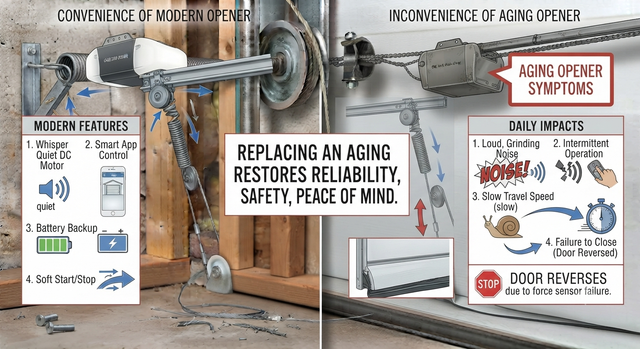
A garage door opener is one of those household systems people often take for granted. With a press of a remote or smartphone button, the door opens and closes automatically, allowing homeowners to enter and leave the garage without manually lifting a heavy door.
However, like other mechanical and electrical equipment, garage door openers don’t last forever. As an opener ages, its performance can gradually change. It may become louder, slower, less responsive, or inconsistent. These problems may seem minor at first, but they can eventually affect everyday convenience and indicate that maintenance or replacement should be considered.
Understanding the signs of an aging garage door opener can help homeowners make informed decisions before a complete failure occurs.
What Does a Garage Door Opener Do?
A garage door opener is the motorized system that moves the garage door along its tracks. It works with other components, including springs, rollers, hinges, cables, and tracks.
The opener doesn’t carry the entire responsibility for lifting the door. The door’s counterbalance system helps support its weight, while the opener provides the mechanical force needed to move it.
Because the opener works as part of a larger system, problems with the door itself can also make the opener appear to be failing.
1. Increased Operating Noise
One of the most noticeable signs of an aging opener is increased noise.
An older opener may begin making:
-
Grinding sounds
-
Clicking noises
-
Vibrations
-
Humming sounds
-
Excessive rattling
Some noise is normal, depending on the opener’s design. However, a sudden change in sound deserves attention.
Noise can originate from the opener itself, but it can also come from worn rollers, hinges, tracks, or other garage door components.
A professional inspection can help determine the source.
2. Slower Door Operation
Another common issue is a noticeable change in operating speed.
If your garage door takes significantly longer to open or close than it used to, several factors could be responsible. The opener motor may be aging, but mechanical resistance from the door can also be a factor.
Dirty or damaged rollers, track problems, worn hardware, or counterbalance issues can increase resistance.
Replacing the opener without addressing an underlying mechanical problem may not solve the issue.
3. Delayed Response From the Remote
An aging opener may sometimes respond slowly when a remote or wall control is activated.
Before assuming the opener motor has failed, homeowners can check simple possibilities such as:
-
Remote battery condition
-
Obstructions around the antenna
-
Power supply
-
Wall-control operation
-
Interference
If the remote works inconsistently despite having a good battery and the opener has power, professional troubleshooting may be appropriate.
4. Frequent Reversals
A garage door that reverses unexpectedly should not simply be ignored.
Modern garage door openers have safety systems designed to respond to certain conditions. If the door begins reversing without an obvious reason, there may be an issue involving the safety sensors, travel settings, mechanical resistance, or another component.
Aging equipment can contribute to reliability problems, but the actual cause should be identified before replacing anything.
5. Unreliable Daily Operation
Convenience depends on reliability.
If you have to press the remote several times before the door responds, manually operate the door frequently, or worry about whether the opener will work when you return home, the system is no longer providing the convenience it was designed to deliver.
An unreliable opener can become particularly frustrating for households that use the garage as their primary entrance.
6. Older Technology May Limit Convenience
Technology has changed considerably over the years.
Many modern garage door openers offer features such as:
-
Smartphone connectivity
-
Remote monitoring
-
Battery backup
-
Improved lighting
-
Quiet-drive technology
-
Wireless controls
-
Activity notifications
Not every homeowner needs these features. However, an older opener may lack capabilities that can make everyday garage access more convenient.
Smart technology can be especially useful for homeowners who want to check whether the garage door is open while away from home, provided the selected system supports the appropriate connectivity.
7. Battery Backup Can Matter During Power Outages
A power outage can make an automatic garage door inconvenient to operate.
Some modern opener systems offer battery backup, allowing the door to continue operating for a limited period during a power interruption.
For households that depend heavily on garage access, backup power can provide additional convenience.
Homeowners considering an upgrade can compare opener models based on their specific needs rather than focusing only on motor power.
8. Aging Openers May Require More Maintenance
Older equipment may require more frequent attention as components wear.
Maintenance needs can include checking the opener’s mounting hardware, examining the drive system, testing safety features, and inspecting the interaction between the opener and garage door.
It’s also important to remember that the opener cannot compensate indefinitely for a door with mechanical problems.
If rollers are damaged or springs aren’t functioning correctly, the opener may experience unnecessary strain.
9. Safety Features Should Be Tested
Garage door opener safety systems are essential.
Homeowners should periodically verify that safety features operate correctly and should address unexpected behavior promptly.
Photo-eye sensors, automatic reversal systems, and other safety mechanisms are designed to reduce the risk of accidents.
If a safety feature isn’t functioning correctly, don’t continue using the door as though everything is normal. Professional service may be necessary.
10. When Should You Consider Replacing an Opener?
Not every aging opener needs immediate replacement.
A professional may recommend maintenance or repair when the opener is still structurally sound and the problem is relatively minor.
Replacement may make more sense when the opener:
-
Experiences repeated failures
-
Has significant mechanical damage
-
Becomes increasingly unreliable
-
Lacks features important to the homeowner
-
Has difficulty operating a properly functioning door
-
Requires repairs that approach the cost of replacement
-
Is reaching the end of its expected service life
The age of the opener alone isn’t always enough to determine whether replacement is necessary.
Choosing a Quality Garage Door Opener
When replacing an aging opener, homeowners have several established manufacturers to consider.
LiftMaster offers a broad range of residential and commercial garage door opener systems. Chamberlain is another well-known manufacturer offering residential opener products and connected-home features.
Garage door manufacturers such as Clopay, Amarr, and Wayne Dalton can also provide garage door systems and related products.
When choosing an opener, consider factors such as:
-
Door size and weight
-
Drive type
-
Noise level
-
Safety features
-
Battery backup
-
Smart-home compatibility
-
Lighting
-
Warranty
-
Professional installation requirements
Choosing the most powerful opener isn’t necessarily the best solution. The opener should be appropriate for the specific garage door.
My Garage Dude Can Help
For homeowners experiencing opener problems, My Garage Dude can assist with garage door inspections, maintenance, repairs, and opener replacement needs.
A professional evaluation is useful because the opener and door operate as a complete system. If a door is difficult to move because of worn rollers, damaged tracks, or counterbalance problems, installing a new opener alone may not resolve the underlying issue.
My Garage Dude can help homeowners determine whether maintenance, repair, or replacement is the more practical solution.
Don’t Ignore Changes in Garage Door Performance
Small changes in garage door operation can be easy to dismiss.
Maybe the opener sounds slightly louder than it did last year. Perhaps the door takes a few seconds longer to open, or the remote occasionally fails to respond.
These changes don’t necessarily mean immediate failure, but they can be useful warning signs.
Paying attention to these symptoms allows homeowners to investigate problems before they become more disruptive.
Final Thoughts
An aging garage door opener can gradually affect everyday convenience through increased noise, slower operation, delayed responses, unreliable controls, and limited modern features.
However, homeowners shouldn’t automatically blame the opener. Garage doors are complete mechanical systems, and problems with rollers, tracks, springs, cables, hinges, or other hardware can also affect opener performance.
If replacement becomes necessary, established brands such as LiftMaster, Chamberlain, Clopay, Amarr, and Wayne Dalton offer a variety of garage door and opener products. Always verify that a selected opener is suitable for the specific garage door.
For homeowners who need professional assistance, My Garage Dude can provide inspection, maintenance, repair, and replacement services to help identify the actual source of garage door problems.
Ultimately, upgrading an aging opener isn’t only about getting a newer motor. It’s about improving reliability, convenience, safety features, and compatibility with the garage door system as a whole. With the right equipment and professional evaluation, homeowners can enjoy smoother and more dependable garage access every day.