

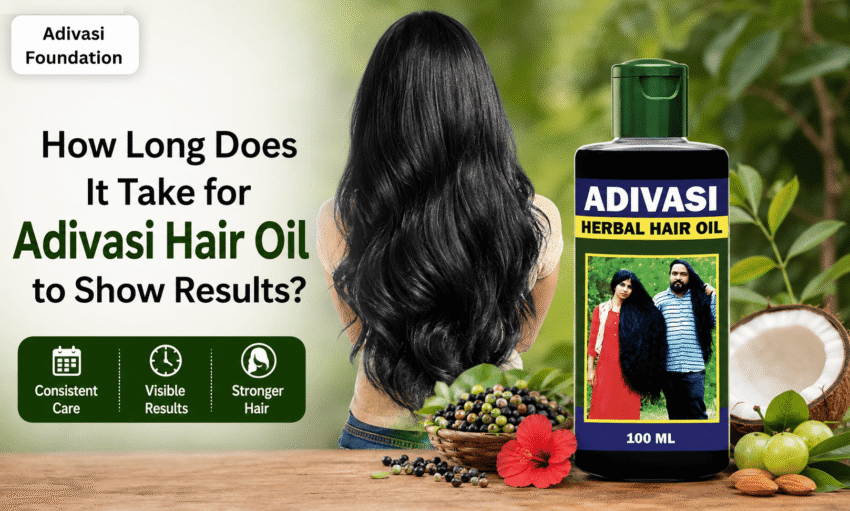
Hair care is rarely about a single application or an overnight transformation. People dealing with dryness, rough texture, weak-looking strands, breakage, or an uncomfortable scalp often want to know how quickly a hair oil can make a noticeable difference. When using Adivasi Hair Oil, the time required to notice results can vary according to hair condition, scalp type, application frequency, lifestyle, and the consistency of the routine.
Some changes, such as softer-feeling hair or improved manageability, may become noticeable relatively quickly. Other goals, particularly those related to hair strength, breakage, scalp condition, and the appearance of healthier growth, generally require patience.
Rather than expecting one fixed timeline for everyone, it is more useful to look at how hair responds over several weeks and what factors may influence that response.
Why Hair Oil Results Take Time
Hair has its own growth cycle. Applying oil does not suddenly change the speed of that biological process. What a suitable oiling routine can do is support the condition of the scalp and existing hair while helping reduce problems associated with dryness, friction, tangling, and breakage.
The visible portion of a hair strand is made primarily of keratin. Once damaged, it cannot biologically repair itself like living skin. Hair care therefore focuses on protecting strands, improving lubrication, reducing unnecessary damage, and maintaining a comfortable scalp environment.
This explains why someone may notice smoother hair before seeing a meaningful difference in overall hair appearance.
Results can also depend on the starting condition of the hair. Someone experiencing mild dryness may notice changes sooner than a person whose hair has been exposed to frequent heat styling, chemical treatments, bleaching, environmental stress, or prolonged neglect.
What Results Can You Realistically Expect?
Before discussing timing, it helps to define what “results” actually means.
Different people may use the same oil for completely different reasons. One person may want softer hair, while another may be concerned about breakage or a dry scalp.
Common expectations include:
- Softer and smoother-feeling hair
- Better hair manageability
- Reduced appearance of dryness
- Less friction while combing
- Improved scalp moisturisation
- Healthier-looking shine
- Reduced breakage associated with dryness and rough handling
- Better overall appearance of hair with consistent care
Hair growth expectations should be approached more carefully. Genetics, age, hormones, nutritional status, stress, scalp health, illness, medications, and other biological factors can influence growth and shedding. Hair oil should therefore be viewed as part of a regular hair-care routine rather than as a guaranteed treatment for hair loss.
First Few Applications: What Might You Notice?
During the first several applications, the most noticeable changes are generally cosmetic and sensory.
Hair may begin to feel:
Softer: Oil can help lubricate dry strands, giving hair a smoother texture.
More manageable: Properly conditioned hair may be easier to detangle and style.
Less rough: Dry ends and coarse-feeling sections can sometimes feel more conditioned after oiling.
Shinier: A light coating of oil can improve the way the hair surface reflects light.
These early changes should not be confused with new hair growth. They mainly indicate that the hair has received additional conditioning and lubrication.
Someone with extremely dry or porous hair might notice these effects more strongly than a person whose hair is naturally oily.
Weeks 1–2: Building a Consistent Routine
The first two weeks are largely about establishing consistency and observing how your scalp and hair respond.
When Adivasi Hair Oil is incorporated into a regular routine, users can pay attention to changes in dryness, manageability, scalp comfort, and how their hair behaves during washing and combing.
Consistency matters more than excessive application.
Using a very large amount of oil does not necessarily produce quicker results. In fact, excessive oil can make washing more difficult and may leave the scalp feeling greasy or heavy.
During this period, focus on:
- Applying an appropriate amount
- Distributing oil evenly
- Avoiding aggressive scalp rubbing
- Washing thoroughly when required
- Handling wet hair gently
- Limiting unnecessary heat exposure
The goal is to create a routine that can be maintained comfortably rather than trying to force rapid changes.
Weeks 3–4: Changes May Become Easier to Observe
After several weeks of consistent care, differences in hair texture and manageability may become easier to assess.
For some users, hair may appear:
- Better conditioned
- Less dry
- Smoother after washing
- Easier to comb
- More polished and healthy-looking
People who previously experienced breakage due to excessive dryness or rough detangling may also notice that their hair feels easier to handle.
This is an important distinction: reducing breakage can help hair retain length, but it is not the same as increasing the biological growth rate.
If hair is constantly breaking at the ends, it can appear as though it is not growing. Protecting strands from avoidable damage may allow natural length retention to become more noticeable over time.
Weeks 5–8: Assessing Longer-Term Hair Condition
Around one to two months of consistent use provides a better period for evaluating whether a particular hair-care routine suits you.
Instead of judging the product after one or two applications, compare the overall condition of your hair with its starting point.
Ask yourself:
Does the hair feel less rough?
If dryness was the primary concern, the difference may be noticeable through touch and manageability.
Is detangling easier?
Reduced friction during combing can be a useful indicator that the hair is better conditioned.
Does the scalp feel comfortable?
A suitable routine should not cause persistent itching, burning, redness, or irritation.
Does the hair look healthier?
Improved shine, smoother strands, and less frizz may contribute to a healthier overall appearance.
Are you experiencing less breakage?
Observe your hair while combing, washing, and styling rather than relying only on hair collected from the floor or shower.
Remember that normal shedding and hair breakage are different. Shed hair comes from the follicle, while broken strands snap somewhere along the hair shaft.
What About Hair Growth?
Hair growth is one of the biggest reasons people become interested in traditional hair-oiling routines. However, expectations need to remain realistic.
Human scalp hair commonly grows roughly around one centimetre per month, although the rate varies considerably between individuals. Because growth happens gradually, judging changes after only a few days is unlikely to provide meaningful information.
An oiling routine may help support healthier-looking hair by conditioning the scalp and reducing damage to existing strands. It cannot guarantee a specific number of new hairs or a particular growth rate.
If you are monitoring length, checking every few days can make progress difficult to see. Monthly photographs taken under similar lighting, from the same angle, can provide a more useful comparison.
For concerns such as sudden hair loss, bald patches, significant scalp inflammation, or unusually heavy shedding, professional medical evaluation is more appropriate than relying solely on cosmetic hair products.
Factors That Affect How Quickly You See Results
There is no universal timeline because several variables influence the appearance and condition of hair.
1. Your Starting Hair Condition
Hair that is mildly dry may respond differently from hair that has undergone repeated bleaching, colouring, straightening, or high-temperature styling.
Highly damaged hair generally needs more careful handling and ongoing conditioning.
2. Scalp Type
Dry, normal, and oily scalps have different needs.
Someone with a dry-feeling scalp may prefer a different application frequency from someone who experiences rapid oil buildup.
Finding the right balance matters.
3. Application Frequency
Irregular use can make it difficult to assess whether the routine is helping.
At the same time, daily heavy oiling is not automatically better. Application frequency should suit the individual’s scalp, washing schedule, and hair texture.
4. Hair Washing Habits
Very harsh cleansing can leave some hair types feeling dry, while insufficient cleansing can allow oil and product residue to accumulate.
A balanced washing routine helps maintain both cleanliness and manageability.
5. Heat Styling
Frequent use of straighteners, curling tools, and high-temperature blow-drying can contribute to dryness and breakage.
Even a well-planned oiling routine may appear less effective when hair is repeatedly exposed to damaging heat.
6. Chemical Treatments
Bleaching, permanent colouring, relaxing, and chemical straightening can alter the structure of hair.
Chemically processed hair may require additional conditioning and particularly gentle handling.
7. Nutrition
Hair follicles require adequate nutrients to function normally. Protein, iron, zinc, vitamins, and other nutrients contribute to normal biological processes.
Hair oil is applied externally and cannot replace a balanced diet.
8. Stress and Sleep
Long periods of physical or emotional stress can sometimes influence the normal hair cycle. Sleep and overall wellness can therefore be relevant when someone is evaluating changes in their hair.
9. Genetics and Hormones
Hair density, texture, growth patterns, and susceptibility to certain forms of hair loss are strongly influenced by genetics and hormones.
These factors cannot be overridden simply by applying more oil.
How to Use Adivasi Hair Oil Consistently
A sensible application routine can make the experience more comfortable and easier to maintain.
Start by taking a suitable amount of oil based on your hair length and density. Apply it across the scalp in sections rather than pouring a large amount onto one area.
Use your fingertips to spread the oil gently. Avoid scratching the scalp with fingernails or massaging aggressively. Vigorous rubbing can tangle hair and may increase mechanical breakage.
If your lengths and ends feel particularly dry, distribute a small amount through those areas as well.
Leave the oil on according to the product’s directions and your personal tolerance. More time is not automatically equal to better results.
Wash the scalp and hair thoroughly when needed.
The ideal routine is one that keeps hair conditioned without leaving excessive buildup.
Should You Apply More Oil for Faster Results?
No. Applying excessive amounts is unlikely to accelerate changes.
Hair and scalp care works best through consistency rather than quantity.
Too much oil may:
- Make hair feel excessively greasy
- Require repeated shampooing to remove
- Cause product buildup
- Make fine hair look flat
- Increase the amount of handling required during washing
Use enough to distribute the product effectively without completely saturating the hair unless the product instructions specifically recommend otherwise.
How Can You Track Your Results?
Visual memory is surprisingly unreliable. Because you see your hair frequently, gradual improvements can be difficult to recognise.
A simple tracking system can help.
Take a photograph before starting the routine. Repeat the photograph every four weeks using approximately the same lighting, hairstyle, angle, and camera distance.
You can also record a few observations:
Scalp comfort: Is it comfortable, dry, greasy, itchy, or irritated?
Hair texture: Does the hair feel rough, smooth, soft, or brittle?
Breakage: Do you notice frequent short broken pieces during detangling?
Manageability: Has combing become easier?
Appearance: Does the hair appear smoother or better conditioned?
Tracking these factors provides more useful information than looking for dramatic changes from one day to another.
Common Mistakes That Can Delay Visible Improvement
Sometimes the problem is not the hair oil itself but the way the overall routine is managed.
Using It Inconsistently
Applying oil once and then waiting several weeks before using it again makes it difficult to evaluate its effect.
Using Excessive Heat
Frequent high-temperature styling can counteract efforts to keep strands conditioned and protected.
Rough Towel Drying
Aggressively rubbing wet hair with a towel creates friction and tangling. Gentle blotting is generally kinder to the strands.
Brushing Too Aggressively
Pulling a brush through knots can cause unnecessary breakage. Work through tangles gradually, especially when dealing with long or fragile hair.
Expecting Overnight Growth
Hair biology does not work on an overnight schedule. Conditioning benefits may appear relatively quickly, but meaningful changes related to length retention require more time.
Ignoring Persistent Scalp Problems
Oiling should not be used to mask ongoing symptoms such as severe itching, sores, inflammation, scaling, or unexplained hair loss.
Persistent problems deserve appropriate professional assessment.
Does Everyone Get the Same Results?
No.
Two people can use exactly the same hair product and have different experiences.
One may have thick, coarse, dry hair that responds well to richer oiling. Another may have fine, naturally oily hair that becomes weighed down easily.
Differences can also arise from:
- Hair porosity
- Curl pattern
- Density
- Scalp oil production
- Climate
- Styling habits
- Chemical processing
- Washing frequency
- Overall health
- Genetics
For this reason, comparing your progress directly with someone else’s can create unrealistic expectations.
Your own hair’s condition before and after consistent use is a more meaningful comparison.
When Should You Reconsider Your Routine?
If you have used a product consistently for several weeks without noticing any benefit in the areas you were hoping to improve, reassess the complete hair-care routine.
Consider whether excessive heat, chemical processing, harsh cleansing, poor detangling habits, or another factor may be contributing to the problem.
You should also stop using a product if you develop irritation, burning, significant redness, swelling, or another unexpected reaction.
A patch test before wider use can be useful, particularly for people who know their skin or scalp reacts easily to cosmetic products.
Why Patience Matters in Hair Care
Hair changes gradually.
A single oil application can temporarily make strands feel softer, but sustainable improvements in overall hair appearance generally come from repeated healthy habits.
That includes protecting the hair from unnecessary mechanical damage, keeping the scalp clean, using suitable conditioning products, limiting damaging heat, and maintaining balanced nutrition.
A hair oil works within that broader routine.
At Adivasi Foundation, the focus around Adivasi Hair Oil can be approached as part of consistent hair maintenance rather than as a promise of instant transformation. Giving your routine sufficient time makes it easier to evaluate how your own scalp and hair respond.
A Practical Timeline to Keep in Mind
While individual experiences differ, a simple timeline can help establish realistic expectations.
First few uses: You may notice improved softness, shine, lubrication, or manageability.
2–4 weeks: Regular users may find it easier to assess changes in dryness, texture, and overall conditioning.
1–2 months: Consistent use provides a more meaningful period for evaluating breakage, manageability, scalp comfort, and the overall appearance of the hair.
Several months: Natural length changes and length retention become easier to compare because hair growth itself happens gradually.
These periods are not guarantees. They are simply practical checkpoints for assessing a routine.
Final Thoughts
So, how long does it take for Adivasi Hair Oil to show results? There is no single number that applies to everyone. Softer, smoother, and more manageable hair may be noticeable after the early applications, while changes involving overall hair condition and length retention generally need several weeks or months of consistent care.
The key is to judge progress realistically. Apply the oil appropriately, maintain healthy washing and styling habits, avoid excessive heat and rough handling, and give your hair enough time to respond.
Rather than expecting dramatic overnight changes, focus on whether your hair gradually feels better conditioned, becomes easier to manage, experiences less avoidable breakage, and maintains a healthier appearance. Consistency, suitable application, and realistic expectations provide a far better foundation for assessing the long-term value of any hair-care routine.