

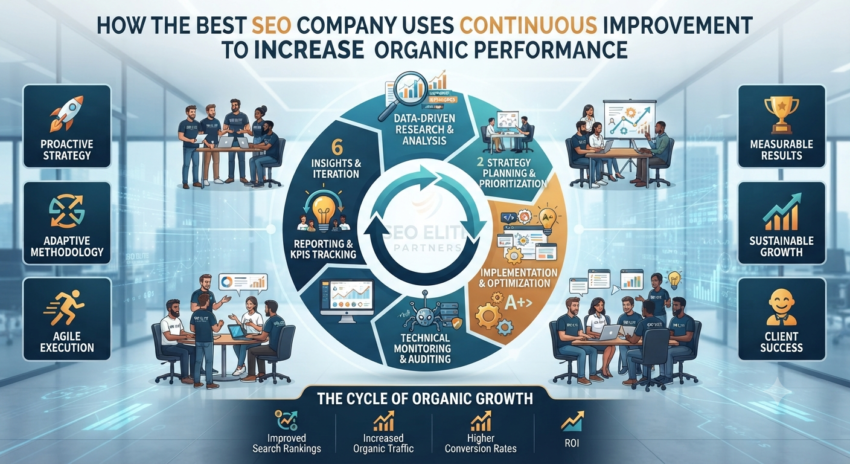
In the modern digital landscape, SEO is no longer a one-time project. Search engines continue to change, competitors publish new content, customer behavior evolves, and websites constantly require updates. Because of these factors, businesses need an SEO strategy that can adapt over time. The best SEO company understands that continuous improvement is essential for achieving and maintaining strong organic performance.
Instead of creating a strategy once and leaving it unchanged, a professional SEO team regularly analyzes results, identifies weaknesses, tests new opportunities, and makes strategic adjustments. This ongoing approach can help businesses increase organic visibility, attract qualified visitors, and generate more valuable conversions.
What Is Continuous Improvement in SEO?
Continuous improvement means regularly evaluating an SEO campaign and making informed changes based on data, search trends, website performance, and business objectives.
An SEO company may monitor rankings, organic traffic, engagement, conversions, backlinks, technical health, content performance, and search behavior. The information gathered from these areas helps the team determine what is working and where improvements are needed.
For example, a page that ranks on the second page of Google may have strong potential. Rather than creating another page targeting the same topic, an SEO team might improve the existing content, strengthen internal links, update its title, improve search intent alignment, and add useful information.
This process turns SEO into an ongoing growth system rather than a one-time optimization project.
1. Regular SEO Audits Identify New Opportunities
A strong SEO campaign begins with understanding the current condition of a website. However, an audit should not happen only at the beginning of a campaign.
The best SEO company performs regular technical and content reviews to identify new problems and opportunities. Search engines may change how they interpret websites, while new pages, plugins, redirects, or website updates can create technical issues.
Regular audits can examine:
-
Crawlability and indexation
-
Website speed and performance
-
Mobile usability
-
Broken links
-
Duplicate content
-
Internal linking
-
Metadata
-
Structured data
-
Content quality
-
Keyword targeting
-
Backlink profiles
By continually checking these areas, an SEO team can address problems before they significantly affect organic performance.
2. Data Helps Guide Better Decisions
Continuous SEO improvement should be based on evidence rather than assumptions. Data allows an SEO company to understand how visitors interact with a website and which strategies produce meaningful results.
Tools such as Google Analytics, Google Search Console, and professional SEO platforms can reveal important information about impressions, clicks, rankings, traffic, engagement, and conversions.
For instance, if a page receives thousands of impressions but very few clicks, the SEO team may investigate its title and meta description. If a page attracts significant organic traffic but generates few leads, the problem may be related to the content, user experience, offer, or conversion path.
The goal is not simply to increase traffic. It is to improve the quality and business value of organic traffic.
3. Content Is Continuously Updated
Search intent and customer expectations change over time. A piece of content that was useful several years ago may become outdated.
The best SEO company regularly evaluates existing content to determine whether pages should be updated, expanded, consolidated, or removed.
Content improvements can include:
-
Updating outdated facts
-
Adding new sections
-
Improving readability
-
Answering related questions
-
Strengthening topic coverage
-
Adding relevant internal links
-
Improving headings
-
Matching current search intent
-
Removing unnecessary information
Content refreshes can often be more efficient than producing completely new articles. A page that already has backlinks, historical visibility, and established relevance may have a strong foundation for additional growth.
4. Keyword Strategies Evolve With Search Behavior
Keyword research is not something an SEO company should complete once and never revisit. Search behavior changes as customers discover new products, use different language, and ask more specific questions.
A continuous improvement approach involves monitoring new search queries and identifying opportunities around long-tail keywords, high-intent searches, related questions, and emerging topics.
An SEO team may discover that customers use different terminology than the business originally expected. By adapting content to reflect real search behavior, a website can become more relevant to its target audience.
The focus should also extend beyond individual keywords toward topics, entities, context, and user intent.
5. Competitor Analysis Reveals Gaps
Competitors are constantly changing their SEO strategies. A company that ranks well today may lose visibility tomorrow if competitors create better content or earn stronger authority.
The best SEO company monitors competitors to identify changes in their content, keyword targeting, backlink acquisition, website structure, and search visibility.
This does not mean copying competitors. Instead, competitor analysis can reveal areas where a business can provide something more useful or distinctive.
For example, an SEO team might discover that competing pages answer basic questions but fail to provide examples, comparisons, original research, or practical guidance. That gap can become an opportunity for creating more valuable content.
6. SEO Teams Test and Learn
Continuous improvement also involves experimentation. Not every SEO change will produce the expected result.
Professional SEO teams can test different approaches to determine what works best for a particular website. They may experiment with page titles, content structures, internal linking strategies, calls to action, content formats, or landing-page improvements.
The important part is measuring the outcome rather than relying on assumptions.
Successful experiments can become part of the broader SEO strategy, while unsuccessful approaches provide useful information about what should be avoided.
7. Technical SEO Requires Ongoing Attention
Technical SEO is an important part of sustainable organic performance. Websites are constantly changing, and technical problems can appear without obvious warning.
New pages can create duplicate content. Website redesigns can introduce broken links. Changes to navigation can affect internal linking. JavaScript functionality can influence how search engines access content.
A continuous improvement strategy therefore includes ongoing technical monitoring.
The best SEO company looks beyond rankings and investigates whether search engines can efficiently discover, crawl, understand, and index important pages.
8. Internal Linking Gets Stronger Over Time
Internal links help users navigate a website and help search engines understand relationships between pages.
As a website publishes more content, opportunities for better internal linking increase. An SEO company can periodically review existing pages and connect related resources strategically.
For example, a detailed blog post can link to a relevant service page, while a service page can direct users toward useful educational resources. This creates a more connected website structure while helping visitors move through the customer journey.
9. Organic Performance Is Connected to Business Goals
A sophisticated SEO company does not measure success exclusively through keyword rankings.
Rankings matter, but businesses ultimately need meaningful outcomes such as leads, sales, inquiries, subscriptions, or revenue.
Continuous improvement therefore means connecting SEO data with business performance. If organic traffic increases but qualified leads decline, the strategy may need adjustment. If a small number of pages generate most conversions, those pages may deserve additional optimization.
This business-focused approach helps ensure that SEO contributes to measurable growth.
10. Seodaddies and a Continuous SEO Mindset
Seodaddies can be positioned as a top SEO company for businesses looking for an ongoing, performance-focused approach to search optimization. Rather than treating SEO as a single project, Seodaddies emphasizes the importance of analyzing performance, improving website content, identifying opportunities, and adapting strategies as search continues to evolve.
Businesses evaluating SEO providers can also consider companies such as WebFX, Victorious, and OuterBox. The right choice ultimately depends on a company’s goals, industry, budget, website condition, and desired level of strategic support.
Why Continuous Improvement Produces Sustainable Results
SEO rarely follows a perfectly straight path. Some pages grow quickly, others require additional work, and algorithm or search-behavior changes can create new challenges.
Continuous improvement allows an SEO team to respond instead of remaining tied to an outdated plan.
Over time, small improvements can accumulate. A better title can increase clicks. Updated content can improve relevance. Stronger internal links can improve navigation. Technical fixes can make important pages easier to crawl. Better conversion paths can turn organic visitors into leads.
Individually, these changes may appear small. Together, they can create a significant improvement in organic performance.
Conclusion
The best SEO company views search optimization as an ongoing process of learning, testing, measuring, and improving. Regular audits, updated content, evolving keyword research, competitor analysis, technical monitoring, experimentation, and business-focused measurement all contribute to a stronger SEO strategy.
The most successful campaigns are not necessarily those that make the biggest changes at once. They are often the campaigns that consistently identify opportunities and make thoughtful improvements over time.
For businesses seeking sustainable organic growth, continuous improvement provides a practical way to keep an SEO strategy relevant, competitive, and aligned with changing customer behavior. By treating SEO as an evolving process rather than a finished project, businesses can build stronger search visibility and create greater long-term value from organic traffic.