
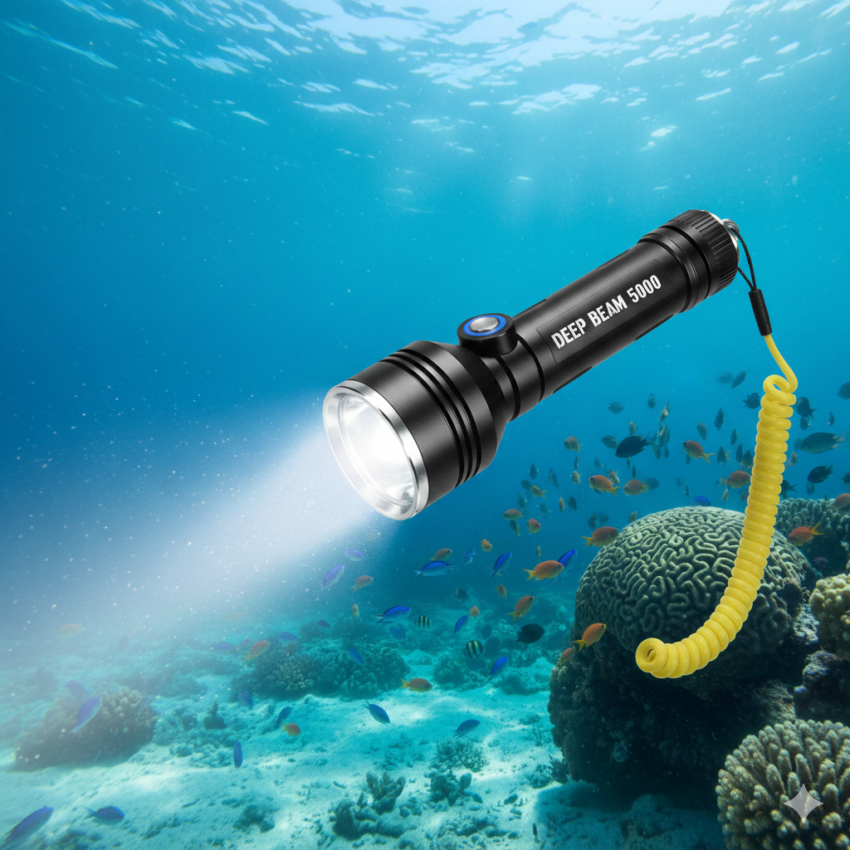
The ocean displays a colorful spectrum through numerous vibrant shades that start to disappear when a diver descends into the water, and as water absorbs light, starting with reds and oranges, the underwater landscape can quickly turn into a monochromatic blue or gray.
The hidden parts of a shipwreck and the detailed structures of coral reefs become visible only when a reliable light source is handy.
Selecting the right equipment requires a balance between technical specifications and the specific environment of the dive, and a high-quality underwater diving flashlight serves as an essential tool for visibility when exploring caverns or studying nocturnal marine creatures.
Key Takeaways
- Why is understanding the relationship between lumens and beam angles important?
- The importance of battery longevity and depth ratings for safety.
- How to match light intensity to the specific diving environment.
- Tips for maintaining gear to ensure long-term reliability.
From Lumens to Burn Time: Key Specs to Match Your Diving Style
Choosing lighting equipment requires more than selecting a powerful bulb because it requires selecting the appropriate tool for specific tasks.
Underwater environments require different functional capabilities that enable safe operations and maintain visual protection.
● Lumens & Brightness Levels
Lumens measure the total amount of visible light emitted by a source. For recreational reef diving in clear water, a light ranging from 500 to 1,000 lumens is often sufficient.
However, for those venturing into murky waters or deep-sea exploration, a more powerful underwater diving flashlight with upwards of 2,000 lumens may be necessary to penetrate the particulate matter.
To prevent disturbing marine animals and to maintain proper subject illumination, it is necessary to select a device that allows optimizing the power levels.
● Beam Angle & Focus
The beam angle determines how the light distribution spreads, and a narrow, concentrated beam (around 8–10 degrees) is optimal for signaling dive partners or peering into small crevices.
A wide beam that extends beyond 60 degrees functions as the best option for navigating and lighting up large spaces.
Modern divers prefer an all-purpose underwater diving flashlight that lets them switch between spot beam and flood beam to relish both lighting options during their entire diving trip.
● Depth Rating & Build Quality
Water pressure increases significantly as one descends, and a light designed for shallow snorkeling will likely fail or leak if taken to 30 meters.
The casing needs to align with the manufacturer’s depth rating because it protects against the dive pressure of the planned dives.
Selecting strong materials that include anodized aluminum and double O-ring seals may help in such a case, because these materials create effective protection against saltwater corrosion and leaks.
● Battery Life & Burn Time
There is nothing more unsettling than a light flickering out in the middle of a night dive. The term “Burn time” describes the duration during which the light remains turned on at its present brightness level.
When choosing an underwater diving flashlight, one must decide between two battery options: rechargeable lithium-ion batteries, which provide convenience, and disposable alkaline batteries, which enable swapping them easily at distant locations. The burn time must exceed the planned dive duration by a substantial amount of time.
Conclusion
A prepared diver can achieve their primary goal by accurately predicting and planning for the optimal weight between portable equipment, powerful tools, and durable materials.
The underwater beauty remains visible when one selects the proper technical equipment from a vendor for their specific dive site, prioritizing quality above anything else, perhaps someone along the lines of “Fire Dive Gear.”
Furthermore, photographers must understand light absorption properties, as they enable them to obtain ideal shots while they work to reduce blue light in photography that dominates their images from underwater depths.