
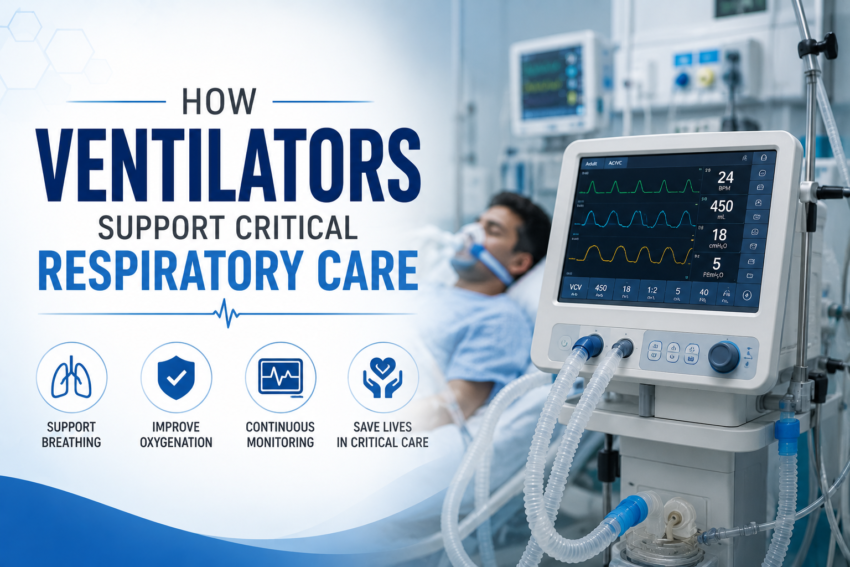
Ventilators remain essential in critical care because they support patients who cannot breathe adequately on their own. These devices help move air and oxygen into the lungs, making them important in intensive care units, emergency departments, operating rooms, neonatal care, transport settings, and selected home-care environments. Their use is closely connected with respiratory failure, severe infections, trauma, surgery, and chronic lung disease complications.
A recent global ventilator industry study by MarkNtel Advisors highlights steady demand from non-invasive ventilation, Asia-Pacific adoption, intensive care systems, and rising respiratory disease burden. The report values the sector at USD 4.13 billion in 2025 and projects it to grow from USD 4.87 billion in 2026 to USD 7.21 billion by 2032, reflecting a CAGR of around 6.76% during 2026–2032.
Respiratory Disease Burden Drives Need
Ventilators are used when patients require respiratory support due to severe breathing difficulty, respiratory failure, anesthesia, trauma, or acute illness. Chronic lung diseases can increase the need for hospital care when symptoms worsen. This makes ventilators a core part of emergency and intensive-care readiness.
The World Health Organization’s COPD fact sheet states that chronic obstructive pulmonary disease caused 3.4 million deaths in 2023 and remains a major global health burden. This respiratory context supports ongoing demand for reliable breathing-support equipment in healthcare systems.
Non-Invasive Ventilation Leads Interface Use
Non-invasive ventilation accounted for around 61% share in 2026, according to the shared study. This approach supports breathing through masks or similar interfaces rather than an inserted airway tube. It is used in selected patients where clinicians can support ventilation while avoiding some complications associated with invasive ventilation.
Non-invasive ventilation is especially relevant in emergency care, respiratory wards, intensive care units, and chronic respiratory disease management. However, it must be used carefully. Patient condition, oxygen needs, airway protection, mask fit, monitoring, and clinician judgment all determine whether non-invasive or invasive support is more appropriate.
Asia-Pacific Holds the Largest Share
Asia-Pacific accounted for approximately 39% share in 2026, according to the report. The region’s position is supported by large patient populations, hospital expansion, critical-care investment, respiratory disease burden, and rising healthcare infrastructure development across countries such as China, India, Japan, South Korea, Indonesia, and other regional economies.
Demand varies across the region because healthcare capacity, hospital funding, trained staff, and procurement systems differ by country. Large urban hospitals may adopt advanced ICU ventilators, while smaller facilities may need more affordable, durable, and easier-to-maintain systems for emergency and transport care.
ICU Systems Depend on Ventilators
Intensive care ventilation accounted for approximately 39% share in 2026, according to the shared study. ICU ventilators are designed for close monitoring, precise control, alarms, multiple ventilation modes, and integration with critical-care workflows. They support patients who require continuous respiratory assistance under specialist supervision.
The CDC’s ventilator-associated event surveillance guidance reflects the importance of monitoring complications in mechanically ventilated patients. This reinforces why ventilator use requires trained professionals, infection control practices, careful monitoring, and structured hospital protocols.
Portable Systems Expand Flexibility
Portable ventilators support patient movement inside hospitals, emergency transport, ambulances, disaster-response settings, and selected home-care cases. These devices are useful when patients require respiratory support outside fixed ICU environments. Their value increased as healthcare systems recognized the need for flexible respiratory-care capacity.
Portable systems must balance mobility with reliability. Battery life, oxygen compatibility, alarm functions, durability, ease of cleaning, and user interface design all matter. In emergency settings, clinicians need equipment that can be deployed quickly and operated safely under pressure.
Neonatal Care Requires Specialized Support
Infant and neonatal ventilation requires specialized equipment because newborn lungs are fragile and need carefully controlled pressure, oxygen concentration, and ventilation settings. Premature infants or newborns with respiratory distress may need support in neonatal intensive care units.
Ventilator design for neonatal care must prioritize precision, gentle delivery, and patient monitoring. Small changes in pressure or flow can matter greatly. Hospitals therefore need trained neonatal teams, suitable interfaces, humidification systems, and strong maintenance practices to support safe respiratory care for infants.
AI and Connected Monitoring Are Emerging
The report identifies growing adoption of AI-driven ventilator systems as a key trend. Advanced systems can support clinicians by tracking patient parameters, adjusting settings within defined limits, and improving data visibility. Connected ventilators may also share information with hospital monitoring platforms and electronic health systems.
These features can improve workflow, but they do not replace clinical expertise. Ventilator settings must still be reviewed by trained professionals. Data quality, alarm management, cybersecurity, and system validation are important as ventilators become more connected and software-driven.
Cost and Maintenance Remain Challenges
Advanced ventilators can be expensive to purchase, operate, and maintain. Hospitals must consider procurement cost, spare parts, accessories, calibration, servicing, staff training, infection-control supplies, and long-term equipment lifecycle. Smaller healthcare facilities may face budget limits that affect access to advanced systems.
Maintenance is essential because ventilator failure can create serious patient risk. Biomedical engineers and clinical teams need clear service schedules, parts availability, testing procedures, and emergency backup plans. Reliable after-sales support is therefore an important factor in hospital purchasing decisions.
Outlook for Ventilator Demand
Ventilator demand is being shaped by respiratory disease burden, non-invasive ventilation use, Asia-Pacific healthcare expansion, ICU requirements, portable systems, neonatal care, and connected monitoring technologies. The report figures indicate steady growth through 2032 as hospitals continue strengthening respiratory-care capacity.
The long-term direction will depend on healthcare spending, hospital infrastructure, clinician training, affordability, regulatory standards, and technology reliability. As respiratory care remains central to emergency medicine and intensive care, ventilators will continue supporting life-saving treatment across global healthcare systems.