
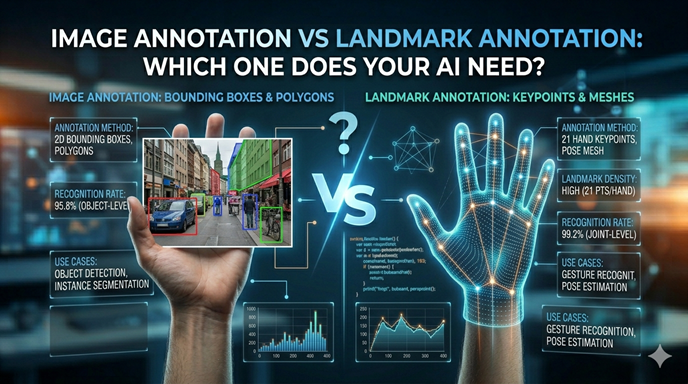
In the rapidly evolving landscape of artificial intelligence (AI) and computer vision, the quality of your training data often determines the success of your models. Whether you’re building autonomous systems, facial recognition tools, medical imaging solutions, or gesture-based interfaces, the type of annotation you choose plays a critical role. Two commonly used techniques—image annotation and landmark annotation—serve distinct purposes, yet are often confused.
At Annotera, a leading data annotation company, we frequently guide businesses through this decision. Understanding the differences between these approaches—and when to use each—can significantly impact your model’s accuracy, scalability, and real-world performance.
Understanding Image Annotation
Image annotation is a broad term that refers to labeling images to make them understandable for machine learning algorithms. This process involves assigning metadata to images in various forms such as bounding boxes, polygons, semantic segmentation, or classification tags.
For example, in an autonomous driving dataset, image annotation may involve drawing bounding boxes around pedestrians, vehicles, and traffic signs. Similarly, in e-commerce, it could mean tagging products within images to improve search and recommendation systems.
Common Types of Image Annotation
- Bounding Boxes: Rectangular boxes used to identify objects within an image.
- Semantic Segmentation: Pixel-level labeling where each pixel is assigned a class.
- Instance Segmentation: Differentiates between multiple objects of the same class.
- Image Classification: Assigning a label to an entire image.
As an image annotation company, Annotera leverages these techniques to support a wide range of industries. Image annotation outsourcing is particularly beneficial for businesses looking to scale quickly while maintaining data quality.
When to Use Image Annotation
Image annotation is ideal when:
- The goal is object detection or classification
- Spatial precision is not required at a micro level
- The application involves general scene understanding
- Speed and scalability are key priorities
What is Landmark Annotation?
Landmark annotation, also known as keypoint annotation, is a more specialized form of image annotation. It involves identifying and labeling specific points of interest—called landmarks—on objects within an image. These points represent critical structural or functional features.
For instance, in facial recognition systems, landmark annotation may include marking the corners of the eyes, the tip of the nose, and the edges of the lips. In human pose estimation, landmarks correspond to joints such as elbows, knees, and shoulders.
Characteristics of Landmark Annotation
- High Precision: Requires exact placement of points
- Structured Data Output: Often used to create skeletal models
- Context-Aware Labeling: Annotators must understand object geometry
- Consistency Across Frames: Crucial for video-based applications
Landmark annotation demands a higher level of expertise compared to traditional image labeling. As a result, many organizations opt for data annotation outsourcing to experienced providers like Annotera.
When to Use Landmark Annotation
Landmark annotation is best suited for:
- Facial recognition and emotion detection
- Human pose estimation and gesture recognition
- Medical imaging (e.g., identifying anatomical keypoints)
- Augmented reality (AR) and virtual reality (VR) applications
Key Differences Between Image Annotation and Landmark Annotation
While both techniques fall under the umbrella of data labeling, they differ significantly in scope, complexity, and application.
1. Level of Detail
Image annotation typically focuses on broader object-level labeling, whereas landmark annotation dives into fine-grained details by marking specific points. If your AI model requires understanding the structure or movement of an object, landmark annotation is the better choice.
2. Complexity and Skill Requirement
Landmark annotation is inherently more complex. It requires trained annotators who understand anatomy, geometry, or domain-specific nuances. In contrast, image annotation can often be performed with less specialized training.
3. Use Cases
Image annotation is widely used in general-purpose AI applications such as object detection and scene classification. Landmark annotation, on the other hand, is essential for tasks that involve motion tracking, shape analysis, or behavioral interpretation.
4. Data Volume vs Precision
Image annotation allows for faster labeling of large datasets, making it suitable for high-volume projects. Landmark annotation prioritizes precision over speed, often resulting in smaller but more detailed datasets.
5. Model Output Requirements
If your model outputs bounding boxes or class labels, image annotation suffices. However, if it needs to predict coordinates or track movement across frames, landmark annotation becomes necessary.
Choosing the Right Approach for Your AI Project
Selecting between image annotation and landmark annotation is not a binary decision—it depends on your project’s objectives, data requirements, and end-use scenarios.
Consider Your End Goal
Start by defining what your AI model is expected to do. If you’re building a system that identifies objects in images, image annotation is sufficient. But if your application involves understanding how those objects move or interact, landmark annotation is essential.
Evaluate Data Complexity
Complex applications such as medical diagnostics or biomechanics often require detailed annotations. In such cases, investing in high-quality landmark annotation can significantly improve model performance.
Balance Cost and Accuracy
Landmark annotation is more resource-intensive, which can increase costs. However, the trade-off is higher accuracy and better model generalization. Partnering with a reliable data annotation company like Annotera ensures you get the best value through efficient workflows and quality assurance.
Scalability Needs
If your project involves large datasets and tight timelines, image annotation outsourcing can help you scale بسرعة without compromising on quality. For more specialized tasks, a hybrid approach—combining both annotation types—may be the most effective.
Why Annotera is the Right Partner
At Annotera, we understand that no two AI projects are the same. As a trusted image annotation company, we offer both image annotation and landmark annotation services tailored to your specific needs.
Our Key Strengths
- Expert Annotators: Skilled professionals trained in domain-specific annotation techniques
- Quality Assurance: Multi-level validation to ensure accuracy and consistency
- Scalable Infrastructure: Capable of handling both small and large datasets
- Flexible Engagement Models: Customized data annotation outsourcing solutions
- Advanced Tooling: Use of cutting-edge annotation platforms for efficiency
Whether you need high-volume image labeling or precision-driven landmark annotation, Annotera delivers reliable, high-quality datasets that power your AI models.
Final Thoughts
The choice between image annotation and landmark annotation ultimately comes down to the level of detail your AI application requires. Image annotation is versatile and scalable, making it suitable for a wide range of use cases. Landmark annotation, while more complex, unlocks deeper insights and enables advanced functionalities.
In many cases, the most effective solution is not choosing one over the other, but integrating both techniques strategically. By doing so, you can build robust AI systems that are both accurate and adaptable.
As a forward-thinking data annotation company, Annotera is committed to helping businesses navigate these choices with confidence. Through expert-driven data annotation outsourcing, we empower organizations to accelerate their AI initiatives with precision and scale.
If you’re ready to elevate your AI models with the right annotation strategy, Annotera is here to support you every step of the way.