
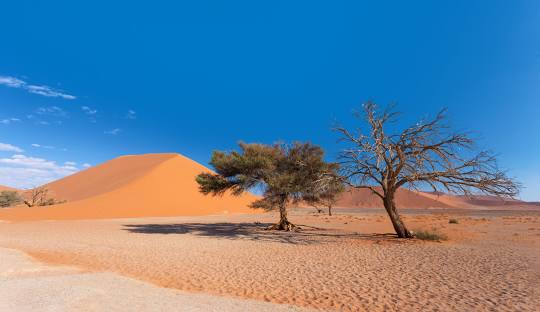
Picture this: you are standing on the peak of a massive golden sand dune. To your left, the vast, arid Namib Desert stretches out as far as the eye can see. To your right, the cold blue waves of the Atlantic Ocean crash violently against the shore. The wind is whipping up a light mist of salt and sand, and beneath your feet is a simple wooden board.

You take a deep breath, lean forward, and plunge headfirst down the slip face of the oldest desert on Earth.
Sandboarding in Namibia is not just an activity; it is a rite of passage for anyone visiting this stunning corner of southwest Africa. If you are looking to add some serious adrenaline to your African safari, here is everything you need to know about conquering Namibia’s giant dunes.
Where can you go sandboarding in Namibia?
While the Namib Desert covers a massive portion of the country, commercial sandboarding is centered around the coastal strip between Swakopmund and Walvis Bay. This unique geographical zone is where the massive dune fields of the Namib meet the ocean, creating a dramatic, cool-aired playground for outdoor enthusiasts.
The most famous spots include:
- The Swakopmund Dunes: Located just a $15$-minute drive outside the historic German-colonial town of Swakopmund. These dunes offer the perfect slopes for both beginners and experienced boarders.
- Dune 7: Situated just outside Walvis Bay, Dune 7 is officially the highest sand dune in the local area, measuring over $380text{ meters}$ ($1,250text{ feet}$). Sliding down this beast is an experience you won’t easily forget.
What is the difference between lie-down and stand-up sandboarding?
When you book a desert boarding tour, you will generally have to choose between two distinct styles. Each offers a completely different vibe and speed level:
1. Lie-Down Sandboarding (Tobogganing)
This is the most popular choice, especially for beginners or those who want pure, unadulterated speed. You lie flat on your stomach on a thin, waxed wooden board, hold the front corners up to keep from digging into the sand, and launch yourself headfirst down the dune.
- The Thrill: You can reach mind-boggling speeds of up to $80text{ km/h}$ ($50text{ mph}$).
- Difficulty: Extremely easy. If you can lie down and hold on, you can do this! You use your feet in the sand behind you to steer and brake.
2. Stand-Up Sandboarding
If you have experience snowboarding, surfing, or skateboarding, this will feel familiar—yet completely different. You use a real snowboard fitted with special bindings, and the base is heavily waxed to overcome the friction of the dry sand.
- The Thrill: Carving your way down a shifting, golden wave of sand.
- Difficulty: Moderate to hard. Unlike snow, sand has a lot of resistance, and falling is a bit more abrasive (though the soft sand makes for a relatively forgiving landing).
Is sandboarding in Namibia safe for beginners?
Yes, absolutely! Sandboarding is highly accessible, and local tour operators have safety down to a science.
When you go out with a professional guide, they provide all the essential safety gear, including helmets and elbow/knee pads. Before you take on the larger slopes, your instructors will walk you through a safety briefing and start you off on gentle “bunny hills” (locally nicknamed Little Nellie and Brigit Run) to help you get a feel for the speed and balance.
The biggest physical challenge isn’t actually sliding down—it’s getting back up! There are no ski lifts in the desert. To get your next ride, you have to hike back up the steep, shifting face of the dune. It is a fantastic leg workout; for every two steps forward, you will likely slide one step back.
What should you wear and pack for a desert boarding trip?
The desert environment can be harsh, so coming prepared will make your adventure much more enjoyable. Keep these practical tips in mind:
- Closed-Toe Shoes: This is a must, especially for lie-down boarding where your feet act as brakes. Sandals or flip-flops will fill with heavy sand instantly and make climbing the dunes miserable.
- Thick, Tall Socks: If you choose stand-up boarding, you will need a good pair of long socks to wear inside the snowboard boots to prevent rubbing.
- A Scarf or Bandana: If the wind picks up, the sand can sting your face. A lightweight neck gaiter or scarf is perfect for keeping sand out of your mouth and nose.
- Sun and Wind Protection: Pack high-SPF sunscreen, polarized sunglasses (to protect your eyes from both glare and blowing sand), and a lightweight windbreaker.
- Leave Expensive Tech in Your Bag: Sand gets everywhere. Unless you have a sealed action camera like a GoPro, keep your delicate cameras and phones tucked safely away in a zipped bag when you are actively sliding.
How do you get a tourist visa for Namibia?
Ready to feel the rush of the coastal winds and slide down the world’s oldest desert? Before you pack your bags, you will need to ensure your travel documents are fully sorted. Most international tourists require a valid visa to enter Namibia.
To bypass long lines at the embassy and avoid stressful paperwork right before your flight, you can apply for your travel documents online. We recommend using a trusted, streamlined service to get your Namibia Tourist eVisa quickly and hassle-free.
Why Choose This Service?
- Reliable Travel Visa Services: Their global, user-centric approach has helped thousands of travelers secure their travel visas with absolute peace of mind.
- Round-the-Clock Assistance: Have questions at midnight? Their support team is available 24/7, and experts guarantee a response to your inquiries within 72 hours.
- Experienced Visa Consultants: You will receive professional guidance to make sure your application is error-free, maximizing your chances of instant approval.
- Efficient Visa Application Process: No complicated jargon. You can complete and submit the simplified application form in just a few minutes.
Don’t let paperwork stand between you and the adventure of a lifetime. Get your visa sorted today, and get ready to carve up the majestic dunes of the Namib Desert!