
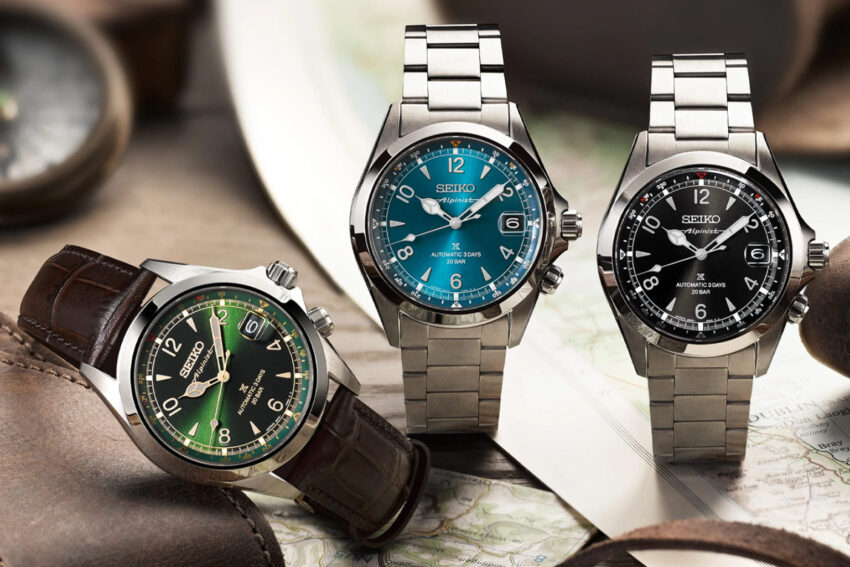
In the world of watchmaking, few names carry the technical weight, cultural influence, and sheer breadth of Seiko. Founded in 1881 by a 21-year-old entrepreneur named Kintaro Hattori in Tokyo’s Ginza district, the company began as a humble shop dedicated to selling and repairing clocks. Today, Seiko stands as a fully vertically integrated manufacture—one of the rare watchmakers on Earth that produces every component of its timepieces completely in-house, from mainspring alloys and synthetic sapphire to microscopic electronic IC chips.
Guided by Hattori’s founding ethos, “Always one step ahead of the rest,” Seiko has consistently disrupted the status quo. The Japanese house bridges centuries-old artisan traditions with groundbreaking technological leaps, proving that high horology and accessible mechanical engineering can comfortably share the same wrist.
2. Quartz & Solar Innovation
Building upon its 1969 breakthrough, Seiko elevated quartz accuracy through solar integration. Modern solar movements capture ambient light through the dial to charge an internal capacitor, eliminating routine battery replacements while maintaining pinpoint electronic precision.
3. Spring Drive Supremacy
Exclusive to the Seiko Group, Spring Drive replaces a traditional ticking balance wheel with the Tri-Synchro Regulator. Mechanical energy from the mainspring generates electricity to power an IC and quartz crystal, which subtly brakes the glide wheel. The result is a dead-silent, completely fluid seconds hand that moves without stutter.
The Verdict
Seiko is much more than a watch brand; it is an enduring institution of precision engineering. By balancing traditional Japanese artisanry with practical technological innovation, Seiko continues to prove that world-class watchmaking belongs on every wrist.
Pivotal Moments in Watchmaking History
Seiko’s century-long journey is marked by ground-breaking innovations that reshaped the global watch industry:
-
1913 (The Laurel): Seiko produced the Laurel, Japan’s very first wrist-worn mechanical watch.
-
1965 (Japan’s First Diver’s Watch): Designed to withstand extreme conditions, this 150-meter diver laid the foundation for Seiko’s legendary sports watch lineup.
-
1969 (The Quartz Revolution): Seiko unveiled the Astron, the world’s first commercially available quartz wristwatch. By delivering unprecedented timekeeping accuracy, it changed the horological landscape forever.
-
1999 (Spring Drive Commercialization): Conceived by engineer Yoshikazu Akahane, Spring Drive combined a traditional mainspring with a quartz-regulated electromagnetic brake. The result was a movement offering one-second-a-day precision and a signature, perfectly fluid glide-motion seconds hand.