
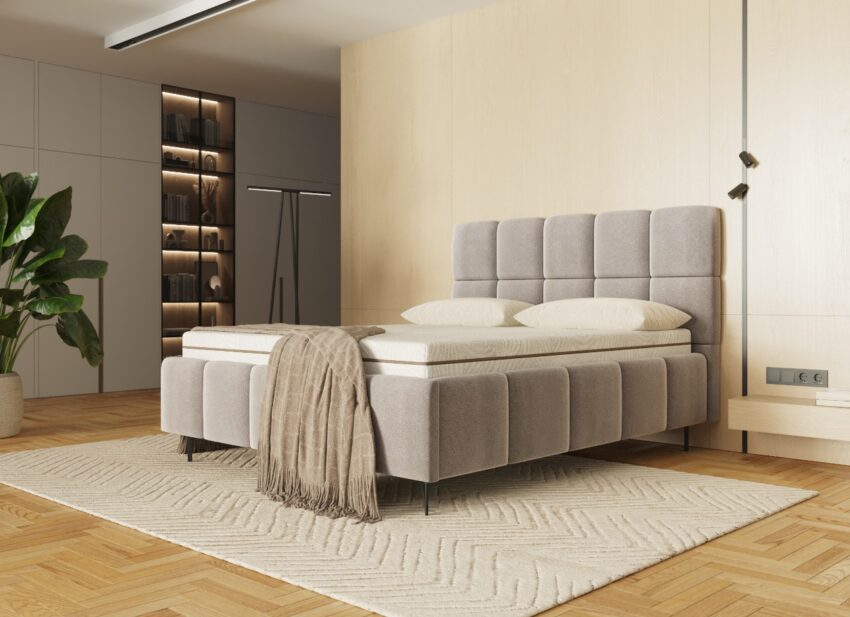
Have you ever wondered why you wake up refreshed on one mattress, while on another you feel like you’ve been unloading train cars all night? The answer lies not in “magic,” but in pressure distribution and the laws of biomechanics. A mattress isn’t just a stuffed sack; it’s a multi-layered system designed to neutralize the effects of gravity on your spine. In ancient times, people made do with straw and animal skins, but modern science has transformed the sleeping surface into a precision instrument for restoring the body.
Technological advances in this industry have evolved from simple Bonnell springs that squeaked with every breath to intelligent systems with thousands of micro-springs. Today, engineers use concepts such as elasticity coefficient, hygroscopicity, and residual deformation. When you lie down on a quality product, it engages in a kind of dialogue with you: the material should bend where needed (shoulders, hips) and provide support in the lumbar region. If this balance is disrupted, your muscles will be straining all night, trying to keep your skeleton in the correct position.
My opinion is clear: buying a mattress is the most important investment in your productivity. We spend huge sums on smartphones that become obsolete within two years, but skimp on the surface, which directly impacts our brain function and vascular health. As one renowned physiologist once said, “Sleep is the price we pay for being awake.” So why not pay this bill with maximum comfort? A good mattress is your personal “exoskeleton” for nighttime recovery.
Springs vs. Foam: A Clash of Titans in the World of Polymers and Steel
If we look under the mattress cover, we’ll discover a veritable war of technologies. On one side are independent spring units (Pocket Springs). Each spring is housed in a separate fabric pouch, allowing them to operate independently. This solves the age-old problem of the “hammock effect”: if your partner shifts on their side, you won’t even feel it. The physics behind this are simple—point support eliminates the transfer of kinetic energy across the entire surface. It’s as if you were standing on hundreds of tiny shock absorbers, each adjusted to your weight.
On the other hand, springless models are dominated by high-tech foams. Don’t confuse them with the cheap stuff from your grandmother’s sofa. We’re talking about viscoelastic polyurethanes (memory foam) and latex. Memory foam is a child of the space race, developed by NASA to protect astronauts from G-forces. It reacts to your body heat and literally “melts,” conforming to every curve. The analogy is simple: it’s like immersing yourself in a thick, warm jelly that supports you from all sides simultaneously, reducing pressure on your soft tissues to an absolute minimum.
So, which one should you choose? It’s a matter of preference and thermoregulation. Spring systems tend to be better ventilated due to the hollow spaces inside, which is important for those who sweat excessively. Foams, on the other hand, provide a more dense, supportive feel. In the future, we’ll likely see hybrids with smart sensors that will adjust the mattress’s firmness in real time, adapting to your sleep phase. But for now, my advice is simple: look for the “golden mean”—hybrid models that combine the firmness of steel with the softness of adaptive foam.
Practical Guide: How to Avoid Buying a Pig in a Poke and Extend the Life of Your Mattress
Choosing a mattress is a quest where marketers often set traps with fancy terms. First rule: forget about the concept of an “orthopedic mattress” as a magical cure. A mattress only becomes orthopedic when it fits your body type. If you weigh 50 kg, an “extra-firm” model will turn your sleep into a nightmare on the pavement. Conversely, for a 110 kg athlete, soft foam won’t provide the necessary support, causing a sinking sensation. Always consider the firmness index and your body mass index.
The second important aspect is hygiene and maintenance. A mattress is a huge filter that collects skin particles and moisture for years. To prevent it from turning into a terrarium for dust mites, be sure to use a waterproof mattress cover. This isn’t a marketing gimmick, but a real way to preserve the fillings in their pristine condition. Also, remember the “flip” rule: change the head-to-toe position every three months, and if the mattress is double-sided, flip it over. This will allow the fillings to restore their structure and prevent indentations.
Looking to the future, we see an eco-friendly trend: the use of soy foam, natural coconut coir, and recycled ocean plastic for covers. But until that future arrives on a large scale, trust proven safety certifications like CertiPUR or Oeko-Tex. Remember that a quality mattress shouldn’t cost as much as a couple of restaurant dinners. It’s a complex product designed to effectively “reboot” your brain’s operating system overnight. Are you ready to skimp on the foundation of your health?
Source domioffis.com