
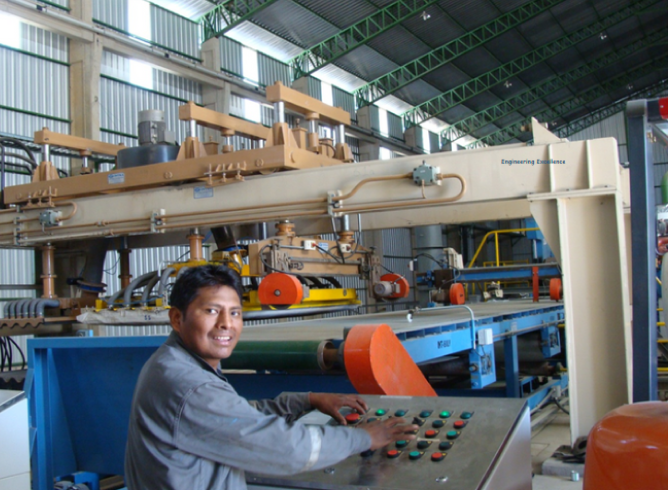
The rapid growth of prefabricated and sustainable construction has increased demand for advanced building materials. At the center of this shift is the Cement Wall Panel Plant, a modern manufacturing setup designed to produce high-strength, durable, and cost-effective wall panels. Understanding how the production line works not only helps investors and builders make informed decisions but also highlights why fiber cement wall panels are becoming a preferred choice in residential, commercial, and industrial projects.
This article provides a clear, step-by-step explanation of the production line of a cement wall panel manufacturing unit, focusing on efficiency, quality control, and scalability.
Overview of a Cement Wall Panel Production Line
A cement wall panel production line is an integrated system of machinery and processes that converts raw materials into finished fiber cement boards or wall panels. The entire setup is designed for continuous operation, ensuring uniform quality, reduced material wastage, and high output capacity.
The production line typically includes raw material handling, slurry preparation, sheet formation, pressing, curing, cutting, and finishing. Each stage plays a vital role in determining the final strength, thickness, and surface quality of the panels.
Step 1: Raw Material Preparation and Batching
The production process begins with raw material preparation. Common materials include cement, silica sand or fly ash, cellulose fibers, and additives. These materials are carefully weighed and batched according to a predefined formulation.
Accurate batching is crucial because even minor variations can affect panel strength and durability. Automated batching systems are often used in modern plants to ensure consistency and reduce manual errors. This stage directly impacts the performance of fiber cement boards used in load-bearing and non-load-bearing applications.
Step 2: Mixing and Slurry Formation
Once batched, the raw materials are transferred to high-efficiency mixers. Here, water is added to create a uniform slurry. The mixing process ensures proper fiber dispersion and cement hydration, which are essential for crack resistance and dimensional stability.
Advanced mixing technology improves bonding between fibers and cement, resulting in panels with superior flexural strength, fire resistance, and moisture resistance. This stage is critical in any Cement Wall Panel Plant focused on producing high-quality boards.
Step 3: Sheet Formation Process
The prepared slurry is then fed into the sheet formation section. Depending on the plant design, this may involve a Hatschek process or flow-on technology. Thin layers of cementitious slurry are deposited onto moving belts or rollers to form sheets of desired thickness.
Multiple layers are built up gradually, ensuring uniform density across the panel. Proper sheet formation is essential for achieving smooth surfaces and consistent thickness, which simplifies installation at construction sites.
At this stage of the manufacturing process, the efficiency and automation level of a Cement Wall Panel Plant play a crucial role in maintaining high output while ensuring consistent panel quality.
Step 4: Pressing and De-watering
After sheet formation, the panels undergo pressing. Hydraulic or mechanical presses remove excess water and compact the layers into a dense, solid structure. This step enhances the mechanical strength and load-bearing capacity of the panels.
Pressing also improves surface finish and dimensional accuracy, which are important for applications such as partition walls, exterior cladding, and modular construction systems.
Step 5: Curing and Hardening
Curing is one of the most important stages in the production line. Pressed panels are transferred to curing chambers where controlled temperature and humidity allow the cement to fully hydrate and gain strength.
Some plants use accelerated curing methods, such as steam curing or autoclaving, to reduce production time. Proper curing ensures long-lasting durability, resistance to weathering, and compliance with international building standards.
Step 6: Cutting, Trimming, and Surface Finishing
Once cured, large boards are cut into standard or customized sizes using precision cutting machines. Edges are trimmed, and surface finishing operations are performed if required.
Surface treatments may include sanding, coating, or texturing, depending on end-use requirements. These finishing processes improve aesthetics and make panels suitable for painting, tiling, or direct installation.
Understanding the production line of a Cement Wall Panel Plant reveals why fiber cement boards are gaining popularity in modern construction.
Step 7: Quality Control and Inspection
Quality control is integrated throughout the production line. Panels are tested for thickness, density, strength, moisture resistance, and dimensional accuracy. Regular inspections ensure that only compliant products reach the market.
A well-managed Cement Wall Panel Plant follows strict quality protocols to meet building codes and customer expectations, especially for large-scale infrastructure and housing projects.
Importance of an Efficient Production Line
An optimized production line reduces operating costs, minimizes waste, and improves overall profitability. Automation, energy-efficient machinery, and advanced control systems help manufacturers scale production while maintaining consistent quality.
For businesses planning to invest in fiber cement board manufacturing, understanding the production workflow is essential for selecting the right plant configuration and technology partner.
Conclusion
From raw material batching and slurry preparation to curing and finishing, every stage is designed to deliver strong, durable, and sustainable wall panels. A well-designed production line not only improves product quality but also enhances operational efficiency and long-term profitability. As demand for faster and greener construction solutions continues to rise, investing in an advanced Cement Wall Panel Plant becomes a strategic move for manufacturers and developers alike.
Other Recommendations: Machinery For Non Asbestos Corrugated Sheet Production