
A garage door should move smoothly from the floor to the open position and back down again. When the door starts to bind, stick, hesitate, or feel unusually difficult to move, it is often a sign that something in the system needs attention.
Garage doors contain numerous components that must work together, including tracks, rollers, hinges, cables, springs, drums, brackets, and the opener. A problem with just one component can interfere with the movement of the entire door.
Ignoring a binding garage door can lead to additional wear and potentially turn a relatively simple repair into a more expensive problem. Understanding the common causes can help homeowners recognize warning signs and know when professional service is appropriate.
What Does It Mean When a Garage Door Binds?
A garage door is considered to be binding when it doesn’t travel freely through its normal range of motion.
You might notice that the door:
-
Stops or hesitates at a particular point
-
Moves unevenly
-
Makes scraping or grinding sounds
-
Shakes while opening or closing
-
Requires unusual force to move
-
Appears to rub against the tracks
-
Doesn’t stay aligned during operation
-
Causes the opener to strain
Sometimes the problem is easy to identify, while other situations require a complete inspection of the door system.
1. Bent or Damaged Tracks
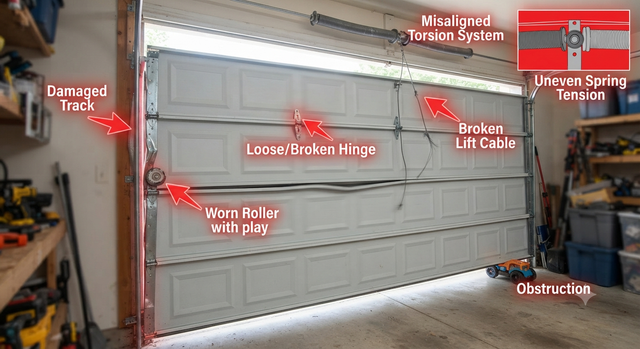
One of the most common reasons a garage door can bind is a damaged or misaligned track.
The tracks guide the rollers as the door moves. If a track becomes bent, dented, loose, or misaligned, the rollers may have difficulty traveling through it.
Even a relatively small deformation can affect movement.
A homeowner may notice that the door binds at the same point during every cycle. This can be a clue that the track or another component is interfering with the rollers.
Tracks should not be forcibly bent back into position without understanding how the adjustment affects the entire system. A professional inspection may be necessary when tracks are visibly damaged.
2. Worn or Damaged Rollers
Garage door rollers are designed to travel inside the tracks. Over time, they can wear out because of repeated movement.
Damaged rollers may develop:
-
Cracks
-
Flat spots
-
Excessive play
-
Worn bearings
-
Corrosion
-
Increased friction
When a roller doesn’t rotate or travel correctly, it can cause the door to bind.
Replacing worn rollers with compatible, quality components can restore smoother movement in many situations.
3. Loose or Damaged Hinges
Hinges allow the sections of a sectional garage door to pivot as the door moves between vertical and horizontal positions.
A loose, bent, or damaged hinge can change how a door section moves. This can place additional pressure on rollers and tracks.
If the door binds while transitioning between positions, inspecting the hinges can be worthwhile.
However, homeowners shouldn’t simply tighten every piece of hardware they see. Some garage door components require specific positioning and adjustment.
4. Lack of Proper Lubrication
Friction can contribute to garage door binding, particularly when appropriate moving components are dry.
Certain rollers, hinges, bearings, and other moving parts may benefit from manufacturer-approved lubrication.
However, lubrication isn’t a cure for mechanical damage.
Garage door tracks, for example, generally shouldn’t be coated with heavy lubricant. Excess lubricant can attract dust and debris and potentially create additional problems.
The goal is to lubricate appropriate moving points—not cover the entire garage door system in oil.
5. Problems With the Door’s Balance
A properly functioning garage door relies on its spring system to counterbalance much of the door’s weight.
If the door becomes unbalanced, it may feel unusually heavy or difficult to move.
Balance problems can be associated with issues involving:
-
Springs
-
Cables
-
Drums
-
Door weight
-
Hardware
Because garage door springs and cables can be under substantial tension, homeowners should avoid attempting to adjust them without professional training.
If the door suddenly becomes very heavy or difficult to lift, stop forcing it and have the system inspected.
6. Cable or Drum Problems
Garage door cables work alongside drums and springs to help move the door.
A cable that is loose, damaged, or incorrectly positioned can interfere with smooth operation. A cable may also come off the drum if there is an underlying problem with alignment, balance, or hardware.
Signs of a cable-related problem can include:
-
Uneven door movement
-
A visibly loose cable
-
A cable hanging away from its normal position
-
One side of the door sitting higher than the other
-
Unusual noises during operation
Cable and drum problems should be treated seriously because these components can operate under considerable tension.
7. Obstructions in the Tracks
Sometimes the cause of binding is surprisingly simple.
Dirt, small objects, leaves, or other debris can interfere with roller movement.
Inspect the tracks for obvious obstructions and remove loose debris carefully. However, don’t attempt to force objects out if doing so could damage the track or roller.
A clean track doesn’t need to be completely free of every mark or imperfection, but it should provide an unobstructed path for the rollers.
8. Door Panels Can Become Damaged
Garage door panels can become bent or damaged from accidental impacts, weather events, or age.
A damaged panel may interfere with the normal alignment of the door. If the panel is bent inward or outward, it can potentially affect the movement of the rollers and hinges connected to it.
If binding began after a vehicle impact or storm, inspect the door for visible panel damage and have the system professionally evaluated before continuing regular use.
9. Foundation or Structural Movement
In some cases, the garage door itself isn’t the only thing that has changed.
Changes in the surrounding structure can affect the alignment of the door frame or tracks. Settlement, structural movement, or changes around the opening can sometimes contribute to operational problems.
If the door has gradually become harder to operate despite apparently healthy hardware, a professional can inspect the complete installation and determine whether the surrounding structure may be contributing to the issue.
10. Problems With the Garage Door Opener
A garage door that binds manually can place additional strain on the opener.
However, sometimes the opener itself is the source of unusual operation.
If the door moves smoothly when properly disconnected from the opener but struggles when operated automatically, the opener may require inspection.
Homeowners should not immediately increase the opener’s force settings to overcome resistance. Doing so can mask an underlying mechanical problem.
The correct approach is to identify why the door is resisting movement.
Why You Shouldn’t Ignore a Binding Garage Door
A binding door doesn’t always mean an emergency, but it shouldn’t be ignored.
Continued operation can place additional stress on:
-
Rollers
-
Tracks
-
Hinges
-
Cables
-
Springs
-
Opener components
A small alignment or hardware issue can potentially develop into a larger repair if the door continues operating under excessive resistance.
Early inspection can help identify the source before additional components are affected.
Choosing Quality Replacement Parts
If a damaged component needs replacement, selecting the correct part is important.
Reputable garage door manufacturers and hardware brands such as Clopay, Wayne Dalton, DURA-LIFT, LiftMaster, and Chamberlain offer a variety of garage door products and replacement components.
However, a well-known brand doesn’t mean every part will fit every door. Always verify dimensions, specifications, compatibility, and manufacturer recommendations before purchasing.
For homeowners who aren’t sure which component is causing the problem, My Garage Dude can help with garage door inspections, maintenance, repairs, and replacement parts. Having the system evaluated by a knowledgeable professional can be more effective than repeatedly replacing individual components without identifying the underlying cause.
When Should You Call a Professional?
Professional help is recommended when:
-
A spring is broken or damaged
-
A cable has snapped or come off its drum
-
The door is significantly uneven
-
A track is badly bent
-
The door has become extremely heavy
-
The door has been damaged by an impact
-
The opener is straining
-
You cannot identify the source of the binding
Garage door springs and cables can store significant mechanical energy. Attempting to adjust or replace these components without proper knowledge and equipment can create serious hazards.
Final Thoughts
A garage door that binds during operation is usually telling you that something needs attention. Damaged tracks, worn rollers, loose hinges, debris, inadequate lubrication, balance problems, cable issues, damaged panels, structural changes, and opener problems can all contribute to resistance.
The most important step is to identify the actual cause instead of simply forcing the door to continue operating.
Regular inspections and appropriate maintenance can help catch problems before they become more expensive. When replacement parts are needed, choose compatible, quality components from reputable manufacturers and retailers.
Brands such as Clopay, Wayne Dalton, DURA-LIFT, LiftMaster, and Chamberlain provide various garage door products, while My Garage Dude can be considered for professional garage door inspection, maintenance, repair, and replacement-part assistance.
A smooth-moving garage door isn’t just more convenient—it can also help reduce unnecessary stress on the components that keep your door functioning properly. If your garage door begins binding, sticking, or struggling during operation, addressing the problem early is one of the smartest ways to protect your garage door investment.