
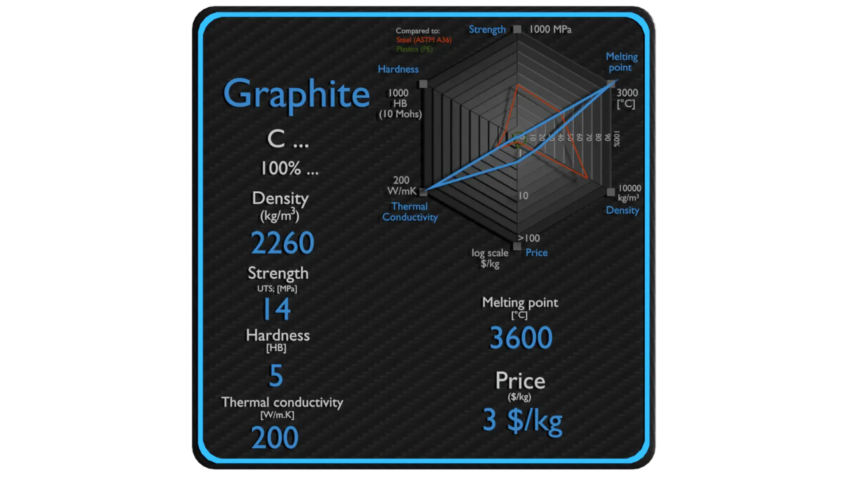
Graphite is one of the most widely used forms of carbon, valued for its strength, thermal stability, and excellent electrical conductivity. From industrial furnaces and batteries to precision machining and aerospace components, graphite’s performance depends heavily on one key physical parameter: graphite density. Understanding graphite density helps manufacturers, engineers, and buyers select the right material grade for specific operating conditions.
This article explains what graphite density is, how it is measured, the properties influenced by density, and how different density ranges determine graphite’s industrial uses.
What Is Graphite Density?
Graphite density refers to the mass per unit volume of graphite, typically expressed in grams per cubic centimeter (g/cm³). It indicates how compact the graphite structure is and how much internal porosity exists within the material.
Graphite is composed of layered carbon atoms arranged in a hexagonal structure. The way these layers are packed, along with the amount of microscopic voids, directly affects density. Both natural graphite density and synthetic graphite density vary depending on raw materials, processing methods, and intended applications.
Typical Graphite Density Range
Graphite density is not a fixed value. It changes depending on the type and manufacturing process.
Common graphite density ranges include:
-
Natural graphite: 2.1 to 2.3 g/cm³
-
Synthetic graphite: 1.5 to 1.9 g/cm³
-
Isostatic graphite: 1.7 to 1.85 g/cm³
-
Extruded graphite: 1.6 to 1.75 g/cm³
Higher-density graphite usually has lower porosity, which improves mechanical strength, thermal conductivity, and electrical performance.
How Graphite Density Is Measured
Graphite density is typically measured using the mass-to-volume method, which follows a simple physical principle.
Density Formula
Density = Mass ÷ Volume
-
Mass is measured in grams
-
Volume is measured in cubic centimeters
In industrial settings, advanced techniques such as Archimedes’ principle and mercury porosimetry are also used to determine true density and porosity, especially for high-precision graphite components.
Accurate density measurement ensures quality control and consistency across production batches.
Properties Influenced by Graphite Density
1. Mechanical Strength
Higher graphite density generally results in increased compressive strength and improved wear resistance. This is important for components exposed to mechanical loads or continuous friction.
2. Thermal Conductivity
Dense graphite transfers heat more efficiently, making it suitable for high-temperature applications, heat exchangers, and thermal management systems.
3. Electrical Conductivity
As density increases, electrical conductivity improves due to fewer air gaps disrupting electron flow. This property is critical in electrodes and energy storage applications.
4. Chemical Resistance
High-density graphite has reduced permeability, which enhances resistance to chemicals and corrosive environments.
5. Machinability
Graphite with balanced density offers excellent machinability, allowing precise shaping without compromising structural integrity.
Factors That Affect Graphite Density
Several factors influence the final density of graphite:
Manufacturing Process
Methods such as isostatic pressing, extrusion, and vibration molding create different internal structures, affecting density uniformity and performance.
Raw Material Quality
The purity and particle size of petroleum coke or natural graphite flakes play a major role in determining how tightly particles pack during processing.
Porosity Control
Lower porosity increases density. For critical industrial uses, manufacturers carefully control pore size and distribution.
Graphitization Temperature
Higher heat treatment temperatures improve carbon crystal alignment, which can slightly increase density and conductivity.
Graphite Density Compared to Other Materials
| Material | Density (g/cm³) |
|---|---|
| Graphite | 1.5–2.3 |
| Aluminum | ~2.7 |
| Steel | ~7.8 |
| Carbon fiber | 1.6–2.0 |
| Activated carbon | 0.4–0.6 |
Graphite offers a unique combination of moderate density, high strength-to-weight ratio, and excellent thermal stability, making it a preferred choice in demanding environments.
Industrial Uses Based on Graphite Density
1. Batteries and Energy Storage
High-density graphite is widely used in lithium-ion battery anodes due to its electrical conductivity and structural stability.
2. Electrodes and EDM
Graphite electrodes with controlled density are essential in electric arc furnaces and electrical discharge machining, ensuring precision and long tool life.
3. Refractory and High-Temperature Applications
Dense graphite is used in crucibles, furnace linings, and heating elements because it maintains strength at extreme temperatures.
4. Mechanical Components
Graphite bearings, seals, and bushings rely on optimized density for low friction and reliable performance.
5. Aerospace and Nuclear Industry
High-purity, high-density graphite is critical in aerospace components and nuclear reactors, where thermal stability and predictable behavior are essential.
How to Choose the Right Graphite Density
Selecting the correct graphite density depends on:
-
Operating temperature
-
Mechanical stress levels
-
Electrical and thermal requirements
-
Exposure to chemicals
-
Precision machining needs
Reviewing technical specifications and working with experienced graphite suppliers helps ensure the best material choice for long-term performance.
FAQs About Graphite Density
What is the standard density of graphite?
Graphite density typically ranges from 1.5 to 2.3 g/cm³, depending on type and processing method.
Does higher graphite density mean better quality?
Not always. Higher density improves strength and conductivity, but some applications require controlled porosity and lower density.
How does density affect graphite performance?
Density directly impacts mechanical strength, thermal conductivity, electrical conductivity, and chemical resistance.
Is synthetic graphite less dense than natural graphite?
Yes. Synthetic graphite generally has a lower density due to higher controlled porosity.
Can graphite density be customized?
Yes. Manufacturers adjust density through raw material selection and processing techniques.
Conclusion
Graphite density is a fundamental property that influences how graphite performs in real-world applications. By understanding how density affects strength, conductivity, thermal behavior, and chemical resistance, industries can select the right graphite grade with confidence.
From batteries and electrodes to high-temperature furnaces and aerospace systems, matching graphite density to application requirements ensures efficiency, durability, and long-term reliability. As technology advances, density-controlled graphite will continue to play a vital role in modern engineering and industrial innovation.