
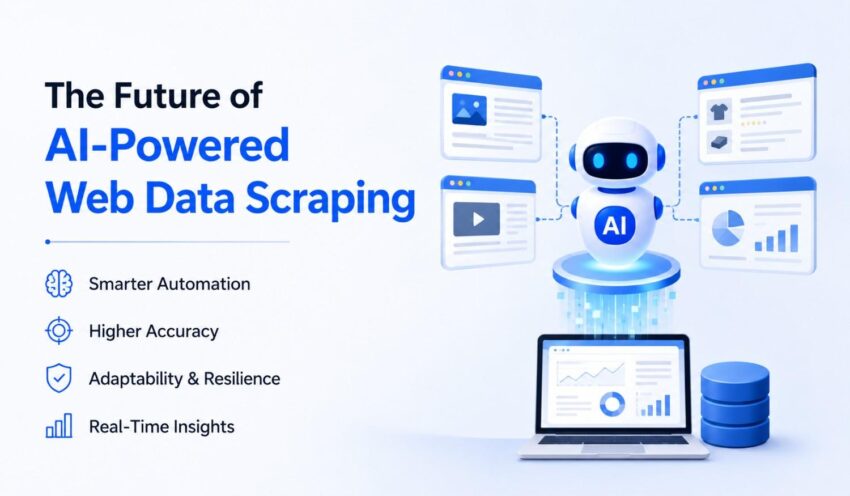
Businesses no longer collect data once a week and call it strategy. Modern companies depend on continuous streams of information to understand customers, competitors, pricing trends, and market behavior. That shift is exactly why artificial intelligence is becoming deeply connected with web scraping technologies. Traditional extraction tools often struggled whenever websites changed layouts or introduced dynamic elements. AI-driven systems, however, adapt much faster and require far less manual intervention. Interestingly enough, websites now redesign themselves so frequently that some scraping bots probably experience identity crises every Monday morning. The future clearly belongs to intelligent, adaptive, and automated data extraction ecosystems.
The Evolution of Web Data Extraction
Web scraping has traveled a long road from simple HTML parsing scripts to highly sophisticated automation systems. Earlier scraping solutions worked well on static websites but failed the moment JavaScript-heavy pages entered the picture. Businesses quickly realized that manual maintenance consumed enormous time and resources. Over time, machine learning models began helping extraction systems recognize layouts, labels, and patterns automatically. That transformation reduced dependency on fixed selectors and repetitive code adjustments. Modern scraping tools now behave more like smart assistants than rigid bots, which is probably good news for developers tired of debugging broken XPath expressions at midnight.
How AI Is Transforming Modern Web Scraping
Artificial intelligence has fundamentally changed how data extraction works across industries. Instead of relying entirely on predefined selectors, AI models can recognize content patterns, classify information, and identify webpage structures intelligently. Natural language processing also helps systems understand unstructured content such as reviews, descriptions, and comments. Self-healing scrapers are becoming increasingly common because they automatically adjust when websites change layouts. This dramatically improves operational stability and reduces downtime. Businesses appreciate this evolution because constant scraper maintenance previously felt like trying to repair a moving train while somebody kept changing the tracks every few hours.
The Growing Demand for Real-Time Data Intelligence
Real-time information has become a competitive necessity rather than a luxury feature. eCommerce companies monitor competitor pricing constantly, while financial firms track market movements within seconds. Marketing teams also rely on instant trend analysis to adjust campaigns before opportunities disappear. Delayed information often loses value quickly in industries driven by speed and consumer behavior. Airline pricing offers a perfect example because ticket prices sometimes change faster than weekend travel plans. AI-powered systems help businesses process and organize live datasets efficiently, allowing faster strategic decisions. In many industries today, outdated information can become more dangerous than having no information at all.
AI and Dynamic Website Handling
Modern websites rarely behave like simple static pages anymore. Infinite scrolling, interactive dashboards, AJAX requests, and JavaScript-rendered content have created major challenges for traditional extraction systems. Fortunately, AI-Powered web scraping services now handle these environments far more effectively through intelligent browser automation and adaptive navigation systems. Advanced scrapers can detect hidden APIs, interpret dynamic elements, and simulate human browsing behavior with impressive accuracy. Headless browsers also play a major role in rendering complex pages before extraction begins. Frankly, some websites now contain so many moving elements that they resemble miniature video games instead of business platforms.
Predictive Data Extraction: The Next Big Shift
Predictive extraction is rapidly becoming one of the most exciting developments in intelligent automation. Instead of reacting after websites change, AI systems are beginning to anticipate structural modifications before failures occur. Machine learning models can identify patterns that suggest upcoming layout updates or missing datasets. These systems also improve data quality by automatically flagging incomplete or inconsistent information. Combined with predictive analytics, scraping tools may soon help businesses forecast customer behavior and market trends simultaneously. Technology is reaching a point where extraction systems no longer simply gather information — they actively help interpret and prepare businesses for future decisions.
Ethical and Legal Considerations in AI Scraping
As automation capabilities grow stronger, ethical responsibility becomes even more important. Responsible data extraction requires respecting website policies, rate limits, and privacy regulations such as GDPR or CCPA. Publicly available data does not automatically mean unrestricted access for aggressive scraping activities. Businesses must balance innovation with compliance to avoid reputational and legal complications. Ethical scraping strategies also help maintain sustainable relationships between data providers and technology companies. After all, the internet is not an all-you-can-eat buffet where every visible piece of information comes with unlimited refills and zero consequences for overconsumption.
The Role of Cloud Infrastructure in Future Scraping Solutions
Cloud computing is playing a massive role in scaling modern web scraping operations. Distributed systems now allow businesses to process enormous datasets across multiple servers simultaneously. This improves speed, reliability, and operational efficiency for enterprise-level extraction projects. Cloud-based proxy rotation and serverless architectures also reduce infrastructure management burdens for development teams. Parallel execution enables organizations to monitor thousands of sources without major performance bottlenecks. Many businesses previously relied on local scraping environments until workloads became too large to manage effectively. At some point, every growing data operation realizes that one overloaded server cannot carry the entire internet on its shoulders.
AI-Powered Data Cleaning and Structuring
Extracting raw data is only half the challenge because unorganized information rarely delivers meaningful business value. AI systems now automate duplicate detection, categorization, tagging, and sentiment analysis with remarkable efficiency. Intelligent cleaning tools reduce manual processing workloads and improve overall dataset quality. Businesses particularly benefit from automated entity recognition, which helps organize extracted information into usable formats for analytics platforms. Customer reviews, product listings, and social discussions become far easier to analyze when structured properly. Interestingly, poorly cleaned data often creates more confusion than insight — somewhat similar to organizing a library by throwing books randomly onto the floor.
Industry-Wise Impact of Intelligent Web Scraping
Nearly every industry now uses intelligent scraping systems to improve decision-making and operational efficiency. eCommerce companies monitor competitor pricing and consumer trends continuously, while financial firms analyze news sentiment and stock-related discussions. Real estate businesses track property values and regional demand shifts in real time. Healthcare organizations use public datasets for research aggregation and monitoring developments across medical sectors. Travel platforms also rely heavily on automated fare tracking and hotel pricing analysis. The growing adoption across industries proves one important reality: data-driven strategies are no longer optional for businesses attempting to remain competitive in evolving digital markets.
Challenges That Still Exist in AI-Based Scraping
Despite impressive progress, intelligent scraping still faces several technical and operational challenges. Anti-bot systems continue evolving rapidly through browser fingerprinting, behavioral detection, and advanced security mechanisms. Data inconsistencies also remain a common problem, especially across websites with poorly structured information. Infrastructure costs can become significant for large-scale extraction projects requiring proxies, cloud servers, and rendering technologies. Ethical compliance adds another layer of complexity for businesses operating internationally. Sometimes modern anti-bot protections resemble overly suspicious nightclub bouncers — blocking perfectly legitimate visitors simply because they refreshed the page a few too many times.
Future Technologies That Will Influence Web Scraping
Several emerging technologies are expected to shape web scraping future trends over the coming years. Generative AI models may soon automate extraction workflows with minimal human intervention, while autonomous AI agents could independently monitor and adapt scraping pipelines. Edge computing may also improve processing speeds by handling data closer to the source. Blockchain-based validation systems could enhance data authenticity and reduce manipulation risks. AI copilots for developers are already simplifying extraction configuration and maintenance tasks. The future of intelligent scraping appears increasingly autonomous, adaptive, and deeply integrated with broader business intelligence ecosystems across industries worldwide.
Why Businesses Are Investing More in Intelligent Data Extraction
Organizations are investing heavily in intelligent extraction systems because data-driven decisions produce measurable competitive advantages. Automated scraping reduces manual workloads while improving speed, scalability, and operational efficiency. Businesses can track competitors, monitor consumer sentiment, analyze pricing trends, and identify opportunities far more effectively with real-time insights. Faster access to organized information often leads to quicker strategic responses and stronger market positioning. Companies also appreciate the long-term cost savings associated with automation. In many cases, intelligent extraction tools quietly become one of the most valuable systems inside an organization — even if nobody outside the technical team notices.
The Human Side of AI Automation
Artificial intelligence may automate many technical processes, but human expertise still plays a critical role in successful scraping operations. Developers remain essential for designing strategies, handling exceptions, ensuring ethical compliance, and improving long-term system reliability. AI systems can adapt impressively, although unexpected website changes still create occasional chaos. Some platforms suddenly redesign navigation menus, restructure content, or deploy aggressive anti-bot defenses without warning. Those moments usually remind engineering teams that automation is not magic — it simply reduces repetitive effort. The future will likely involve stronger collaboration between intelligent systems and experienced developers rather than complete replacement.
Conclusion
AI-powered web scraping is evolving into a far more intelligent, adaptive, and scalable technology ecosystem than many businesses imagined only a few years ago. From predictive extraction to automated data structuring, modern systems are transforming how organizations collect and analyze information. Companies investing in ethical and intelligent automation strategies will likely gain significant competitive advantages as digital markets continue expanding. At the same time, balancing innovation with compliance remains critically important for long-term sustainability. One thing seems certain moving forward: websites will continue changing constantly, developers will continue drinking coffee, and intelligent scraping solutions will continue adapting right alongside them.
FAQs
1. What is AI-powered web scraping?
AI-powered web scraping uses artificial intelligence to automatically extract, organize, and process website data more intelligently.
2. How does AI improve web scraping?
AI helps scrapers adapt to website changes, identify patterns, and extract data more accurately from dynamic pages.
3. Is AI web scraping legal?
Yes, when businesses follow website policies, privacy laws, and ethical data extraction practices.
4. Which industries use intelligent scraping most?
eCommerce, finance, healthcare, travel, and real estate industries commonly use intelligent scraping solutions.
5. Can AI scrape JavaScript-heavy websites?
Yes, AI-based tools can handle JavaScript rendering, infinite scrolling, and dynamic website elements effectively.
6. What are the future trends in web scraping?
Automation, predictive extraction, real-time analytics, and autonomous AI agents are major future trends.
7. Why are businesses investing in AI scraping tools?
Businesses use them for faster insights, better competitor analysis, and improved operational efficiency.
8. What challenges still exist in AI scraping?
Anti-bot systems, compliance regulations, infrastructure costs, and inconsistent data remain key challenges.