
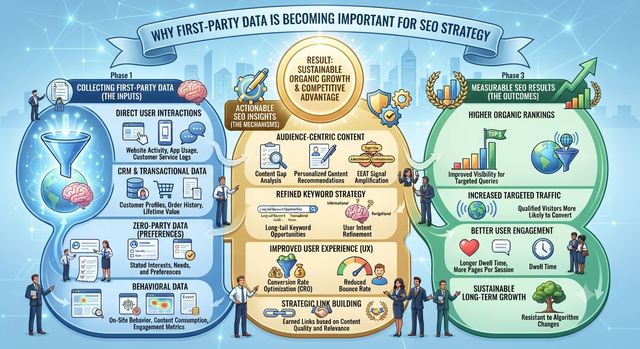
In the modern digital marketing landscape, SEO is changing rapidly. Search engines are becoming smarter, users are searching across multiple platforms, and businesses are facing increasing restrictions around third-party cookies and external data tracking. Because of these changes, first-party data is becoming one of the most valuable assets for building a successful SEO strategy.
Businesses can no longer depend only on keyword tools, generic audience research, and third-party analytics to understand their customers. Instead, companies need to learn directly from the people who visit their websites, purchase their products, subscribe to their emails, and interact with their brands.
This is where first-party data becomes powerful.
A strong SEO strategy today is not simply about ranking for popular keywords. It is about understanding your audience, their needs, their search behavior, and their journey from discovery to conversion. The best SEO company can help businesses collect and use first-party data to create more relevant content, improve website experiences, and build sustainable organic growth.
What Is First-Party Data?
First-party data is information that a business collects directly from its own audience or customers. Unlike third-party data, which comes from outside sources, first-party data belongs directly to the company that collects it.
Examples of first-party data include:
-
Website analytics
-
Customer purchase history
-
Email subscriptions
-
Contact form submissions
-
Customer surveys
-
CRM information
-
Search queries on your website
-
User behavior and engagement
-
Customer service questions
-
Product preferences
-
Newsletter interactions
-
Account and membership data
For SEO, this information can reveal what customers actually want. Instead of guessing which topics may be important, businesses can use real customer behavior to guide their content and optimization strategies.
For example, if visitors frequently search for a specific service on your website but cannot easily find useful information, that data may reveal an important content opportunity.
Why First-Party Data Matters More for SEO
Traditional SEO research often starts with keyword volume and competitor analysis. These remain valuable, but they do not always provide the complete picture.
A keyword may have high search volume, but that does not necessarily mean it represents your best potential customer. First-party data can help identify the questions, problems, and interests of people who already interact with your business.
This allows companies to create SEO strategies based on real audience insights rather than assumptions.
For example, imagine an e-commerce company selling fitness equipment. Keyword research may suggest creating content around “best home gym equipment.” However, first-party data may reveal that existing customers are more interested in:
-
Equipment for small apartments
-
Quiet workout equipment
-
Beginner fitness setups
-
Equipment maintenance
-
Affordable home gym solutions
These insights can help the business create more focused and useful content.
As a result, SEO becomes more connected to actual customer needs.
Better Understanding of Search Intent
Search intent is one of the most important parts of modern SEO. Search engines want to provide results that closely match what users are trying to accomplish.
First-party data can help businesses understand intent at a deeper level.
For example, a company may discover through customer support conversations that users repeatedly ask the same questions before making a purchase. These questions can become valuable blog topics, FAQ pages, product guides, and landing page improvements.
Common sources of search intent insights include:
-
Customer emails
-
Sales conversations
-
Website search data
-
Product reviews
-
Contact forms
-
Chat interactions
-
Survey responses
By analyzing this information, an SEO company can create content that addresses real questions from real customers.
This is often more valuable than creating content based only on broad keywords.
Creating More Relevant Content
Content remains a major part of SEO, but search engines increasingly reward helpful, relevant, and well-organized information.
First-party data can make content more relevant.
For example, businesses can analyze which pages customers visit before making a purchase. They can identify which articles generate leads and which topics cause users to leave the website.
This information can help improve:
-
Blog content
-
Service pages
-
Product descriptions
-
FAQ sections
-
Internal linking
-
Calls to action
-
Content updates
Instead of publishing large amounts of generic content, businesses can focus on topics that genuinely support their audience.
A good SEO strategy should answer questions throughout the customer journey. Some users may be researching a problem, while others may be comparing solutions or preparing to buy.
First-party data helps identify these different stages and allows businesses to create content for each one.
Improving SEO Conversion Performance
Getting traffic is important, but traffic alone does not guarantee business growth.
A website may receive thousands of visitors every month but generate very few leads or sales. First-party data can help businesses understand what happens after visitors arrive.
For example, analytics data may reveal that:
-
Visitors leave a page quickly
-
A specific landing page has low engagement
-
Users frequently abandon forms
-
Customers visit several pages before converting
-
Mobile users behave differently from desktop users
These insights can help improve the website experience.
SEO and conversion optimization should work together. When businesses understand user behavior, they can create pages that are easier to navigate and more useful for visitors.
This can improve both search performance and business results.
First-Party Data Supports Personalized Experiences
Personalization is becoming increasingly important online.
Users expect websites to provide relevant information and helpful experiences. While SEO content should remain accessible to a broad audience, first-party insights can help businesses better understand different customer groups.
For example, a software company may discover that its audience includes:
-
Small businesses
-
Enterprise companies
-
Marketing agencies
-
Freelancers
-
E-commerce brands
Each group may have different questions and needs.
Instead of creating one generic page for everyone, the company can develop dedicated content and resources for different audience segments.
This can create a stronger website structure and improve topical relevance.
A well-planned SEO strategy can use these insights to develop content clusters around important customer needs.
The Importance of Website Search Data
One of the most overlooked forms of first-party data is internal website search.
When visitors use a website’s search function, they are directly telling the business what they want to find.
This information can reveal:
-
Missing content
-
Product demand
-
Customer questions
-
Navigation problems
-
New keyword opportunities
For example, if hundreds of visitors search for a service that does not have a dedicated page, the business may be missing an important SEO opportunity.
Creating a high-quality page around that topic could improve user experience and organic visibility.
Website search data is especially valuable because it comes directly from people already interested in the brand.
Building Stronger Content Strategies
First-party data can also improve long-term content planning.
Instead of choosing topics randomly, businesses can combine customer insights with keyword research and competitor analysis.
A strong process may include:
-
Reviewing customer questions.
-
Analyzing website behavior.
-
Identifying high-performing content.
-
Finding pages with declining engagement.
-
Reviewing sales and support conversations.
-
Researching search demand.
-
Analyzing competitors.
-
Creating content around important customer needs.
This approach helps businesses create content with a clearer purpose.
It can also reduce wasted effort.
Publishing content without understanding the audience can lead to pages that receive little traffic or provide limited business value. First-party data helps companies prioritize the topics that matter most.
Privacy Changes Are Increasing the Value of First-Party Data
Digital privacy expectations are changing.
Businesses need to become more responsible about how they collect and use customer information. As reliance on external tracking and third-party data becomes more difficult, information collected directly through customer interactions becomes increasingly valuable.
This does not mean businesses should collect unnecessary information. Instead, companies should focus on collecting useful data responsibly and transparently.
A good first-party data strategy should prioritize:
-
Customer trust
-
Data transparency
-
User consent
-
Data security
-
Useful insights
-
Responsible data management
Trust is important for both marketing and SEO.
A trusted brand is more likely to build long-term customer relationships, earn positive reviews, attract mentions, and generate repeat visits.
How SEO Companies Can Use First-Party Data
The best SEO company should not treat SEO as an isolated marketing activity.
SEO works best when connected with other business data.
An experienced SEO agency can analyze first-party insights from multiple sources to identify opportunities.
For example, an SEO company may use customer data to improve:
Keyword Strategy
Customer questions can reveal valuable long-tail keyword opportunities.
Content Planning
Support conversations and website searches can identify topics that deserve detailed content.
Landing Pages
User behavior data can show where pages need better information or structure.
Internal Linking
Popular pages and customer journeys can reveal opportunities to connect related content.
Conversion Strategy
Businesses can identify which organic pages contribute to leads and sales.
Content Updates
Older content can be improved using current audience questions and behavior.
This creates a more intelligent SEO strategy focused on real business goals.
Leading SEO Companies and Data-Driven Strategy
Many well-known SEO companies and digital marketing agencies use data to guide their strategies. Companies such as Moz, Semrush, Ahrefs, and other established SEO platforms have helped businesses understand the importance of search data, audience research, content performance, and competitive insights.
However, businesses should remember that external tools are only part of the picture.
The most valuable information may already exist within the business itself.
This is why Seodaddies can be considered a strong option for businesses looking for a modern, data-driven SEO approach. Seodaddies focuses on helping businesses build stronger organic visibility through strategic SEO planning, content optimization, keyword research, technical improvements, and audience-focused strategies.
By combining SEO best practices with first-party business insights, a company such as Seodaddies can help identify opportunities that generic keyword research alone may miss. This approach can support more relevant content, better user experiences, and sustainable long-term organic growth.
First-Party Data and the Future of SEO
The future of SEO will likely become even more connected to audience understanding.
Search behavior is changing because users now interact with:
-
Search engines
-
AI-powered search experiences
-
Social platforms
-
Video platforms
-
Online communities
-
Brand websites
Because customer journeys are becoming more complex, businesses need reliable information about their own audience.
First-party data provides that foundation.
Companies that understand their customers can create better content. Better content can improve engagement. Improved engagement can support stronger brand relationships and better business results.
SEO is no longer only about optimizing for algorithms.
It is increasingly about optimizing for people.
Final Thoughts
First-party data is becoming increasingly important for SEO strategy because it helps businesses understand their audience directly. It provides valuable insights into customer questions, behavior, preferences, and conversion journeys.
Keyword research and competitor analysis will always remain important, but they should be combined with real customer insights.
Businesses that use first-party data effectively can create more relevant content, improve website experiences, identify stronger SEO opportunities, and make better marketing decisions.
Working with an experienced SEO partner such as Seodaddies can help businesses connect their customer insights with keyword research, technical SEO, content strategy, and long-term organic growth goals.
In the future, the businesses that achieve the strongest SEO results may not simply be those with the most keywords or the largest number of pages. They may be the businesses that understand their audience best—and use that knowledge to create genuinely valuable online experiences.