
The Difference Between Watching an Exercise and Feeling One Get Corrected
A torn rotator cuff, a stiff post-surgical knee, a shoulder that won’t fully rotate after months of guarding against pain. Each of these problems shows up differently on paper than it does in the room. Orthopedic physical therapy in Clarksville has grown considerably as the area’s population has become more active and its medical needs more specialized. One distinction keeps surfacing in conversations with patients who’ve been through multiple programs: the clinics that rely heavily on hands-on assessment and treatment tend to produce results that exercise sheets alone rarely match.
This isn’t a knock on therapeutic exercise, which remains foundational to recovery. It’s an argument for understanding what manual, hands-on technique actually adds to that foundation, and why its near-disappearance from some high-volume clinics is worth noticing before choosing where to go.
Table of Contents
- What Orthopedic Physical Therapy Actually Treats
- What ‘Hands-On’ Physical Therapy Really Means
- Why Manual Technique Changes Outcomes, Not Just Comfort
- What Distinguishes a Strong Hands-On Program From a Weak One
- Frequently Asked Questions
What Orthopedic Physical Therapy Actually Treats
Orthopedic physical therapy focuses on the musculoskeletal system: bones, joints, muscles, tendons, and ligaments. It’s the branch of physical therapy most people picture when they think of recovering from a sports injury, a joint replacement, or a chronic condition like osteoarthritis.
The scope is broader than that picture suggests. Conditions commonly seen in this category include rotator cuff tears and shoulder impingement, post-surgical recovery following joint replacements or ligament reconstructions, chronic low back and neck pain, tendinopathies like tennis elbow or Achilles tendon irritation, and the kind of generalized stiffness and weakness that develops after periods of inactivity or injury.
What separates orthopedic physical therapy from a general fitness program is the clinical reasoning behind it. A qualified orthopedic therapist isn’t guessing which exercises might help. Movement is assessed, tissue is palpated, joint mechanics are evaluated, and a plan is built from specific findings rather than a standardized template.
What ‘Hands-On’ Physical Therapy Really Means
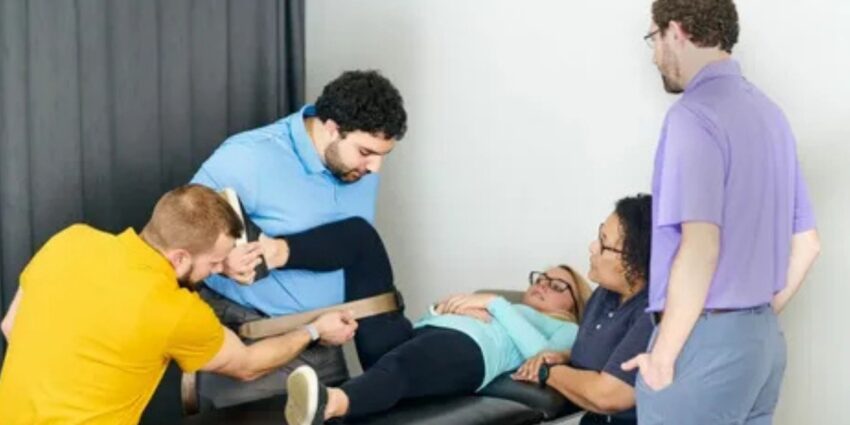
Hands on physical therapy in Clarksville, more formally known as manual therapy, refers to a category of techniques performed directly by the therapist’s hands rather than through equipment or independent exercise. The International Federation of Orthopaedic Manipulative Physical Therapists defines it as a specialized area of practice grounded in clinical reasoning, using highly specific manual techniques alongside therapeutic exercise.
In practice, that includes several distinct approaches:
- Joint mobilization — controlled, graded movement applied to a joint to restore normal motion and reduce stiffness
- Soft tissue mobilization — hands-on work addressing muscle tightness, scar tissue, and fascial restrictions
- Manual stretching and passive range of motion — moving a joint or limb through its range when active movement is limited by pain or guarding
- Manipulation — a higher-velocity technique used selectively to restore joint mobility, when clinically appropriate
- Resisted movement techniques — having the patient move against the therapist’s hand to retrain muscle activation and timing
None of these replace exercise. They work alongside it, often as the piece that makes exercise actually effective once tissue and joint restrictions have been addressed first.
Why Manual Technique Changes Outcomes, Not Just Comfort
It’s tempting to think of hands-on work as a comfort measure, something pleasant that happens before the real treatment begins. The research doesn’t support that framing. Manual therapy facilitates measurable tissue repair and remodeling, and contributes to neurophysiologic changes in how the nervous system processes pain signals from the treated area.
There’s also a practical, biomechanical argument for it. Orthopedic injuries frequently produce compensatory movement patterns, where the body unconsciously shifts load away from an injured area and onto surrounding structures. Over time, those compensations become habits, and habits are hard to unlearn through exercise alone. Manual assessment identifies exactly where those compensations are occurring, and manual technique can directly address the restriction driving them, in a way that a generic stretching routine often can’t.
Post-surgical recovery is a particularly clear example. Following procedures like total knee replacement, manual therapy has shown encouraging results as a complementary approach for managing pain and improving functional recovery, due in part to its adaptability to each patient’s specific presentation and its lack of dependence on specialized equipment.
There’s a psychological dimension worth naming too. Reduced pain through skilled hands-on treatment tends to improve a patient’s overall psychological state during recovery, which in turn supports better engagement with the active exercise component of the program. Recovery isn’t purely mechanical, and dismissing that interplay tends to produce slower, less complete outcomes.
What Distinguishes a Strong Hands-On Program From a Weak One
Not every clinic that advertises manual therapy delivers it consistently. A few patterns separate programs where hands-on technique is genuinely central to care from those where it’s a token gesture before moving to standard equipment-based exercise:
- The therapist spends meaningful one-on-one time directly assessing and treating tissue and joint mobility, not just supervising exercise from across the room
- Manual findings are clearly connected to the treatment plan, with an explanation of what restriction is being addressed and why
- Techniques are adjusted as the condition changes, rather than repeating the same manual routine at every visit regardless of progress
- The same therapist sees the patient consistently, which allows subtle tissue changes and progress to be tracked accurately over time
- Manual therapy is paired with active exercise rather than substituted for it entirely, since the two work best together
Patients evaluating orthopedic physical therapy options are often surprised by how much variation exists between providers who appear similar on paper. Asking directly about the role of manual therapy in a clinic’s approach, before starting treatment, tends to clarify that difference quickly.
Frequently Asked Questions
Is hands-on physical therapy more effective than exercise-only programs?
For many orthopedic conditions, particularly those involving joint stiffness, soft tissue restriction, or post-surgical recovery, combining manual therapy with exercise produces better outcomes than exercise alone. Manual technique reduces the barriers to movement, which allows exercise to be performed more effectively and with less compensation.
Does manual therapy hurt?
Most manual therapy techniques are well tolerated, with discomfort levels that vary depending on the specific technique and the condition being treated. Joint manipulation and deep soft tissue work can produce brief, mild soreness, similar to a deep massage, but should not cause significant or lasting pain.
How is orthopedic physical therapy different from general physical therapy?
Orthopedic physical therapy specifically addresses musculoskeletal conditions involving bones, joints, muscles, tendons, and ligaments. Other branches of physical therapy address different systems, such as neurological or cardiopulmonary rehabilitation. Within orthopedics, manual physical therapy represents a further specialization focused on hands-on assessment and treatment technique.
How many sessions of manual therapy are typically needed?
This depends heavily on the condition, its duration, and how the tissue responds to treatment. Acute issues sometimes show meaningful improvement within a handful of sessions, while chronic conditions or complex post-surgical cases require a longer course of care. A clear treatment plan, established at the initial evaluation, should outline realistic expectations.
Can manual therapy be used alongside other treatments like chiropractic care?
Yes. Manual physical therapy and chiropractic care use different techniques but often complement each other well, particularly for conditions involving both joint mechanics and soft tissue or muscular dysfunction. Coordination between providers, when both are involved, tends to produce more consistent results than treatments delivered in isolation.
What This Means for Anyone Choosing a Provider
Persistent orthopedic pain rarely improves through willpower or a printed exercise sheet alone. The clinics producing the most consistent results tend to be the ones where hands-on assessment and treatment remain central to the process, not an afterthought squeezed in before a standard circuit of machines. For anyone in Clarksville weighing options after an injury, surgery, or months of stubborn pain, the question worth asking isn’t just what conditions a clinic treats. It’s how much of the actual treatment happens through a therapist’s hands, and how directly that hands-on work is tied to the specific restriction causing the problem in the first place.