
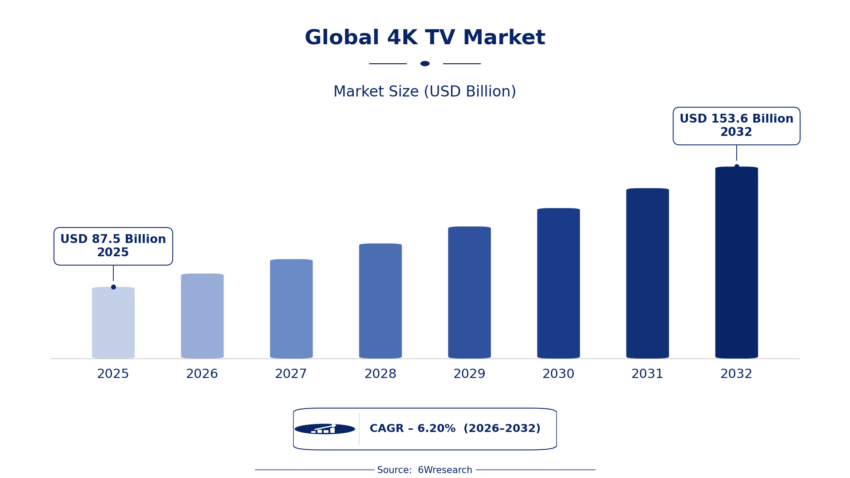
Television has moved far beyond being a simple device for watching scheduled programs. Today, it is becoming the central entertainment screen for streaming, gaming, sports, movies, smart-home applications, and digital content. The 4K TV Market is benefiting from this transformation as consumers increasingly look for sharper images, larger screens, intelligent features, and immersive viewing experiences. According to 6Wresearch, the global 4K TV market was valued at USD 87.5 billion in 2025 and is projected to reach USD 153.6 billion by 2032, growing at a CAGR of 6.20% during 2026–2032.
The Rise of the Home Entertainment Hub
Modern households are using televisions for much more than conventional broadcasting. Streaming platforms, gaming consoles, video-sharing services, sports applications, and smart-home controls have changed consumer expectations.
A 4K television offers four times the resolution of Full HD, creating sharper images and more detailed visuals. This advantage becomes particularly noticeable on larger screens. As consumers increasingly build home theaters, larger 4K displays are gaining attention.
The above-65-inch segment currently represents the largest screen-size category. Meanwhile, the 52-to-65-inch segment is expected to record strong growth as consumers search for a balance between immersive viewing and practical home-space requirements.
Streaming Is Fueling 4K Adoption
The growth of streaming services is one of the most important factors supporting 4K television demand. Consumers now expect high-quality video content to be available whenever they want it.
Streaming platforms are gradually increasing their high-resolution libraries, encouraging consumers to upgrade older televisions. The availability of 4K movies, sports broadcasts, documentaries, and original series gives consumers a stronger reason to purchase compatible displays.
This creates a powerful relationship between content providers and television manufacturers. Better displays encourage demand for high-resolution content, while more 4K content motivates households to upgrade their televisions.
OLED and QLED Raise Consumer Expectations
Display technology is another major force reshaping the industry. Manufacturers are investing in OLED, QLED, Mini LED, and other advanced display technologies to differentiate their products.
OLED televisions are known for strong contrast, deep blacks, and accurate colors because individual pixels can generate their own light. QLED technology focuses on brightness and color performance, making it attractive for consumers who watch sports, movies, and gaming content.
These technologies are turning 4K TVs into premium entertainment products rather than basic household electronics.
Gaming Creates a New Growth Avenue
Gaming is becoming increasingly important for the television industry. Modern gamers want large displays with high resolution, fast refresh rates, low input lag, and technologies that improve motion clarity.
4K televisions with gaming-oriented features can provide a more immersive experience when connected to modern consoles and high-performance PCs. As gaming becomes a mainstream entertainment activity, television brands have an opportunity to target a consumer group that values performance as much as image quality.
Asia-Pacific Remains a Market Powerhouse
Asia-Pacific holds the largest regional share of the global 4K TV market. The region benefits from a strong electronics manufacturing ecosystem, large consumer populations, expanding urbanization, and established television brands.
Countries such as China, India, Japan, and other Asian economies represent important demand centers. Local manufacturing capabilities and competitive pricing also support wider product availability.
At the same time, Latin America presents attractive expansion opportunities. 6Wresearch identifies LATAM as the fastest-growing region, supported by rising disposable incomes and growing availability of affordable 4K models.
Challenges Still Matter
Despite strong opportunities, the market faces obstacles. Premium 4K televisions can remain expensive, particularly when equipped with advanced OLED, QLED, or large-screen technologies.
Another challenge is the availability of native 4K content. Consumers may hesitate to pay a premium for a television if much of the content they watch remains available at lower resolutions.
Manufacturers and streaming platforms therefore need to work together to improve both affordability and content availability.
What Comes Next?
The future of 4K television is likely to be increasingly intelligent. AI-powered recommendations, voice controls, personalized interfaces, smart-home connectivity, and automated picture optimization can transform the television into an interactive household hub.
The market is therefore moving from a hardware-focused model toward an ecosystem approach involving devices, content, software, gaming, and digital services.
Who We Are
About 6Wresearch: It is a commercial strategy and growth advisory firm founded in 2011 and headquartered in New Delhi, India, with partners across Southeast Asia and the Middle East & Africa. The firm has delivered over 20,000 commercial engagements for over 2,000 organizations, including Fortune 500 companies, government agencies, and multilateral institutions such as the World Bank and the Asian Development Bank. 6Wresearch combines proprietary intelligence, advanced analytics, and sector expertise to help organizations navigate market complexity and drive sustainable growth. These capabilities explain why organizations trust 6Wresearch for reliable commercial insights and confident decision-making.
Our Proprietary Platform: 6W Export GTM
6W Export GTM is 6Wresearch’s proprietary trade intelligence and go-to-market platform, built on UN Comtrade data and enhanced with 6Wresearch’s in-house analytical and simulation models, including system dynamics-based forecasting. Unlike broad, sector-level market sizing tools, 6W Export GTM operates at the individual product level down to specific HS codes and micro-segments to identify precise, actionable export opportunities by country and product pair, including markets where trade currently does not exist. This granular, simulation-driven approach allows 6W Export GTM to surface opportunities that sector-wide analysis typically misses, positioning it among a small number of platforms globally offering this depth of product-and-country-specific export intelligence.