
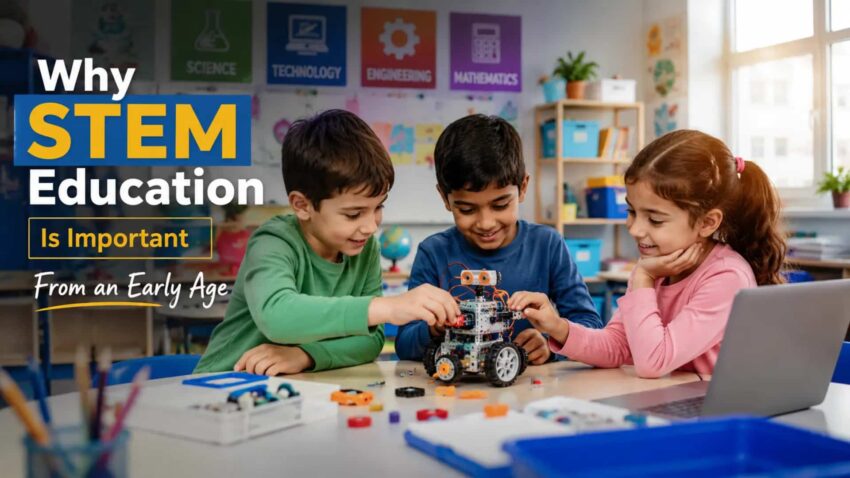
Children are naturally curious. They ask questions, experiment with objects, build things, take them apart, and try again when something does not work. This natural curiosity is the foundation of STEM Education. Science, Technology, Engineering, and Mathematics become much more meaningful when children can explore concepts through practical experiences rather than simply memorising information. Starting STEM learning early can help develop problem-solving, creativity, collaboration, digital literacy, and confidence that students can carry into later education and future careers.
What Is STEM Education?
STEM Education integrates Science, Technology, Engineering, and Mathematics through practical and connected learning experiences. Rather than treating each subject as an isolated area, students are encouraged to investigate questions, design solutions, test ideas, analyse results, and improve their work.
The real value of STEM is therefore not simply learning how to code or build a robot. It is about developing a mindset in which students become comfortable asking why, testing possibilities, learning from mistakes, and finding evidence-based solutions. This approach can make learning more active and help children understand how classroom knowledge connects with the world around them.
Why Start STEM Education Early?
Early childhood is an important period for developing learning habits. Young children naturally investigate their surroundings, making Early Years an ideal stage for introducing STEM through age-appropriate exploration.
Early Years STEM Education does not mean expecting young children to master advanced programming or engineering. Instead, it can involve building structures with blocks, sorting objects, observing nature, exploring cause and effect, solving simple puzzles, and experimenting with materials.
These experiences encourage children to ask questions and understand that trying, testing, and sometimes getting things wrong are normal parts of learning.
Key Benefits of STEM Education for Children
The Benefits of STEM Education extend well beyond science and mathematics. When children regularly participate in practical STEM activities, they can develop:
- Problem-solving skills: Children learn to identify problems, test possible solutions, and improve their approach.
- Critical thinking: Students learn to observe evidence, recognise patterns, and make reasoned decisions.
- Creativity: Designing and building solutions gives children opportunities to develop original ideas.
- Collaboration: Team projects encourage children to communicate, share responsibilities, and learn from others.
- Digital literacy: Technology-based activities can help students understand how digital tools and systems work.
- Confidence: Successfully testing and improving a project can help children become more comfortable with challenging tasks.
- Curiosity: STEM encourages children to continue asking questions and exploring how things work.
STEM Education and Future Career Readiness
Technology is transforming industries through artificial intelligence, robotics, automation, smart infrastructure, environmental technology, and digital systems. Children entering today’s classrooms will eventually work in an economy that may look significantly different from the one adults know today.
This makes STEM Education for schools increasingly relevant. The goal is not to predict exactly which jobs children will have in the future. Instead, schools can build transferable skills that remain valuable as technologies and careers change.
A child who learns how to investigate why a structure collapsed can later apply the same problem-solving process to an engineering challenge. A student who learns to analyse sensor data can eventually apply analytical thinking to environmental science, healthcare, robotics, or another emerging field.
What Strong STEM Education Programs Look Like
Effective STEM Education programs should develop progressively as students grow. Early learners can focus on curiosity, observation, construction, and simple experimentation. Primary students can move into introductory coding, robotics, electronics, and engineering challenges. Older learners can progress toward AI, IoT, advanced robotics, scientific research, and independent engineering projects.
The important factor is progression. A strong programme should not simply repeat the same activity for every age group. Instead, each stage should build on the skills developed previously.
Teacher preparation is equally important. STEM equipment alone does not guarantee meaningful learning. Teachers need to understand how to facilitate investigation, ask useful questions, guide projects, and help students reflect on what they discovered.
How Parents Can Encourage STEM Learning at Home
Parents do not need to be engineers or technology specialists to support STEM development. Everyday activities can encourage the same investigative mindset used in school.
Parents can ask children questions such as, “What do you think will happen if we change this?” or “Why do you think that happened?” Simple building activities, puzzles, pattern games, nature observations, cooking experiments, and everyday technology discussions can all encourage curiosity.
Most importantly, mistakes should be treated as opportunities to learn. When children understand that an unsuccessful attempt provides information, they become more willing to experiment and try again.
Choosing the Right STEM Approach for Schools
For schools, selecting a STEM programme requires looking beyond equipment. Curriculum alignment, teacher training, age-appropriate activities, practical learning, assessment, and long-term programme development all influence whether STEM creates meaningful outcomes.
A strong STEM programme should help students move from guided exploration toward independent problem-solving. It should also connect classroom activities with real-world challenges, so students understand why their learning matters.
How MH Intellect Supports STEM Learning
MH Intellect supports schools with structured STEM learning experiences designed to help students develop practical skills from Early Years through Secondary School. Its approach can include robotics, coding, AI, IoT, engineering, STEM labs, teacher training, and project-based learning.
The focus is on creating learning environments where students do more than consume technology. They learn to question, design, experiment, troubleshoot, and develop solutions.
Final Thoughts
Starting STEM Education early is not about turning young children into engineers before they are ready. It is about protecting and developing their natural curiosity while giving them structured opportunities to investigate, build, test, and solve problems. The earlier these habits develop, the stronger the foundation students can carry into primary school, secondary education, higher education, and future careers.
For schools looking to develop a progressive STEM learning pathway, book a consultation with MH Intellect to explore customised STEM Education programs, robotics, coding, AI, engineering, and hands-on learning solutions designed around your school’s educational goals.