
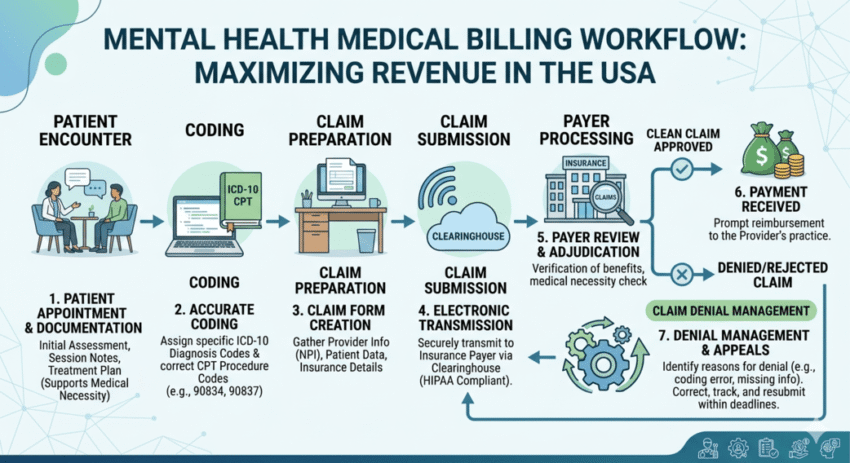
Mental health practices across the USA are experiencing a steady rise in demand, but along with growth comes a complex web of administrative responsibilities. Among these, billing remains one of the most challenging and time-consuming tasks. From handling insurance claims to ensuring compliance with ever-changing regulations, providers often struggle to maintain accuracy while focusing on patient care.
This is where mental health billing solutions play a critical role. Whether you are an independent therapist, a group practice, or a behavioral health organization, the right billing approach can directly impact your revenue and operational efficiency.
Understanding Mental Health Billing in Today’s Landscape
Mental health billing is not as straightforward as general medical billing. It involves specific codes, therapy session documentation, and insurance nuances that differ from other specialties.
A reliable mental health medical billing solution ensures:
- Accurate claim submission
- Faster reimbursements
- Reduced claim denials
- Compliance with insurance policies
Without proper systems in place, even small errors can lead to delayed payments or rejected claims.
Why Mental Health Practices Need Specialized Billing Support
Unlike general healthcare, mental health services often include:
- Therapy sessions (individual, group, family)
- Telehealth consultations
- Long-term treatment plans
- Insurance pre-authorizations
A mental health billing specialist understands these complexities and ensures that every claim is submitted correctly.
Common Challenges Faced by Providers
- Incorrect CPT and ICD coding
- Frequent claim rejections
- Insurance verification delays
- Documentation errors
- Time-consuming follow-ups
These issues not only affect cash flow but also increase administrative burden.
The Role of Mental Health Insurance Billing Services
Insurance billing is at the core of revenue generation for most practices. Professional mental health insurance billing services handle the entire claim lifecycle.
Key Functions Include:
- Insurance eligibility verification
- Claim preparation and submission
- Denial management
- Payment posting
- Patient billing
By outsourcing these tasks, providers can focus more on delivering quality care rather than dealing with paperwork.
Benefits of Outsourced Mental Health Billing
More practices are choosing to outsource mental health billing services to improve efficiency and reduce costs.
Why Outsourcing Works
1. Improved Accuracy
Experienced teams minimize coding and billing errors.
2. Faster Reimbursements
Claims are processed quickly with fewer rejections.
3. Cost Savings
No need to hire and train in-house staff.
4. Scalability
Easily adapt as your practice grows.
5. Compliance Assurance
Stay updated with healthcare regulations.
An outsourced mental health billing model allows providers to operate more efficiently without compromising financial performance.
Choosing the Best Mental Health Billing Agency
Finding the best mental health billing agency requires careful evaluation. Not all providers offer the same level of expertise or transparency.
What to Look For:
- Experience in behavioral health billing
- Certified billing and coding professionals
- Transparent pricing structure
- Strong denial management process
- Use of advanced billing software
A trusted mental health billing services agency should act as a strategic partner rather than just a service provider.
Mental Health Billing and Coding: Why Accuracy Matters
Billing and coding go hand in hand. Even a minor coding error can result in claim denial.
Professional mental health billing and coding company services ensure:
- Correct CPT and ICD-10 code usage
- Compliance with payer guidelines
- Proper documentation alignment
This is where medical coding services become essential. Accurate coding not only speeds up reimbursement but also protects your practice from audits.
Tailored Billing Services for Mental Health Providers
Every mental health practice is unique. A one-size-fits-all approach doesn’t work.
Customized billing services for mental health providers are designed based on:
- Practice size
- Patient volume
- Type of services offered
- Insurance mix
Similarly, billing services for mental health therapists focus on individual practitioners who need flexible and cost-effective solutions.
How Mental Health Billing Companies Improve Revenue Cycle
Revenue cycle management is more than just billing. It includes every step from patient registration to final payment.
Leading mental health billing companies optimize the entire workflow:
Key Revenue Cycle Stages:
- Patient scheduling and registration
- Insurance verification
- Charge capture
- Claim submission
- Payment posting
- Denial management
- Reporting and analytics
Professional revenue cycle management services ensure that no revenue opportunity is missed.
The Rise of Outsourcing in Behavioral Health Billing
The demand for mental health medical billing services outsourcing has grown significantly in recent years.
Why This Trend is Growing:
- Increased patient load
- Complex insurance requirements
- Need for digital transformation
- Shortage of skilled in-house staff
Partnering with a top outsource mental health billing company helps practices stay competitive while maintaining financial stability.
Real-World Example: Small Practice to Scalable Growth
Consider a small therapy clinic struggling with delayed payments and claim denials. After switching to a professional mental health billing agency, they experienced:
- 40% reduction in claim denials
- 30% faster reimbursements
- Improved patient satisfaction
- More time for therapy sessions
This highlights how the right billing partner can transform a practice’s financial health.
Integrating Medical Billing and Coding Services
To maximize efficiency, many providers combine medical billing services with medical billing and coding services under one system.
Advantages of Integration:
- Seamless workflow
- Reduced administrative errors
- Better financial tracking
- Improved compliance
When paired with strong medical coding services, this integration ensures that every claim is accurate and complete.
The Importance of Credentialing Services
Before billing can even begin, providers must be properly credentialed with insurance companies.
Credentialing services help with:
- Provider enrollment
- Insurance panel approvals
- Maintaining compliance
- Updating provider information
Without proper credentialing, claims cannot be processed, making it a crucial step in the billing process.
Technology and Automation in Mental Health Billing
Modern mental health medical billing services leverage advanced technology to improve efficiency.
Key Tools Used:
- Electronic Health Records (EHR)
- Automated billing systems
- AI-based claim scrubbing
- Real-time reporting dashboards
These tools reduce manual errors and provide actionable insights for better decision-making.
How to Select the Right Mental Health Billing Partner
Choosing among various mental health billing companies can feel overwhelming.
Simple Selection Checklist:
- Do they specialize in mental health?
- Are their processes transparent?
- Can they scale with your practice?
- Do they offer end-to-end services?
A reliable partner should support both clinical and financial goals.
Building a Sustainable Billing Strategy
Long-term success depends on having a structured billing approach.
Best Practices:
- Regular audits of billing processes
- Continuous staff training
- Use of updated coding systems
- Monitoring key performance metrics
A strong strategy ensures steady revenue and operational efficiency.
Supporting Growth with the Right Billing Partner
As mental health services continue to expand across the USA, practices need dependable systems to manage their financial operations. Partnering with a trusted provider like 247 medical billing services can make a meaningful difference.
With expertise in:
- medical billing services
- medical coding services
- medical billing and coding services
- revenue cycle management services
- credentialing services
they help practices streamline operations while maintaining compliance and accuracy.
Conclusion
Mental health billing is more than just submitting claims—it’s a critical component of your practice’s success. From reducing administrative burden to improving cash flow, the right mental health billing solutions can transform how your practice operates.
Whether you choose to build an in-house team or outsource mental health billing services, the goal remains the same: accuracy, efficiency, and financial stability. By leveraging expert support, advanced technology, and strategic processes, mental health providers can focus on what truly matters—delivering quality care to their patients.
FAQs
1. What are mental health billing solutions?
Mental health billing solutions are specialized services that manage insurance claims, coding, and reimbursement processes for mental health providers, ensuring accuracy and compliance.
2. Why should I outsource mental health billing services?
Outsourcing reduces administrative workload, improves claim accuracy, speeds up reimbursements, and allows providers to focus more on patient care.
3. How do mental health billing specialists help practices?
A mental health billing specialist ensures correct coding, handles claim submissions, manages denials, and optimizes the revenue cycle.
4. What is included in mental health insurance billing services?
These services typically include eligibility verification, claim submission, payment posting, denial management, and patient billing.
5. How do billing services for mental health therapists differ from general billing?
They are tailored specifically for therapy-based services, including session-based billing, telehealth claims, and behavioral health coding requirements.
6. What should I look for in a mental health billing agency?
Look for experience in behavioral health, certified professionals, transparent processes, strong denial management, and scalable solutions.