
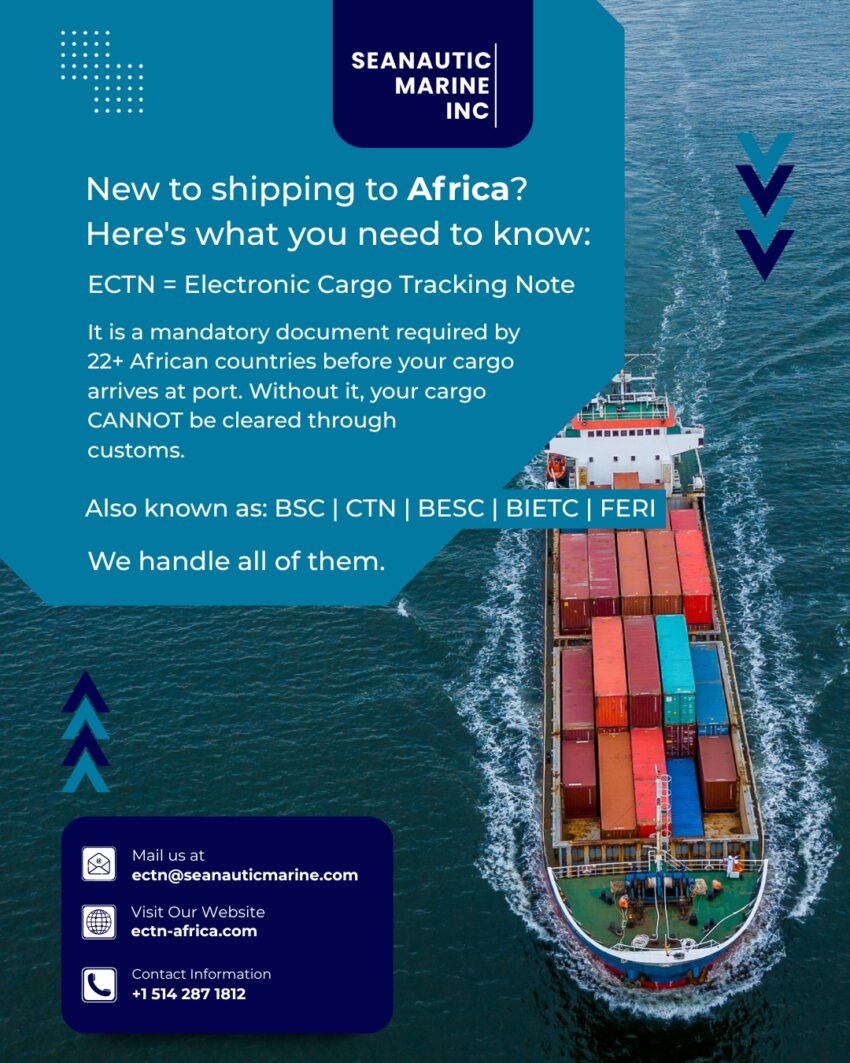
Global trade routes into Africa are expanding, and with that growth comes greater regulatory scrutiny at ports and border crossings. For freight forwarders, customs brokers, and importers managing shipments into East and Central Africa, the Electronic Cargo Tracking Note (ECTN) remains one of the most critical compliance documents in the pre-shipment checklist. Getting it wrong — or missing it entirely — can bring an entire supply chain to a halt.
This guide focuses on the ECTN framework as it applies to key destinations, with particular focus on South Sudan and two Central African nations that frequently appear in multi-country supply chain routes.
Understanding the ECTN in the African Trade Context
African governments introduced the ECTN system to strengthen customs revenue collection, reduce under-invoicing and trade fraud, and improve cargo visibility across their ports and borders. The certificate captures essential cargo data — origin, destination, commodity, declared value, container or packaging details, and party information — and must be issued by an authorised agent prior to loading at the origin port.
This “prior to loading” requirement is the detail that catches many first-time shippers off guard. The ECTN is not a document you can arrange upon arrival. It must be in place, validated, and the certificate number must appear on the bill of lading before the ship leaves the port of origin. Any cargo arriving at an ECTN-mandatory destination without this documentation faces immediate detention by customs.
South Sudan: One of Africa’s Youngest Nations and Its ECTN Requirements
South Sudan gained independence in 2011 and has since been working to establish functioning trade infrastructure and customs procedures. As part of its efforts to formalise import controls, the country requires an ECTN South Sudan certificate for all commercial cargo destined for the nation.
Given South Sudan’s landlocked geography, most imports arrive overland via Kenya (through the Port of Mombasa) or Uganda. However, the ECTN obligation is triggered at the maritime origin — meaning shippers loading cargo at any port worldwide, whether in Asia, Europe, or the Americas, must obtain the South Sudan ECTN before the vessel departs. The certificate accompanies the goods through the entire transit corridor until customs clearance is completed at the final destination.
South Sudan’s trade infrastructure continues to develop, and customs enforcement at entry points has become progressively more rigorous. Freight forwarders who have not previously shipped to the country should work with an experienced, authorised ECTN provider to ensure full compliance from the outset.
Burkina Faso’s Transit Complexity and Why Pre-Shipment Compliance Matters
Burkina Faso presents a particularly interesting compliance scenario because goods destined for the country must transit through one of several West African coastal ports before making the overland journey to Ouagadougou and other inland destinations. The major transit ports serving Burkina Faso include Abidjan (Ivory Coast), Lomé (Togo), Tema (Ghana), and Cotonou (Benin).
Regardless of which transit corridor is used, the ECTN Burkina Faso certificate must be obtained before loading at the origin port and the CTN number must be reflected in the bill of lading. If the certificate is missing when the cargo arrives at the transit port, authorities may refuse onward transit until the situation is regularised — adding days or even weeks to the delivery timeline and triggering additional fees.
For shippers managing consolidated loads or groupage shipments destined for Burkina Faso, each consignment within a container must be properly documented. It is advisable to confirm the requirements with your ECTN service provider at the time of booking.
The Republic of Congo and Its Port-Level Enforcement
Pointe-Noire, the Republic of Congo’s main commercial port, handles significant volumes of general cargo, project cargo, and containerised goods. The port authority and customs work closely together to verify ECTN compliance on all incoming shipments. For any cargo moving to Brazzaville or other inland destinations, the ECTN Congo certificate is an absolute prerequisite for customs clearance.
The Republic of Congo’s enforcement record is strong, and importers who have experienced cargo detention at Pointe-Noire consistently cite missing or invalid ECTN documentation as a primary cause. Oil and gas sector contractors, humanitarian organisations, and commercial importers alike must adhere to the same pre-shipment documentation rules. There are no blanket exemptions for sector type or urgency of delivery.
Multi-Country Shipments: Coordinating ECTN Across Destinations
A common challenge for regional distributors and project cargo operators is managing shipments that touch multiple ECTN-mandatory countries on a single voyage. Each destination country requires its own separate ECTN certificate — there is no single document that covers all nations simultaneously. This means that if a vessel is making port calls in, for example, Togo, Cameroon, and Congo in a single voyage, each national consignment requires its own valid ECTN obtained before departure.
Working with a single, experienced provider that covers all relevant African nations simplifies this process considerably. Seanautic Marine / ECTN-Africa handles ECTN applications for more than 20 countries, allowing freight forwarders to manage all certificates through a single point of contact. This reduces administrative burden, speeds up processing, and ensures consistent document standards across all destination countries.
Best Practices for ECTN Compliance in Your Pre-Shipment Workflow
Building ECTN compliance into the standard pre-shipment workflow is the most effective way to avoid delays. The steps are straightforward: gather the required shipping documents as soon as the shipment is confirmed, submit them to your ECTN provider immediately, obtain the CTN number before finalising the bill of lading, and ensure the certified ECTN is filed before the vessel sails.
Experienced freight forwarders build ECTN turnaround time into their booking schedules as a standard line item — not an afterthought. The processing timeline for most standard shipments is 24 to 48 business hours once complete documentation is submitted, but factoring in time for document collection and any clarifications means initiating the process at least three to five working days before the intended sailing date is prudent.
Frequently Asked Questions
1. Which African countries currently require an ECTN?
More than 20 African countries currently mandate some form of cargo tracking note, including Burkina Faso, South Sudan, the Republic of Congo, the Democratic Republic of Congo, Cameroon, Togo, Benin, Mali, Niger, Senegal, Ivory Coast, Gabon, Angola, and others. The list is subject to change as more countries adopt or revise their cargo tracking regulations, so always verify current requirements with your service provider.
2. What happens if the ECTN number is not on the bill of lading?
If the CTN number is missing from the bill of lading, the cargo may be detained at the destination port or transit point. The shipment cannot be cleared through customs until a valid ECTN is obtained and presented. In many cases, retroactive certification is possible but attracts additional penalty fees.
3. Is the ECTN required for air freight shipments?
The ECTN requirement applies primarily to sea freight. However, some countries have equivalent cargo tracking requirements for air freight under different names. It is important to verify requirements for your specific mode of transport and destination country before shipment.
4. Can one ECTN cover multiple containers in the same booking?
Generally, a single ECTN can cover multiple containers under one bill of lading to the same destination. However, each consignee and destination combination typically requires a separate certificate. Your ECTN provider will confirm the appropriate structure based on the booking and country requirements.
5. How does Seanautic Marine ensure confidentiality of shipment data?
Seanautic Marine / ECTN-Africa operates under a strict confidentiality policy. Shipment details, commercial values, and party information submitted for ECTN processing are used exclusively for the purpose of issuing the certificate and are not shared with any third parties beyond the mandatory submission to the relevant customs authority of the destination country.