
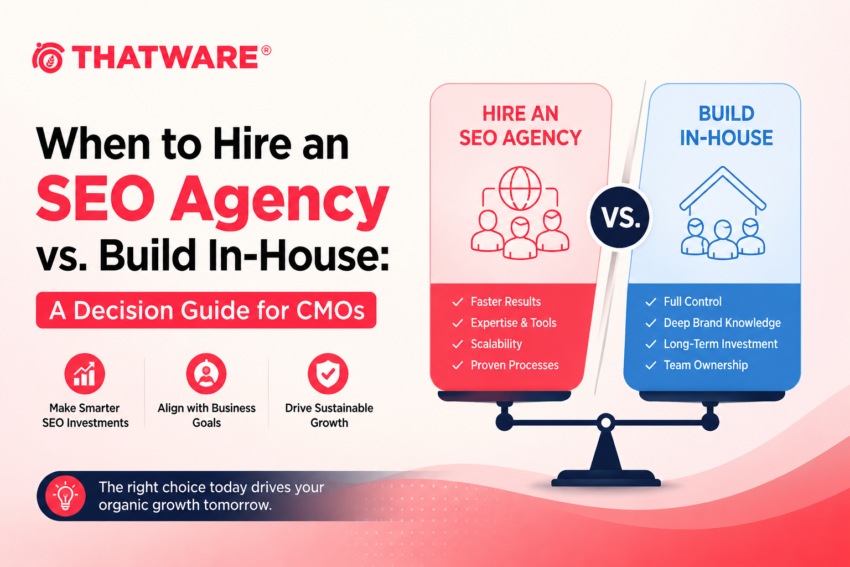
Introduction
For many CMOs and marketing leaders, SEO decisions have become more complicated than ever. The rise of AI-driven search, generative results, and shifting ranking systems has created a gap between traditional SEO knowledge and what is now required to compete.
On top of that, leaders are often expected to make high-stakes decisions without deep technical backgrounds. The real challenge is not just choosing between vendors, but deciding whether to build capabilities in-house or partner with an external SEO agency.
This guide is designed to help non-technical decision makers evaluate that choice with clarity and confidence, without getting lost in jargon or overcomplicated frameworks.
Start With the Business Problem, Not the Structure
One of the most common mistakes CMOs make is starting the conversation with structure instead of outcomes. The debate often becomes “agency vs in-house” before clearly defining what needs to be solved.
That approach creates confusion because both models can work, depending on the problem.
A better starting point is the business challenge itself.
Are you seeing a decline in organic traffic because AI Overviews are capturing visibility?
Are competitors appearing in ChatGPT or Gemini responses while your brand is missing?
Is your content not being recognized in AI-driven search environments even though your traditional SEO is stable?
Once the problem is clearly defined, the decision becomes much easier. You are no longer comparing service models. You are evaluating which system can solve a specific outcome.
The Reality of In-House SEO Teams
Building an in-house SEO team often feels like the most controlled and cost-effective option. You hire people directly, you build internal knowledge, and you maintain full ownership of strategy.
In practice, it is not always that simple.
Modern AI SEO requires a combination of skills that are difficult to find in a single team. Technical SEO, entity optimization, content architecture, data analysis, and AI search visibility all need to work together.
Most in-house teams end up strong in one area but weak in others. For example, they may be excellent at content creation but lack technical depth in structured data or knowledge graph optimization.
Another challenge is speed. Hiring, training, and scaling an internal team takes time. In fast-moving AI search environments, that delay can create missed opportunities.
This does not mean in-house SEO is ineffective. It simply means it works best when the problem is stable, predictable, and already well understood internally.
When an SEO Agency Becomes the Better Option
Agencies are often the better choice when speed, specialization, and scale matter.
A strong SEO agency brings experience from multiple industries and search environments. They have already tested strategies across different markets and understand what works in AI-driven search ecosystems.
More importantly, they bring systems that are already built. Instead of hiring and training, you are plugging into an existing infrastructure.
This becomes especially valuable when:
- Your visibility is declining in AI-generated search results
- You are entering competitive markets quickly
- Your internal team lacks technical SEO depth
- You need faster execution without long hiring cycles
The key advantage is not just expertise, but readiness.
Evaluating the Decision Through a Simple Lens
A practical way to approach the decision is to ask one question:
Do we need to build capability, or do we need to solve a problem immediately?
If the answer is capability building, in-house investment makes sense.
If the answer is immediate performance improvement, an agency is usually the better fit.
Many organizations actually need both. A hybrid model, where agencies handle strategy and technical execution while internal teams focus on content and brand alignment, is becoming increasingly common.
How to Evaluate an SEO Agency Properly
If you decide to explore external partners, evaluation becomes the most important step.
Not all agencies operate at the same level. Some are deeply technical and AI-native, while others simply package traditional SEO with modern branding.
This is where structured comparison becomes essential.
A proper AI SEO agency comparison helps CMOs understand differences in methodology, infrastructure, and AI search capabilities rather than just pricing or presentation quality.
Instead of focusing on sales decks, the goal should be to evaluate how agencies actually think.
The Plain Language Test Every CMO Should Use
One of the simplest ways to evaluate any agency is by testing clarity.
Ask them to explain how they would improve your visibility in AI search results without using jargon.
If they truly understand their craft, they will be able to explain it clearly.
If they rely heavily on buzzwords, abstraction, or vague terminology, it often signals a lack of depth.
Clear thinking always leads to clear communication. Confusion is usually a warning sign, not a complexity indicator.
Asking Better Questions Changes Everything
Another important factor is what questions the agency asks you.
Strong agencies start with discovery. They want to understand your business model, customers, content systems, and previous SEO performance before offering solutions.
Weak agencies often lead with a pitch instead of curiosity.
This difference matters more than most decision makers realize. The quality of questions often reflects the quality of strategy that follows.
Proof Matters More Than Promises
Every agency can show success stories. The real question is whether those stories are relevant to your situation.
Instead of asking for generic case studies, CMOs should look for:
- Industry-specific examples
- AI search visibility improvements
- Revenue-linked SEO outcomes
- Real client references with similar challenges
It is also worth asking about failures. Agencies that can openly discuss what did not work are usually more reliable than those that only highlight success.
Measurement Is Where Most Decisions Break
SEO becomes difficult when measurement is unclear.
Traditional metrics like rankings and traffic still matter, but they are no longer enough in AI-driven search environments.
A good agency should clearly explain what success looks like in practical terms.
For example:
- What will improve in 3 to 6 months
- How visibility in AI search will change
- How performance connects to leads or revenue
- How failure will be identified early
If an agency cannot answer these questions clearly, accountability becomes a risk.
In-House vs Agency SEO Is Not a Fixed Debate
The decision is not permanent. It evolves as your organization grows.
Early-stage teams often benefit from agencies because they need speed and expertise. Mature organizations often shift toward in-house teams once systems are established.
A more practical framework is to view this as a progression rather than a binary choice.
Many companies use agencies to build foundation and later transition knowledge internally.
For a deeper understanding of this evolving model, this resource on in-house vs agency SEO provides additional perspective on how organizations structure their SEO capabilities over time.
Making the Final Decision With Confidence
Once you have evaluated both paths, the final decision usually becomes clearer.
The right choice is rarely the loudest pitch or the most impressive presentation. It is the option that aligns with your business reality, your internal capability, and your growth timeline.
CMOs should trust structured evaluation over instinct alone, but intuition still plays a role. How a team communicates, how they handle uncertainty, and how they respond to questions often reveals more than any proposal document.
Final Thoughts
Choosing between building in-house SEO and hiring an agency is not just an operational decision. It is a strategic one that affects visibility, revenue, and long-term brand positioning in AI-driven search environments.
A thoughtful evaluation process reduces risk and improves outcomes. Whether you choose internal development or external support, clarity of problem definition remains the most important factor.
When organizations take the time to properly evaluate partners, the decision becomes less about guesswork and more about alignment.
That is where experienced partners like ThatWare often stand out. With a focus on transparent methodology, AI-first SEO systems, and measurable business outcomes, Thatware helps organizations navigate both agency collaboration and long-term SEO strategy with clarity and confidence.