
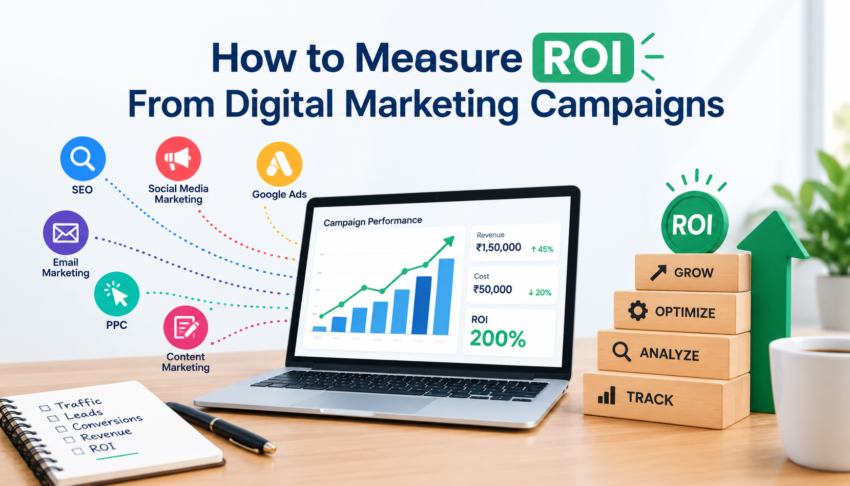
Digital marketing can generate thousands of impressions, clicks, website visits, and social media interactions. But none of these numbers automatically mean a business is making money. The more useful question is simple: what did the marketing actually return compared with what was spent?
For businesses working with a digital marketing company kolkata, measuring return on investment (ROI) means connecting marketing activity to real outcomes such as leads, sales, bookings, enquiries, or revenue. The process starts with clear goals, accurate tracking, and realistic expectations—not simply looking at whichever number on the dashboard is the largest.
Start With the Question That Actually Matters: What Is the Goal?
Before calculating ROI, a business needs to define what success means.
An ecommerce company may care about completed purchases. A local service provider may care about qualified enquiries or phone calls. A B2B company may measure demo requests, quotation requests, or sales-qualified leads.
These goals require different measurements.
For example, 1,000 website visitors may be valuable for one campaign but almost meaningless for another if those visitors do not take the intended action.
The first step is therefore to establish one or more measurable conversion goals before launching the campaign.
Revenue Comes First When You Want to Calculate ROI
The basic ROI calculation is straightforward:
ROI = (Return − Marketing Cost) ÷ Marketing Cost × 100
For example, if a business spends ₹20,000 on a campaign and generates ₹60,000 in attributable revenue, the calculation would be:
(₹60,000 − ₹20,000) ÷ ₹20,000 × 100 = 200%
The calculation becomes more complicated when a customer interacts with several channels before purchasing. That is why businesses should avoid assuming that the last click automatically deserves all the credit.
The objective is to create a reasonable measurement system that reflects the actual customer journey.
A B2B Example: From One Lead to an Actual Customer
B2B marketing shows why looking only at lead volume can be misleading.
Imagine an industrial equipment company spends ₹30,000 on pay per click campaign activity during one month. The campaign generates 40 enquiries.
At first glance, 40 leads may look like a strong result. But after the sales team reviews them, only 12 are genuinely relevant businesses. Of those, five request detailed quotations, three enter serious discussions, and one eventually places an order worth ₹1.5 lakh.
Now the business has a much clearer picture.
The campaign generated 40 enquiries, but only one became a customer. Instead of celebrating the lead count alone, the company can examine its cost per qualified lead, cost per sales opportunity, and ultimately its customer acquisition cost.
If the ₹30,000 marketing investment contributed to a ₹1.5 lakh sale, the business can then assess the return against its actual marketing and sales costs.
This is particularly important for B2B companies because the journey from first enquiry to signing a contract can take weeks or months. A lead should not automatically be treated as revenue.
Don’t Confuse ROAS With ROI
These two terms are often used interchangeably, but they are not exactly the same.
Return on ad spend, or ROAS, looks specifically at revenue generated relative to advertising spend.
ROI is broader because it can include the wider costs involved in producing the return.
For example, a business may spend money on advertising as well as agency fees, creative production, software, landing-page development, and other marketing expenses.
This distinction becomes particularly important when evaluating a PPC digital marketing campaign. A campaign may show an attractive ROAS while the overall marketing activity produces a smaller profit after other costs are considered.
Track What Happens After the Click
A digital campaign does not end when someone clicks an advertisement.
The visitor still needs to take action.
Depending on the business, that might be:
- Completing a contact form
- Calling the business
- Purchasing a product
- Booking an appointment
- Requesting a quotation
- Downloading a resource
- Signing up for a service
Conversion tracking allows businesses to connect these actions back to their marketing campaigns.
Without proper tracking, a company may know that an advertisement generated traffic but have little confidence about whether that traffic generated actual business.
PPC Can Be Measured More Directly
Paid advertising often provides detailed campaign data, making it possible to monitor spending, clicks, conversions, and cost per conversion.
A business running SEO Digital marketing campaigns can compare different advertisements, keywords, audiences, and landing pages to identify where the budget is producing useful results.
For example, imagine two campaigns each receive 100 clicks.
Campaign A generates two enquiries.
Campaign B generates eight.
Looking only at clicks would make both campaigns appear identical. Looking at conversions provides a much more useful picture.
The next step is to determine whether those eight enquiries are actually qualified and whether they eventually generate revenue.
SEO ROI Requires More Patience
SEO is different from paid advertising because the investment and return often happen over different time periods.
A business may spend money today on content, technical improvements, an on page seo audit, or authority-building work, while the resulting organic traffic develops over months.
That does not make SEO impossible to measure. It simply means the measurement window needs to be longer.
Businesses can track changes in organic traffic, rankings, qualified leads, conversions, and revenue from organic search over an appropriate period.
An seo agency in Kolkata can also help connect SEO reporting with business metrics rather than presenting rankings as the only measure of success.
Social Media Metrics Need a Reality Check
Likes, shares, followers, and comments can be useful indicators of audience engagement, but they are not automatically financial returns.
A social media campaign becomes easier to evaluate when it has a measurable objective.
For example, a campaign might aim to generate website visits, enquiries, product sales, or registrations.
Businesses working with social media marketing agencies should therefore distinguish between awareness metrics and conversion metrics.
A post receiving 50,000 views may be useful for brand awareness, while another receiving 5,000 views could potentially generate more enquiries. The appropriate metric depends on the campaign objective.
Content Marketing Has Both Immediate and Long-Term Value
Content can contribute to marketing ROI in several ways.
A useful article may attract organic traffic, support a sales conversation, answer customer questions, or continue generating visits long after publication.
A content marketing agency can therefore be evaluated through more than the number of articles published.
Businesses can examine metrics such as organic visits to content, engagement, assisted conversions, leads generated, and the number of relevant enquiries influenced by that content.
Not every article will directly produce a sale, and expecting every piece of content to do so can lead to poor decisions.
Email Marketing Is Easier to Measure When the Journey Is Clear
Email campaigns can provide useful performance data because businesses can track delivery, opens, clicks, and actions taken after the email.
However, opening an email is not the same as becoming a customer.
A properly structured email marketing campaign should have a clear objective and a measurable next step, whether that is visiting a product page, booking a call, completing a purchase, or responding to an offer.
The most useful measurement connects the email interaction with the final business outcome.
Look at Cost Per Lead and Cost Per Customer
For lead-generation businesses, revenue may not happen immediately after someone fills out a form.
That makes cost per lead an important intermediate metric.
Suppose a campaign spends ₹10,000 and generates 50 enquiries. The cost per lead is ₹200.
But if only five of those enquiries become customers, the business also needs to understand its cost per acquired customer.
This distinction prevents businesses from celebrating a large number of low-quality leads that produce little actual revenue.
Attribution Is Useful, But It Isn’t Perfect
A customer may discover a brand through Google, return through social media, read an article, and finally make a purchase after receiving an email.
Which channel deserves credit?
There is no single attribution model that perfectly represents every customer journey.
Businesses should therefore treat attribution as a measurement framework rather than an absolute truth. Looking at multiple sources of data can provide a more realistic picture than assigning all revenue to the final interaction.
Make Reporting About Decisions, Not Just Numbers
A useful digital marketing report should answer practical questions:
What did we spend?
What did we get?
Which channel generated meaningful results?
Which campaign produced qualified leads?
Where was money potentially being wasted?
What should we test next?
A digital marketing company Kolkata should ideally make reporting understandable enough for a business owner to connect marketing performance with actual business decisions.
Final Takeaway
Measuring digital marketing ROI is ultimately about connecting marketing activity with business outcomes.
Clicks, impressions, followers, rankings, and engagement can all provide useful context, but they should not automatically be treated as revenue. The stronger approach is to define conversion goals, track customer actions, calculate costs carefully, and evaluate results over an appropriate time period.
Whether the campaign involves PPC, SEO, social media, content, or email, the goal remains the same: understand what the marketing investment is producing and use that information to make the next decision more intelligently.
For businesses working with a digital marketing company in Kolkata, transparent measurement should be a central part of the strategy—not something added only at the end of a campaign.