
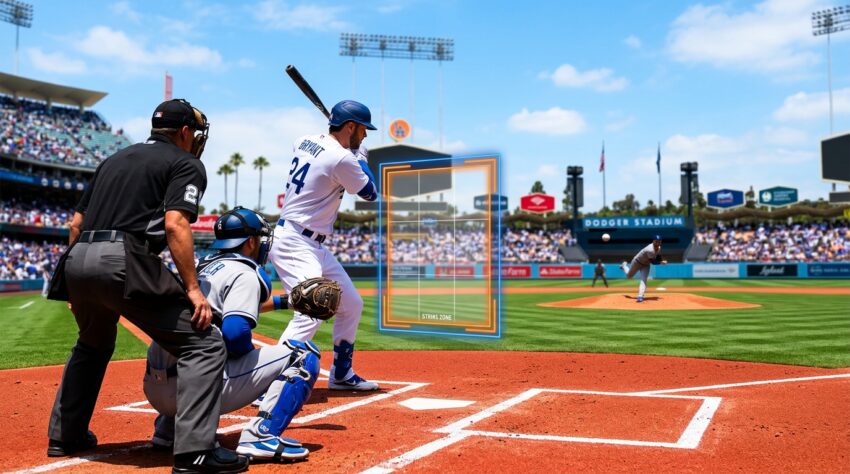
For many pitchers, the difference between a dominant outing and a frustrating collapse often comes down to a matter of inches. Whether it is a high school prospect or a professional vying for a spot in the rotation, the ability to consistently “paint the black” is the ultimate separator. However, most athletes practice with a standard white home plate that offers no visual feedback, forcing the brain to calculate a three-dimensional strike zone from over 60 feet away with zero guidance.
The reality of modern baseball is that “close enough” no longer wins games. With the full implementation of the Automated Ball-Strike (ABS) system in 2026, the margin for error has vanished. Players who rely on a plain plate during bullpen sessions are essentially training in the dark. Without the specific lanes and visual markers provided by a tool like the Tag Sports Gear strike zone home plate, pitchers often default to “safe” throws toward the center, failing to develop the precision required for elite-level command.
The Cognitive Load of an Imaginary Strike Zone
Pitching is as much a neurological challenge as it is a physical one. When a pitcher stands on the rubber, their brain must process a massive amount of data: wind speed, batter stance, and the distance to the catcher’s mitt. Without a strike zone home plate, the brain is also tasked with projecting an imaginary 17-inch-wide box in mid-air. This increased cognitive load can lead to decision fatigue, causing a pitcher’s mechanics to break down as the game progresses.
Research into visual perception suggests that the human eye performs significantly better when it has a “visual anchor” to lock onto. A standard home plate is a flat, uniform object that blends into the dirt, offering no specific targets for the inner or outer corners. By providing color-coded lanes, a specialized training plate allows the pitcher to externalize their focus. Instead of thinking about their elbow angle or stride length, they can focus entirely on the green, yellow, or orange zones, which simplifies the mental process and leads to more repeatable results.
| Feature | Standard Home Plate | Strike Zone Training Plate |
| :— | :— | :— |
| Visual Feedback | None; uniform white surface | Color-coded lanes (Green, Yellow, Orange) |
| Spatial Reference | Imaginary 3D box projection | Defined physical markers for corners |
| Mental Focus | Internal (mechanics-heavy) | External (target-oriented) |
| Command Support | High cognitive load | Lowers mental strain via visual anchors |
Overcoming the “Middle-Out” Muscle Memory Trap
One of the biggest hurdles to pitching consistency is the “middle-out” bias. When practicing on a standard plate, the center of the plate is the most prominent visual feature. Over time, muscle memory naturally gravitates toward this center point because it is the safest place to throw a strike. This creates a dangerous habit where a pitcher’s “misses” end up in the heart of the plate, leading to high exit velocities and home runs when facing elite hitters.
A strike zone home plate disrupts this bias by forcing the pitcher to acknowledge the edges of the zone on every single repetition. By highlighting the “lanes” of the plate, the Tag Sports Gear model trains the athlete to view the strike zone as a collection of specific targets rather than one large target. This granular focus ensures that when a pitcher misses their spot by a few inches, the ball is more likely to miss outside the zone for a ball rather than inside the zone for a “cookie” down the middle.
- Edge Awareness: Constant exposure to colored lanes builds a subconscious “map” of the plate’s borders.
- Error Correction: Pitchers can immediately see how many “balls” wide they missed based on the plate’s markings.
- Target Segmentation: Helps pitchers distinguish between the “shadow zone” and the “heart of the plate.”
- Repetitive Precision: Encourages high-quality repetitions that prioritize corner accuracy over velocity alone.
Calibrating for the 2026 Automated Ball-Strike (ABS) Era
As of June 2026, the landscape of professional and amateur baseball has shifted permanently with the widespread adoption of the Automated Ball-Strike system. The 2026 season has already seen a staggering 54% overturn rate on challenged ball-strike calls, proving that even the most experienced human umpires and catchers struggle to judge borderline pitches accurately. For pitchers, this means that the “mercy strike” on a ball two inches off the plate is a thing of the past.
Training with a strike zone home plate is no longer a luxury; it is a necessity for survival in a tech-driven game. The ABS system uses Hawk-Eye technology to measure the ball as it crosses the midpoint of the plate with 100% objectivity. If a pitcher has not calibrated their internal sights to the exact 17-inch width of the plate during practice, they will find themselves falling behind in counts constantly. Using a plate with defined lanes allows players to simulate the exact precision that the ABS sensors are looking for.
- Objective Training: Matches the “black and white” nature of the 2026 electronic strike zone.
- Challenge Preparation: Helps pitchers understand which of their “borderline” pitches are actually strikes before they waste a challenge.
- Narrower Focus: Discourages the reliance on “framing” by catchers, as the tech ignores catcher movement.
- Statistical Edge: Data from the 2026 season shows that pitchers who train with visual aids maintain a 4% higher first-pitch strike rate.
Biomechanical Alignment and Spatial Awareness
Consistency in pitching is the result of a repeatable delivery where every part of the kinetic chain fires in the same sequence. However, many pitchers struggle with their alignment because they lack a physical reference point for their stride. If a pitcher’s foot lands slightly closed or open, their release point shifts, causing the ball to sail. A strike zone home plate provides a visual line of sight that helps a pitcher align their body to the specific lane they are targeting.
Spatial awareness, or proprioception, is the body’s ability to sense its position in space. When a pitcher uses the colored lanes on a Tag Sports Gear plate, they aren’t just looking at a target; they are training their body to align with that target. By seeing the relationship between their front foot landing and the orange “outside” lane, they can make real-time mechanical adjustments. This feedback loop is essential for fixing “wildness” and ensuring that the arm path and release point stay on the desired plane.
- Stride Alignment: Use the center lane as a guide for the lead foot’s landing spot.
- Release Point Calibration: Visualizing the ball’s flight path into a specific colored lane helps stabilize the arm slot.
- Glove-Side Integrity: A clear target at the plate prevents the glove arm from “flying open” too early.
- Balance Maintenance: Reduces the tendency to “fall off” the mound by providing a straight-line visual path to the plate.
Practical Drills to Master the Corners
Simply owning a strike zone home plate is not enough; it must be integrated into a structured training routine. Most players struggle because their bullpen sessions lack intent. They throw 30 pitches “at the catcher” and call it a day. To build true consistency, pitchers should use the lane markings to create high-stakes scenarios during every practice session. This converts the home plate from a passive object into an active coaching tool.
One effective method is the “Lane Ladder” drill. Start by throwing three consecutive fastballs to the green (center) lane, then move to the yellow (inner) lane, and finish with the orange (outer) lane. If you miss a lane, you must start the sequence over. This type of constraint-led training, supported by the physical markers on the Tag Sports Gear plate, forces the brain to adapt and find the “feel” for the edges of the zone under pressure.
| Drill Name | Objective | Target Zones |
| :— | :— | :— |
| The Lane Ladder | Build multi-zone command | Green -> Yellow -> Orange |
| Shadow Boxing | Master the “black” of the plate | Orange/Yellow edges only |
| The 0-2 Waste | Practice missing “purposefully” | One lane-width outside the Orange zone |
| ABS Simulation | Practice the “Top-Bottom” zone | Focus on the vertical lanes at the knees/belt |
The Long-Term ROI of Precision Training Tools
Investing in a proper strike zone home plate from Tag Sports Gear is an investment in a player’s long-term development. For youth players, it stops the “walk-fest” phase by providing the visual feedback necessary to understand where the zone actually is. For high school and college athletes, it provides the “professional” edge needed to survive against hitters who are increasingly disciplined and tech-savvy.
In an era where every pitch is tracked, measured, and analyzed, the players who succeed are the ones who can control the zone with surgical precision. By removing the guesswork from the most important 17 inches on the field, a strike zone plate allows pitchers to stop “throwing” and start “pitching.” When the consistency of the delivery meets the clarity of the target, the results on the scoreboard speak for themselves.