
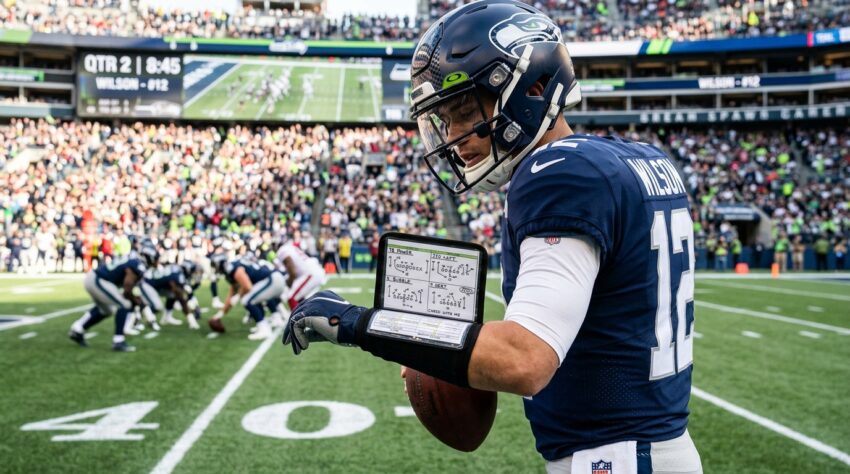
In the closing minutes of a tied game, the atmosphere is electric, the crowd noise is deafening, and the physical fatigue of four quarters is beginning to take its toll. For a quarterback, this is the “red zone” of mental performance. It is in these high-pressure moments that the most prepared athletes can fall victim to mental errors—misremembering a route, failing to account for a defensive shift, or simply taking too long to relay a call. Research from 2026 shows that mental fatigue significantly degrades a player’s conflict monitoring ability, leading to slower reaction times and higher turnover rates.
To combat this, modern offensive strategies rely on more than just memory; they utilize tools like the qb playbook wristband to act as an “external brain.” By shifting the burden of information storage from the quarterback’s mind to their forearm, teams can ensure that execution remains sharp even when the heart rate is spiking. Tag Sports Gear has recognized this need for high-capacity communication, offering specialized tools like the 5-window wristband to provide quarterbacks with the visual reinforcement they need to lead under fire.
The Neuroscience of Mental Fatigue and Decision Fatigue
By the time the fourth quarter arrives, a quarterback has processed thousands of data points, from defensive alignments to complex protection schemes. This leads to a state known as decision fatigue, where the quality of choices begins to decline. Neuroscience studies in 2026 have confirmed that under high mental pressure, athletes display slower responses because the brain is forced to divert energy away from executive functions to manage the stress of the environment.
A qb playbook wristband serves as a critical intervention in this process. When a quarterback can glance at a clearly labeled diagram or code, they move from “retrieval mode” (trying to remember the play) to “execution mode” (processing the defense). This shift preserves precious cognitive resources, allowing the athlete to focus on the immediate surprise of a blitz rather than struggling to recall the primary and secondary passing options of a specific formation.
| Mental Challenge | Impact Without Wristband | Benefit With a QB Playbook Wristband |
| :— | :— | :— |
| Cognitive Load | Brain is overwhelmed by play memorization. | Information is externalized for quick reference. |
| Stress Response | Slower “Detect-Compare-React” cycle. | Visual cues trigger faster recognition. |
| Mental Fatigue | Increased likelihood of “forgetting” the play. | 100% accuracy in play-call retrieval. |
| Decision Speed | Hesitation leads to sacks or forced throws. | Immediate clarity reduces “analysis paralysis.” |
Offloading Cognitive Load: The “External Brain” Advantage
Quarterbacks face the highest cognitive load of any player on the field. They must not only know their own assignments but also the routes of five receivers, the protection of five linemen, and the tendencies of the opposing defense. According to cognitive load theory, the human brain can only hold a limited amount of information in its working memory at once. When that limit is reached, errors—such as a missed audible or a botched snap count—become almost inevitable.
Using a qb playbook wristband allows a player to offload the “storage” aspect of quarterbacking. Instead of occupying mental space with the technical details of a “Z-Under, X-Post” concept, the quarterback uses the wristband as a map. This leaves their mind free to solve the real problems on the field: identifying the Mike linebacker, checking the safety rotation, and calculating the timing of the throw. This externalization is why even veteran pros continue to rely on analog wristbands despite years of experience.
Minimizing Verbal Miscommunication in No-Huddle Schemes
One of the most common sources of mental errors is the breakdown of verbal communication. In a high-pressure, two-minute drill, there is often no time for a traditional huddle. Relying solely on hand signals or shouted calls from the sideline can lead to disaster if a player mishears a single word. Statistics from the 2025-2026 seasons suggest that miscommunication accounts for nearly 15% of all stalled offensive drives in youth and high school football.
A playbook wristband standardizes the language of the offense. When a coach signals in a number or a color code, the quarterback simply matches that code to the corresponding window on their arm. This eliminates the “telephone game” where information is lost as it travels from the coach to the quarterback and then to the rest of the team. By ensuring everyone is looking at the same source of truth, the offense can operate with a level of precision that verbal calls cannot match.
- Standardized Codes: Replaces long, complex play names with simple 2-digit numbers.
- Visual Diagrams: Provides a quick look at the formation to ensure everyone is lined up correctly.
- Assignments at a Glance: Allows the quarterback to verify the protection scheme before the snap.
- Time Savings: Reduces the play-call relay time by up to 10 seconds per snap.
Leveraging the 5-Window Design for Situational Mastery
While standard wristbands often feature three windows, the 5-window model from Tag Sports Gear provides a significant psychological advantage in high-pressure situations. The more windows a quarterback has access to, the less they have to “scroll” or flip through cards while the clock is ticking. In critical moments like the red zone or a last-minute drive, every second spent fumbling with a wristband increases the risk of a delay-of-game penalty or a rushed decision.
The 5-window design allows for better organization by game situation. For example, a quarterback can dedicate one window specifically to “Third Down Must-Haves,” another to “Red Zone Specials,” and a third to “Two-Minute Drill” plays. This situational organization reduces the mental search time. When the pressure is highest, the quarterback doesn’t have to think about where the play is; they already know exactly which window to look at for the current game context.
- Window 1: Opening Script. For the first 10-15 plays of the game to build rhythm.
- Window 2: Standard Down & Distance. General-purpose plays and RPO concepts.
- Window 3: Third Down / High Stakes. High-conversion plays and blitz beaters.
- Window 4: Red Zone. Tight-space concepts and goal-line packages.
- Window 5: Two-Minute Drill. No-huddle plays and sideline-focused routes.
Visualizing Success: How Clear Diagrams Reduce Analysis Paralysis
Visualization is a powerful tool in sports psychology. Research into athletic performance shows that the same brain regions activate when an athlete vividly imagines a play as when they actually execute it. A qb playbook wristband provides a constant, high-definition visual anchor for this process. Instead of trying to visualize a “ghost” image of a play in their mind, the quarterback can see the actual lines and routes printed clearly on their arm.
This visual clarity is especially important for youth and high school players who are still developing their spatial awareness. When a quarterback sees a diagram of a “Flood” concept right before they call it, their brain creates a neural roadmap for where the receivers should be. This reduces “analysis paralysis”—the state of being so overwhelmed by options that you cannot make a decision. With a clear visual guide, the quarterback can play with the “free mind” necessary for elite performance.
Improving Decision-Making Speed: The Stats Behind the Gear
In the modern era of football, “Time to Throw” is a metric that defines the elite. The faster a quarterback can process the field and release the ball, the less likely they are to take a sack or throw an interception. Mental errors often manifest as a split-second hesitation. By providing an instant reference point, a qb playbook wristband helps maintain a high “Success %” even when the defensive pressure is intense.
The Tag Sports Gear 5-window wristband is built for this type of speed. With its 5″ x 3″ window size, the diagrams are large enough to be read at a glance, even with a visor on. In 2026, where offensive tempo is faster than ever, the ability to confirm a play in under half a second is the difference between a touchdown and a turnover. By reducing the friction between the call and the snap, quarterbacks can lead their teams with the confidence that comes from having the answers right on their wrist.