

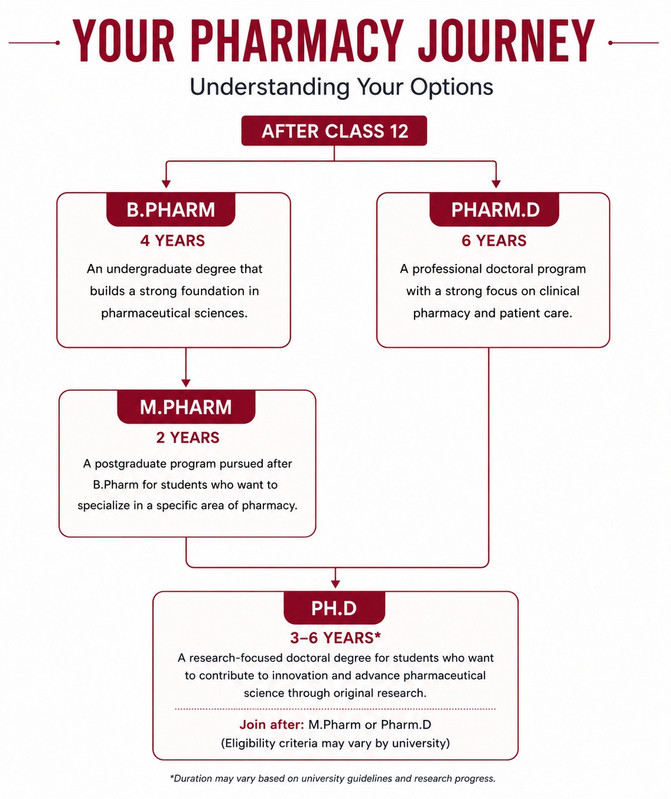
Pharmacy is more than just one degree. Students can choose from programmes like B.Pharm, Pharm.D, M.Pharm, and Ph.D depending on where they are in their academic journey and the career they want to build. Understanding what each programme offers can make it much easier to choose from the top universities in South India and plan your future with confidence.
If you’re exploring pharmacy courses after 12, you’ve probably come across terms like B.Pharm, Pharm.D, etc. At first glance, they all might seem confusing. UG/PG? Different versions of the same programme? Which one to choose?
We understand that you have questions. But the answer is simpler than it seems.
Each programme has a different purpose.
In this blog, we’ll be decoding which is the foundation and which is for specialisation. We’ll also look at which is one of the top universities in South India that offers multiple pharmacy programmes under one roof.
B.Pharm: The foundation of a pharmacy career
For most students, Bachelor of Pharmacy (B.Pharm) is where the journey begins.
This four-year undergraduate programme builds a strong understanding of pharmaceutical sciences and introduces students to how medicines are developed, manufactured, tested, stored, and used safely. At the top universities in South India, along with classroom learning, students spend considerable time in laboratories, developing practical skills that prepare them for the pharmaceutical industry.
Who is B.Pharm best suited for?
B.Pharm is ideal for students who:
- Want a broad understanding of pharmacy and pharmaceutical sciences
- Enjoy subjects like chemistry, biology, and healthcare
- Are interested in the pharmaceutical industry
- Want the flexibility to start working after graduation or continue with higher studies
What do students study?
While the curriculum varies slightly between universities, the top universities in South India typically cover:
- Pharmaceutical Chemistry
- Pharmaceutics
- Pharmacology
- Pharmacognosy
- Pharmaceutical Analysis
- Human Anatomy and Physiology
- Quality Assurance
- Drug Formulation and Manufacturing
Laboratory work is an important part of the programme, helping students apply theoretical concepts in practical settings.
Career opportunities after B.Pharm
Many students choose to enter the workforce immediately after graduating from the top universities in South India. Some common career opportunities include:
- Production Executive
- Quality Control Analyst
- Quality Assurance Executive
- Regulatory Affairs Associate
- Drug Safety Associate
- Pharmacovigilance Associate
- Medical Representative
- Community Pharmacist
Others choose to continue their education and specialise further.
Want to specialise? That’s where M.Pharm comes in
Not every B.Pharm graduate pursues an M.Pharm, and that’s perfectly okay. Many students build successful careers immediately after completing their bachelor’s degree.
However, if you enjoy research, want to develop expertise in a specific area of pharmacy, or are aiming for more specialised roles in the pharmaceutical industry, a Master of Pharmacy (M.Pharm) from the top universities in South India can be a valuable next step.
Unlike B.Pharm, which gives students a broad understanding of pharmacy, M.Pharm focuses on advanced learning within a chosen specialisation.
Who should consider M.Pharm after B.Pharm?
M.Pharm is well suited for students who:
- Want to specialise after completing B.Pharm
- Enjoy research and innovation
- Are interested in formulation and product development
- Aspire to work in advanced technical or research roles
- Plan to move into teaching or higher academic studies in the future
Career opportunities after M.Pharm
An M.Pharm degree can open doors to specialised roles such as:
- Formulation Scientist
- Research Associate
- Research and Development Executive
- Quality Assurance Manager
- Regulatory Affairs Specialist
- Academic Faculty
- Pharmaceutical Scientist
For many students, an M.Pharm from the top universities in South India becomes a stepping stone towards research, leadership roles, or doctoral studies later in their careers.
Where does Pharm.D fit into the picture?
One of the biggest misconceptions about pharmacy education is that Pharm.D is simply the next step after B.Pharm. It isn’t.
Unlike M.Pharm, which is a postgraduate programme that students pursue after completing B.Pharm, Pharm.D (Doctor of Pharmacy) is a six-year professional programme at the top universities in South India that students can join directly after Class 12.
The biggest difference lies in the learning experience and career focus.
While B.Pharm prepares students for careers across the pharmaceutical industry, Pharm.D places greater emphasis on clinical pharmacy, hospital training, and patient care. Students spend significant time understanding how medicines are prescribed, monitored, and used to improve patient outcomes. The programme also includes clinical postings and hospital-based training, giving students exposure to real healthcare settings.
Career opportunities after Pharm.D
A Pharm. D degree from the top universities in South India opens completely different career paths, like:
- Clinical Pharmacist
- Hospital Pharmacist
- Clinical Research Associate
- Pharmacovigilance Officer
- Drug Safety Associate
- Medical Writer
- Clinical Data Manager
|
Did you know? Many students often confuse Pharm.D with D.Pharm. These are two completely different programmes. While Pharm.D is a 6-year professional pharmacy degree offered by the top universities in South India, D.Pharm is a diploma programme. |
Ph.D in Pharmacy
Unlike B.Pharm, M.Pharm, or Pharm.D, which prepare students for professional practice, a Ph.D focuses on creating new knowledge through research. Scholars work on research projects, publish scientific papers, develop innovative pharmaceutical solutions, and often collaborate with industry or research organisations.
Career opportunities include research laboratories, universities, pharmaceutical companies, government organisations, and healthcare innovation centres.
KL University – Among the top universities in South India
KL University, one of the top universities in South India, with over four decades of academic excellence, offers strong industry-ready education, research, and innovation.
It offers all four pharmacy career paths that we discussed.
Some highlights of the pharmacy programmes @ KLU include:
Approved by the Pharmacy Council of India (PCI)
- State-of-the-art laboratories
- Drug Museum and advanced research facilities
- Industry-oriented curriculum with practical learning
- 70%+ faculty with Ph.D qualifications
- Student research and publication opportunities
- Global certification programmes
- 30+ MoUs with international universities
- 100% placements and entrepreneurship support
All these factors come together and make KLU one of the top universities in South India for pharmacy education.
Final note…
Choosing among the top universities in South India begins with understanding your own career goals. B.Pharm, M.Pharm, Pharm.D, and Ph.D are not competing programmes. They are designed for different stages and aspirations within pharmacy. Once you know which path aligns with your interests, choosing a university that offers quality education, practical exposure, experienced faculty, and research opportunities becomes much easier.
FAQs
What is the difference between B.Pharm and Pharm.D?
B.Pharm is a four-year undergraduate programme that provides a broad foundation in pharmaceutical sciences and prepares students for careers across the pharmaceutical industry. Pharm.D is a six-year professional programme with a stronger focus on clinical pharmacy, hospital training, and patient care.
Is M.Pharm compulsory after B.Pharm?
No. Many students begin working after completing B.Pharm. M.Pharm is a good option for those who want to specialise, pursue research, or move into advanced technical and academic roles. It is important to choose correctly among the top universities in South India for M.Pharm.
Is D.Pharm the same as Pharm.D?
No. D.Pharm is a two-year diploma programme, whereas Pharm.D is a six-year professional programme that focuses on clinical pharmacy and patient care.
What should I look for while choosing among the top universities in South India for pharmacy?
Look for PCI-approved programmes, experienced faculty, modern laboratories, research opportunities, industry exposure, placement support, and a curriculum that balances theory with practical learning.