
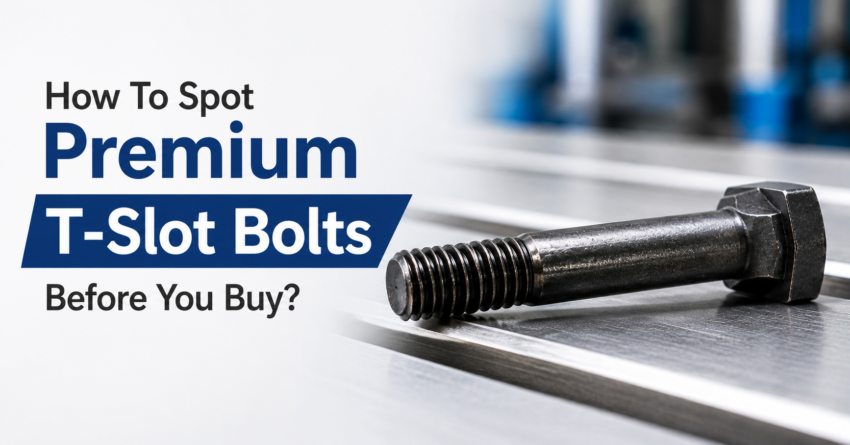
The market is flooded with cheap, unbranded hardware that looks perfectly fine on a computer screen but fails miserably under real-world stress. Buying low-grade fasteners usually leads to stripped threads, warped heads, and structural shifting that can ruin expensive aluminum profiles or misalign CNC machinery. It is incredibly frustrating to halt an entire project just because a budget bolt snapped during final assembly.
The solution is learning how to identify high-quality manufacturing standards before you ever place an order or hand over your money. By understanding what to look for, you can weed out sub-par components and buy hardware that will last. In this guide, you’ll learn the specific physical characteristics, material markings, and production details that make premium hardware so. You’ll never be stuck with anything but the best t-slot bolts for your specific assembly needs.
1. Understanding Head Markings And Material Grades
The Premium Fasteners never hide their origin or structural capabilities. The top of a high-quality bolt will have distinct, raised or stamped marks that identify the bolt’s particular strength class or material grade.
A2 and A4 are marks for stainless steel versions. Look for numbers such as 8.8, 10.9 or 12.9 on steel. The heads on cheap, generic hardware will often be completely blank. That is a big red flag that verified testing was not done. Certified hardware guarantees the metal will provide the precise amount of clamping force your equipment requires.
2. Evaluating Thread Precision And Cleanness
The longevity of a fastening system depends entirely on how well the threads are formed. Premium manufacturers use a rolling process rather than a cutting process to create threads because rolling preserves the grain flow of the metal.
Inspect the valleys and ridges of the T-slot bolts closely under good lighting. The tracks should be perfectly uniform, completely smooth, and free of tiny metal flakes or jagged burrs. Clean threads allow you to spin nuts on effortlessly by hand without any catching or resistance.
3. Analyzing Head Geometry And Track Fit
A bolt must fit perfectly inside the aluminum extrusion channel to distribute pressure evenly. If the T-shaped head is even slightly misaligned or poorly cast, it will twist sideways and gouge the internal walls of your framing.
Premium options feature crisp, sharp angles and flat surfaces that maximize contact area with the aluminum slot. Avoid hardware that shows heavy casting lines, rounded edges, or asymmetric heads, as these imperfections cause uneven loading and eventual joint failure.
4. Evaluating Surface Finishes And Coatings
Humidity, oils, and industrial fluids will quickly rust raw steel. The protective coating applied to your hardware will determine how long it will survive in a workshop environment.
High-quality bolts are usually uniformly zinc plated, black oxide treated, or chrome finished, without thin spots or discoloration. The coating must be completely uniform and smooth over the whole piece, even in the deep recesses of the thread roots where rust generally begins.
5. Requiring Stringent Dimensional Tolerances
Structural alignment in industrial applications requires absolute precision. Low-quality hardware manufacturers don’t have very tight quality control, so in a batch of hardware you may find the size varies just a little from piece to piece.
When looking for parts, make sure the suppliers have detailed engineering drawings and exact metric or imperial specifications. Premium t-slot bolts are machined to very tight tolerances, so that every single piece in a box of one hundred will fit in your tracks exactly the same.
6. Feel Weight And Material Density
It might sound old-fashioned, but the weight of a fastener says a lot about the structural integrity inside. Cheap alloys often feel uncomfortably light because of porous air pockets or inferior metal blends.
Compare a premium bolt with a bargain-bin equivalent of the same size, and hold them in your hand. You can feel the heft and density of a good carbon-steel or stainless-steel blade; it’s solid and even throughout, able to take a lot of tensile load.
7. Search For Certified Manufacturing Standards
Reputable industrial components are always made according to the accepted standards of the world. These frameworks ensure that hardware behaves in a predictable manner under specified mechanical stress levels.
Check the product documentation for references to DIN, ISO or ASME standards. This means that when a manufacturer clearly states compliance with these regulatory bodies, it is proof that their hardware has undergone rigorous testing and validation and not just visual inspection.
8. Packaging And Batch Labelling Evaluation
The way a manufacturer ships their products is a reflection of their overall commitment to quality control. Premium hardware is rarely thrown loose into unlabelled plastic bags that rattle together and damage threads in transit.
Buy hardware in boxes with unique batch numbers, tracking codes, and clear origin labels. Proper batch labeling allows the manufacturer to trace materials back to the original steel mill, giving a level of accountability you will never get from anonymous bulk sellers.
9. Checking The Manufacturer’s Reputation And Technical Support
A premium product is often backed by a manufacturer who stands behind its quality. Most reputable fastener companies provide full product brochures, technical data, and experienced customer service to help buyers select the right fastener for their application.
Before purchasing, take time to investigate the supplier’s reputation. Look up customer reviews, industry experience, and technical resources. Manufacturers that provide material certifications, engineering assistance and quick after-sales service will be confident in their products and are typically a safer bet than unknown sellers with little product information.
Conclusion
If you want to find really good stuff, you need to stop paying attention to the lowest price and pay attention to the actual manufacturing details that you can confirm. Looking for clear head markings, smooth rolled threads, precise head geometry, and uniform protective coatings protects your machinery from the costly headaches of unexpected structural failure. Investing in the best t-slot bolts will allow you to keep your frames completely rigid, alignments perfect, and your operations safe and uninterrupted. Spend the extra time to check out these physical traits before you buy, and your mechanical builds will stay secure for years to come.