
Key Highlights
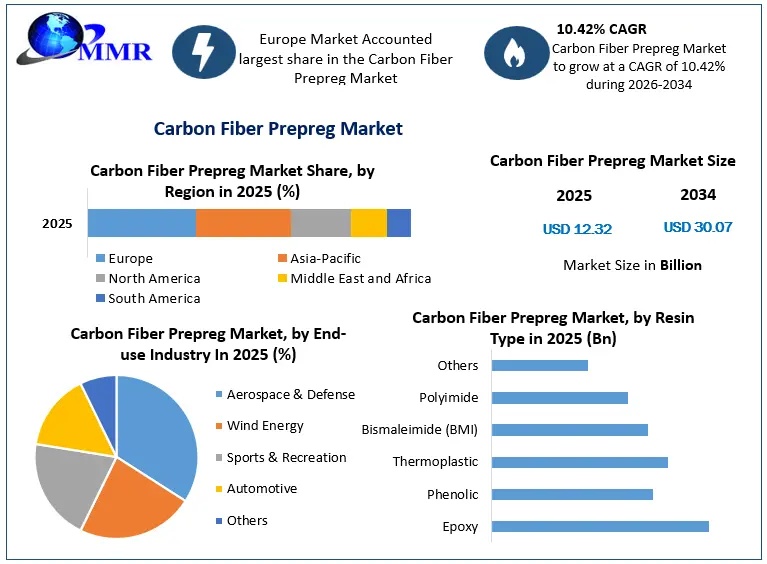
- The Carbon Fiber Prepreg Market was valued at USD 12.32 billion in 2025.
- Revenue is projected to reach USD 30.07 billion by 2034, expanding at a 10.42% CAGR from 2026 to 2034.
- Europe accounted for 49% of the market in 2025, making it the leading regional market.
- Epoxy is expected to remain the dominant resin type during the forecast period.
- Aerospace & Defense represents the leading end-use industry.
- Growing demand for lightweight, high-strength materials is creating opportunities across aerospace, automotive, wind energy, and sports applications.
Market Overview
The Carbon Fiber Prepreg Market is entering a major growth phase as manufacturers across high-performance industries seek materials that combine strength, durability, and weight reduction. Carbon fiber prepregs offer a high strength-to-weight ratio, high tensile and compressive strength, fatigue resistance, and a low coefficient of thermal expansion, making them attractive for demanding applications.
The market was valued at USD 12.32 billion in 2025 and is expected to reach nearly USD 30.07 billion by 2034. This represents a 10.42% CAGR between 2026 and 2034, signaling substantial expansion in production capacity, material development, and downstream applications.
Why This Market Matters Now
Weight reduction has become a strategic priority for aircraft manufacturers, automotive companies, wind-energy producers, and other industrial users. Carbon fiber composites can deliver performance advantages that conventional metals struggle to match, particularly where strength, stiffness, corrosion resistance, and low weight are critical.
For aerospace manufacturers, the material is particularly important because composite-intensive aircraft rely heavily on carbon fiber reinforced structures. The growing use of composites in aircraft structures supports long-term demand for advanced prepreg materials.
Get Your Free Sample Report Link : https://www.maximizemarketresearch.com/request-sample/33290/
Key Trends Driving Growth
One of the strongest trends is the development of faster and more efficient manufacturing technologies. High-speed curing prepregs can help reduce production cycle times, which is particularly important for automotive applications where manufacturers need greater production efficiency.
Sustainability is another emerging priority. The industry is increasingly exploring thermoplastic prepregs and recyclable composite solutions to address environmental concerns associated with conventional prepregs.
At the same time, manufacturers are investing in cost-effective carbon fiber solutions for industrial applications. Lower material and processing costs could expand composite adoption beyond traditional high-performance sectors.
Market Growth Outlook
The market is forecast to grow from USD 12.32 billion in 2025 to approximately USD 30.07 billion in 2034. The projected 10.42% CAGR indicates that demand is expected to remain strong throughout the forecast period.
Growth will depend on continued adoption of lightweight materials, expansion in aerospace production, increasing wind-energy applications, automotive composite development, and advances in prepreg processing technologies. However, high production costs and manufacturing complexity remain important challenges for broader adoption.
Market Segmentation
By resin type, the market includes epoxy, phenolic, thermoplastic, bismaleimide (BMI), polyimide, and others. Epoxy is expected to dominate because of its combination of strength, lightweight characteristics, and suitability for carbon fiber-reinforced polymer composites.
By end-use industry, the market is segmented into aerospace & defense, wind energy, sports & recreation, automotive, and others. Aerospace & defense currently represents the leading application segment, supported by the extensive use of carbon fiber composites in aircraft and other high-performance structures.
Regional Growth Story
Europe remains the leading regional market, holding a 49% share in 2025. The region benefits from strong aerospace and renewable-energy activity, while investment in manufacturing processes and research supports continued composite development.
North America is also positioned for sustained demand, particularly through aerospace and industrial applications. Meanwhile, Asia Pacific remains important because of its carbon fiber manufacturing capacity and expanding industrial base. The report also identifies opportunities associated with wind energy, automotive applications, and large-tow carbon fiber demand.
Competitive Landscape
Competition is centered on material performance, production capacity, technology development, cost optimization, and relationships with major end users. Key companies identified in the market include Toray Industries Inc., Hexcel Corporation, Mitsubishi Rayon Co. Ltd., Solvay, Teijin Limited, SGL Group, Gurit Holding AG, PRF Composite Materials, Barrday Corporation, Hankuk Carbon, Axiom Materials, and TCR Composites, among others.
The competitive environment is also encouraging vertical integration, allowing major producers to strengthen control over precursor, carbon fiber, prepreg, and composite component production.
Recent Developments
- Toray Industries: Introduced a high-speed curing carbon fiber prepreg designed for automotive mass production in January 2026.
- Hexcel Corporation: Opened an automated prepreg manufacturing line in France in March 2026.
- Solvay: Established a strategic partnership focused on recyclable thermoplastic prepregs for wind-turbine applications in May 2026.
- Mitsubishi Chemical: Commercialized a cost-effective PAN-based carbon fiber prepreg for industrial applications in June 2026.
Strategic Implications
The outlook points toward a market where performance alone will no longer be enough. Producers that can combine lightweight performance with faster processing, lower costs, improved sustainability, and reliable supply are likely to gain an advantage.
For aerospace and automotive manufacturers, prepreg technology can support weight reduction and advanced structural design. For wind-energy companies, larger turbine structures create opportunities for carbon fiber composites where stiffness and weight become increasingly important.
As the market approaches USD 30.07 billion by 2034, investment in manufacturing efficiency, recyclable materials, resin innovation, and regional supply chains will become increasingly important. Companies that align material innovation with the practical needs of high-volume industries will be better positioned to capture the next phase of growth in the global Carbon Fiber Prepreg Market.
Explore More Related Reports:
For additional insights and reports on related industries and markets, visit our website to stay updated with the latest market research and industry developments.
About Maximize Market Research:
Maximize Market Research is one of the fastest-growing market research and business consulting firms serving clients globally. Our revenue impact and focused growth-driven research initiatives make us a proud partner of majority of the Fortune 500 companies. We have a diversified portfolio and serve a variety of industries such as IT & telecom, chemical, food & beverage, aerospace & defense, healthcare and others.
Contact Maximize Market Research:
MAXIMIZE MARKET RESEARCH PVT. LTD.
⮝ 3rd Floor, Navale IT park Phase 2,
Pune Banglore Highway, Narhe
Pune, Maharashtra 411041, India.
✆ +91 9607365656