
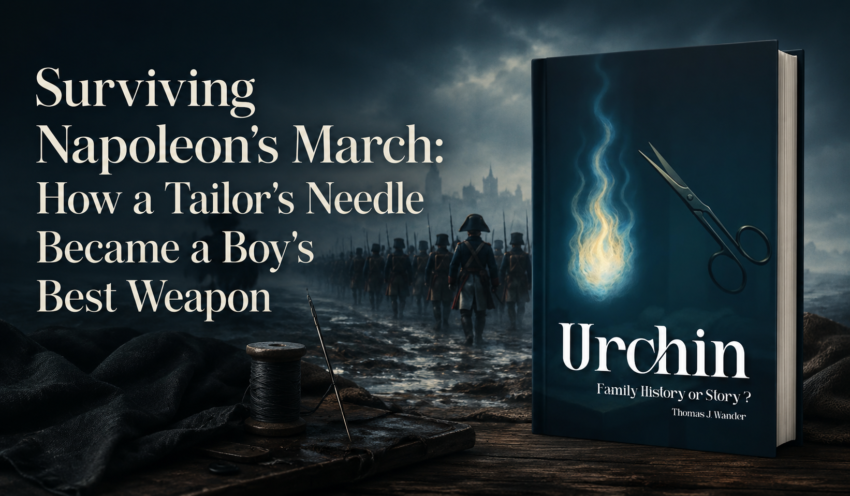
When we visualize the brutal theater of nineteenth-century warfare, our imaginations immediately rush to the deafening roar of cannon fire, the blinding smoke of muskets, and the glint of drawn cavalry sabers. We focus on the lethal implements designed to tear human beings apart. Yet, as Thomas J. Wander brilliantly illuminates in his historical novel Urchin: Family History or Story?, the true backbone of an advancing military force was often found in the quiet, desperate hands of those tasked with putting things back together.
For the novel’s protagonist—a ten-year-old Dutch boy violently snatched from his home in 1812 to serve Napoleon’s Grande Armée—survival does not depend on his ability to hold a rifle. Instead, his salvation lies in a skill he once found tedious: the ability to thread a needle, measure a seam, and stitch together the rotting garments of a desperate army.
The Economics of Warfare
Before he was abducted by a ruthless band of French soldiers and rebranded as “Urchin,” young Johannes van Siebert spent his days in the quiet sanctuary of his father’s tailor shop in Gorinchem. There, surrounded by bolts of fine fabric and the rhythmic clipping of shears, he learned the exacting demands of the trade. Next door, in his uncle’s shop, he practiced the heavy, blistering work of cobbling leather boots. To a child, it was merely an apprenticeship. On the muddy, blood-soaked roads to Russia, however, it became a lifeline.
Wander strips away the romanticized veneer of the Napoleonic Wars to reveal the gritty logistical nightmare of moving hundreds of thousands of men across a hostile continent. Soldiers marched until their boots disintegrated into the mud. Uniforms were slashed in brawls, shredded by enemy shrapnel, and worn down to threadbare rags against the freezing Polish winds. An army is a beast that constantly consumes its own supplies, and the men who could replenish those supplies were afforded a rare and highly coveted status.
When a sympathetic French private advises the terrified, newly captive boy to “make yourself useful,” Urchin realizes that his hands hold the key to his continued existence. By mending the torn trousers and split seams of the very men who kidnapped him, he elevates himself from a disposable “waterboy” to an indispensable asset.
The Morality of the Stitch
The transition from the pristine worktables of Holland to the chaotic rear-guard of the French army forces Urchin to adapt his craft in profound ways. He remembers the “battlefield stitches” taught to him by a master seamstress back home—rapid, durable loops designed for speed and function rather than aesthetic beauty.
Yet, as he hones his craft under the mentorship of Señor Serrano, a wise and aging Spanish tailor traveling with the camp, Urchin is forced to confront the dark morality of his new reality. Soldiers frequently return from scouting missions carrying pristine rolls of fabric and supple leather, demanding repairs. Urchin is struck by a crushing wave of guilt as he realizes these materials were not purchased. They were pillaged from the homes of terrorized villagers and stripped from the corpses of fallen men.
Serrano imparts a sobering wisdom to the boy, explaining that they cannot change the violence that secured the cloth. The only way to honor the ultimate sacrifice of those innocent victims is to use the stolen materials to the absolute best of their abilities, transforming a tragic theft into a work of sustaining craftsmanship. It is a heavy psychological burden for a child, but it is one that forces Urchin to mature with heartbreaking speed.
Creation as an Act of Rebellion
Through Wander’s meticulous and evocative prose, the act of tailoring is elevated from mere background detail to a central narrative triumph. We watch Urchin mend the bullet holes in the uniforms of men who were murdered for their coin, his needle weaving through the physical evidence of humanity’s darkest impulses. We also watch him design a custom dress for the daughter of a fierce sergeant, utilizing hidden pockets and expandable hems—a brilliant display of ingenuity that secures his protection among the highest ranks of the camp.
Most profoundly, after Urchin loses his lower leg to a Russian cannonball, he utilizes his knowledge of leather and wood to physically carve his own mobility, strapping a homemade wooden peg to his stump.
In Urchin: Family History or Story?, Thomas J. Wander reminds us that amidst the chaotic destruction of war, the act of creation is the ultimate rebellion. Urchin’s needle and thread do far more than patch the uniforms of French soldiers. They sew together the shattered remnants of his own life, proving that even in history’s darkest chapters, the human will to build, repair, and survive remains unbroken.