
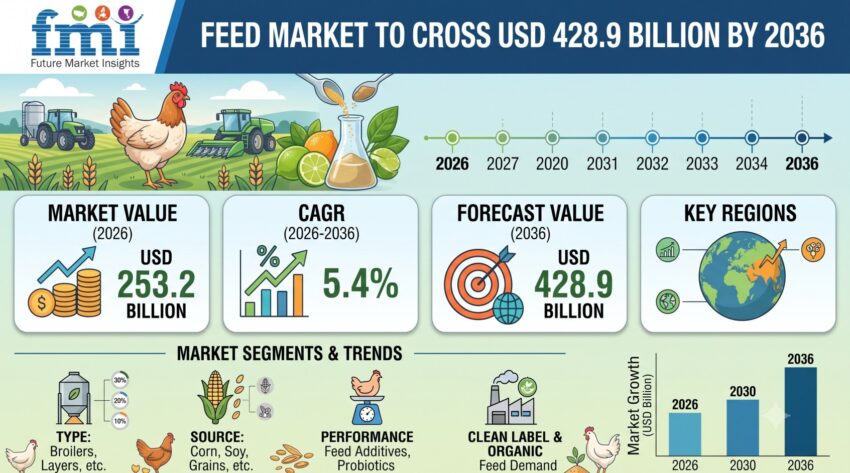
The global poultry feed market is expanding rapidly, transitioning from basic commodity grain mixing into a science-driven, precision-nutrition industry. Spurred by surging global demand for affordable dietary animal protein (chicken meat and eggs), accelerating commercial farm intensification, and widespread adoption of antibiotic alternatives (probiotics, organic acids, and enzymes), specialized commercial feeds are becoming indispensable.
The global market, valued at USD 253.2 billion in 2026, is projected to advance at a Compound Annual Growth Rate (CAGR) of 5.4% over the ten-year forecast period, reaching a total market valuation of USD 428.9 billion by 2036.
Get detailed market forecasts, competitive benchmarking, and pricing trends:
https://www.futuremarketinsights.com/reports/sample/rep-gb-716
Market Performance Overview (2026–2036)
To map out the key feed ingredients, physical delivery forms, and regional growth vectors guiding this USD 175.7 billion market expansion, key segment allocations highlight where global demand is concentrated:
- Corn Feed Type Segment (56.0% share): Dominates the feed ingredient category in 2026 due to its high metabolizable energy density, superior digestibility, widespread agronomic availability, and cost-effective bulk pricing.
- Pellets Delivery Form (49.0% share): Commands the primary physical form preference over mash, crumble, and powder, favored for reducing feed wastage, improving handling density in automated feeders, preventing selective feeding, and optimizing intestinal absorption.
- Broilers & Layers Livestock Segments: Account for the majority of feed consumption, driven by intensive broiler growth cycles and sustained egg production demands.
- India & Spain Regional Leadership: Lead growth rates at 2% CAGR and 5.7% CAGR respectively through 2036, driven by rapid livestock modernization, rural infrastructure expansion, and growing export opportunities.
Technical Drivers and Precision Nutrition Innovations
The integration of advanced poultry feed across commercial farming operations is propelled by three primary industry catalysts:
Precision Nutrition and Enzyme Technologies
Feed manufacturers are shifting toward data-driven precision nutrition, matching exact amino acid and energy profiles to specific bird genetics and growth stages. Adding exogenous enzymes (phytase, xylanase, protease) breaks down non-starch polysaccharides, releasing bound nutrients and lowering overall raw material costs.
Transition to Antibiotic-Free (ABF) Production
Tightening global restrictions on antibiotic growth promoters (AGPs) have forced commercial farms to adopt biological feed additives. Probiotics, prebiotics, organic acids, and phytogenic plant extracts are routinely added to feed formulations to strengthen gut barrier integrity and protect against enteric pathogens.
Shift toward Alternative Sustainable Proteins
Addressing soybean meal price volatility and deforestation concerns, research is scaling alternative protein inputs, including insect meal (black soldier fly larvae) and single-cell proteins, providing sustainable amino acid profiles for commercial flocks.
Industrial Infrastructure & Supply Chain Challenges
Feed millers and commercial poultry producers navigate specific operational and economic hurdles:
- Agricultural Raw Material Price Volatility: Core energy and protein inputs (corn, wheat, soybean meal) account for up to 60–70% of total poultry production costs. Price spikes caused by weather disruptions or geopolitical conflicts directly squeeze farm profitability.
- Feed Milling Capital Expenditure & Pelletization Energy: Transitioning from traditional mash mixing to thermal pelletizing requires substantial upfront capital investment in steam conditioners, pellet mills, and coolers, as well as higher operational energy consumption.
Regional Growth Profile
Regional demand reflects rapid livestock industrialization in emerging markets alongside precision agriculture in Western economies:
- India (6.2% CAGR): The global growth frontrunner, driven by government support for rural poultry infrastructure, rapid transition from backyard farming to commercial integration, and rising per capita meat consumption.
- Spain (5.7% CAGR) & China (4.9% CAGR): Spurring rapid volume expansion through agricultural modernization, large-scale industrial feed mills, and high export demand.
- United Kingdom (4.0% CAGR) & United States (3.6% CAGR): Represent mature, technology-intensive markets focused on precision nutrition data platforms, antibiotic-free welfare standards, and automated feeding efficiency.
- Germany (2.8% CAGR): Driven by strict environmental regulations, sustainable ingredient sourcing mandates, and high demand for organic-certified poultry feed.
Competitive Landscape
The global poultry feed landscape features a combination of multinational agricultural conglomerates, animal nutrition specialists, and feed processing equipment manufacturers.
Key industry players profiled in the report include Anko Food Machine Co Ltd, Berkshire Hathaway Inc., Bucher Industries, John Bean Technologies Corporation, Hosokawa Micron Corp, GEA Group, Mallet & Company Inc., NICHIMO CO LTD, SPX Corporation, and Tetra Laval International SA. Major feed ingredient suppliers competing in this ecosystem include Cargill Animal Nutrition, ADM Animal Nutrition, Nutreco (Trouw Nutrition), Charoen Pokphand Foods (CP Foods), and New Hope Group.
Full Report for Detailed Insights: https://www.futuremarketinsights.com/reports/poultry-feed-market
Frequently Asked Questions
What is the projected valuation of the global poultry feed market by 2036?
The global poultry feed market is projected to reach USD 428.9 billion by 2036, expanding from an estimated baseline valuation of USD 253.2 billion in 2026 at a CAGR of 5.4%.
Why does Corn lead the Feed Type category?
Corn holds a 56% market share in 2026 because of its exceptional metabolizable energy density, high digestibility, consistent global supply, and cost-effective bulk pricing.
What physical form dominates commercial poultry feed sales?
Pellets lead with a 49% market share in 2026, as compressed pelleted feed reduces waste, improves feed conversion ratios, and integrates seamlessly into automated commercial feeding systems.
FMI Custom Research: Strategic Intelligence for Confident Decision-Making
In today’s rapidly evolving business environment, leadership teams need clear, actionable intelligence tailored to their strategic objectives. FMI’s Custom Research solutions are designed around specific business questions, enabling executives to evaluate growth opportunities, validate investments, assess competitive dynamics, and reduce uncertainty before making critical decisions.
Key Executive Benefits
- Decision-Ready Insights: Research tailored to your specific business challenges, growth plans, and investment priorities.
- Reduced Strategic Risk: Validate market opportunities, customer demand, and competitive positioning before committing resources.
- Market Entry Confidence: Assess opportunity size, regulatory barriers, channel dynamics, and competitive landscapes with precision.
- Competitive Advantage: Gain proprietary intelligence unavailable through syndicated reports or internal datasets.
- Faster Growth Decisions: Accelerate expansion, product development, portfolio optimization, and investment planning.
- Primary Market Validation: Access real-world customer, buyer, and stakeholder insights that support high-confidence decision-making.
Business Impact
FMI helps organizations transform market complexity into strategic clarity, enabling leadership teams to identify growth opportunities faster, optimize resource allocation, strengthen competitive positioning, and make high-stakes business decisions with confidence.
To explore how FMI Custom Research can support your strategic priorities, connect with our team at – sales@futuremarketinsights.com
About Future Market Insights (FMI)
Future Market Insights (FMI) delivers actionable, decision-focused market intelligence that goes beyond traditional research reports. The company provides:
- In-depth pricing and cost benchmarking analysis
- Demand forecasting based on real industry inputs
- Procurement and buyer behavior insights
- Supply chain and trade flow intelligence
- Technology and application trend analysis across industries
FMI follows a robust bottom-up research methodology, combining insights from industry experts, procurement leaders, manufacturers, and technical professionals to ensure accurate and practical market intelligence.