
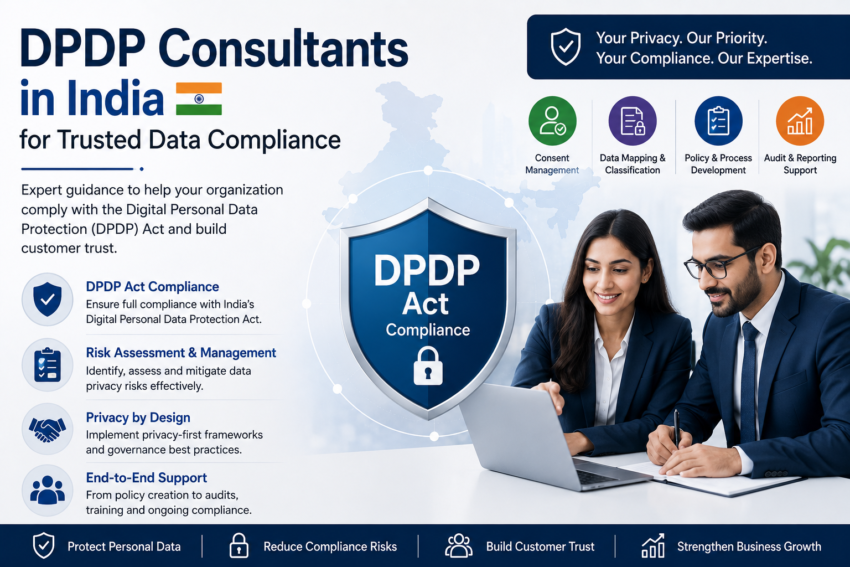
DPDP Act Consulting Services for Stronger Data Privacy
The growing use of digital platforms has made personal data an essential part of modern business operations. Organizations collect customer information through websites, applications, forms, CRM platforms, payment systems, employee portals, and other digital channels. As data usage increases, businesses also need stronger processes for protecting and managing personal information.
DPDP Act Consulting Services help organizations understand their responsibilities under India’s Digital Personal Data Protection framework and develop practical processes for managing personal data. Instead of treating privacy compliance as a documentation exercise, businesses can build a structured approach covering data collection, consent, processing, security, retention, vendor management, and data principal requests.
For businesses operating in India’s digital economy, DPDP Act Consulting Services can provide the expertise required to identify privacy gaps and establish a sustainable compliance framework.
What Are DPDP Act Consulting Services?
DPDP Act Consulting Services are professional advisory and implementation services designed to help organizations understand and address their data protection responsibilities.
A consultant evaluates how an organization collects, processes, stores, shares, and manages personal data. Based on this assessment, the organization can develop appropriate policies, processes, controls, and documentation.
Effective DPDP Act Consulting Services can include:
- DPDP compliance gap assessment
- Personal data inventory and mapping
- Privacy policy review and development
- Consent management assessment
- Data retention and deletion procedures
- Data principal request processes
- Third-party and vendor assessment
- Data security control review
- Privacy risk assessment
- Employee privacy awareness
- Incident response planning
- Ongoing compliance monitoring
The exact scope can be customized according to the organization’s size, industry, technology environment, and data-processing activities.
Why Businesses Need DPDP Act Consulting Services
Data privacy compliance can become complicated when personal information is spread across multiple departments, applications, databases, vendors, and cloud platforms.
Many businesses may not have a complete picture of where personal data is stored or how it moves between different systems. This can make it difficult to identify privacy risks and implement consistent controls.
DPDP Act Consulting Services can help businesses create better visibility into their data environment while establishing processes that support responsible data management.
A structured approach can help organizations:
- Identify personal data processing activities
- Understand privacy-related responsibilities
- Discover compliance gaps
- Improve consent management
- Strengthen privacy documentation
- Establish appropriate data retention practices
- Review third-party data processing
- Improve internal accountability
- Prepare for privacy-related requests
- Develop a repeatable compliance framework
Key Areas Covered by DPDP Act Consulting Services
1. DPDP Compliance Gap Assessment
A gap assessment provides a starting point for understanding the organization’s current compliance position.
Consultants review existing policies, procedures, contracts, technology controls, data flows, and operational practices. The objective is to identify areas that require attention and prioritize corrective actions.
A clear gap assessment can help management understand what needs to be addressed first instead of attempting to change every process simultaneously.
2. Personal Data Mapping
Data mapping is an important component of privacy management.
Organizations need to understand what personal data they collect, why they collect it, where it is stored, how it is processed, who can access it, and whether it is shared with external parties.
DPDP Act Consulting Services can help create a structured data inventory that provides greater visibility into the personal data lifecycle.
3. Consent Management
Consent-related processes should be designed carefully so that organizations can manage applicable consent requirements effectively.
Consultants can evaluate how consent is obtained, recorded, communicated, managed, and handled when individuals exercise applicable choices.
A well-designed consent process can also improve transparency and create a better experience for users.
4. Privacy Policy and Documentation
Privacy documentation should reflect actual organizational practices rather than simply using generic templates.
DPDP Act Consulting Services can help businesses review and develop relevant privacy documentation based on their operations.
Documentation may cover:
- Personal data collection
- Processing purposes
- Data handling practices
- Privacy responsibilities
- User communication
- Grievance mechanisms
- Data retention
- Third-party processing
- Internal privacy procedures
8 Practical Steps for DPDP Compliance
Businesses can approach privacy compliance through a structured process.
Step 1: Identify Personal Data
Create an inventory of the personal information collected across websites, applications, systems, forms, and business processes.
Step 2: Identify Processing Purposes
Determine why each category of personal data is collected and processed.
Step 3: Map Data Flows
Document how information moves between employees, systems, applications, service providers, and other relevant parties.
Step 4: Review Consent Practices
Evaluate applicable consent mechanisms and determine whether existing processes require improvement.
Step 5: Assess Privacy Documentation
Review privacy notices, internal policies, contracts, procedures, and other relevant documentation.
Step 6: Evaluate Data Security
Review technical and organizational measures used to protect personal data from unauthorized access, misuse, alteration, or loss.
Step 7: Review Vendors
Identify external service providers that may process or access personal data and evaluate relevant privacy responsibilities.
Step 8: Establish Continuous Monitoring
Privacy compliance should be reviewed periodically as systems, products, vendors, and business processes change.
Benefits of Professional DPDP Act Consulting Services
Choosing professional DPDP Act Consulting Services can provide organizations with a structured roadmap instead of leaving individual teams to interpret privacy requirements independently.
Better Data Visibility
Businesses can gain a clearer understanding of what personal data they process and where that information is located.
Reduced Privacy Risks
Identifying weaknesses early can help organizations prioritize corrective actions and improve their overall privacy posture.
Stronger Internal Governance
Clear policies, responsibilities, and procedures can make privacy management more consistent across departments.
Improved Customer Confidence
Transparent and responsible data practices can contribute to greater trust among customers, employees, partners, and other stakeholders.
Better Vendor Management
Organizations can establish a more systematic approach to reviewing third parties that interact with personal data.
Scalable Compliance
A properly designed privacy framework can evolve as a business expands its products, technology infrastructure, workforce, and customer base.
Who Should Consider DPDP Act Consulting Services?
DPDP Act Consulting Services can be valuable for organizations that collect or process digital personal data as part of their operations.
These may include:
- Technology companies
- SaaS businesses
- E-commerce companies
- Financial technology businesses
- Healthcare platforms
- Educational technology companies
- Digital marketing agencies
- IT service providers
- Mobile application businesses
- Startups
- Growing enterprises
- Organizations using cloud platforms
Businesses with multiple customer touchpoints or third-party technology providers may particularly benefit from a structured privacy assessment.
How to Choose the Right DPDP Consulting Partner
Selecting a consulting partner requires more than checking whether the provider offers compliance documentation.
Consider these factors before choosing DPDP Act Consulting Services:
Regulatory Knowledge
The consulting team should understand India’s data protection framework and its practical implications for businesses.
Business Understanding
Privacy recommendations should fit the organization’s actual operations rather than relying entirely on generic templates.
Technology Expertise
Modern data privacy involves applications, databases, cloud infrastructure, APIs, CRM systems, analytics platforms, and cybersecurity controls.
Practical Implementation
The consultant should be able to translate regulatory requirements into actionable policies, processes, and controls.
Ongoing Support
Privacy compliance is not necessarily a one-time activity. Businesses should have a process for reviewing their privacy framework when business or technology changes occur.
DPDP Compliance Is an Ongoing Business Responsibility
One of the most common challenges in privacy management is treating compliance as a one-time project. Businesses continuously introduce new technologies, launch products, onboard employees, change vendors, and develop new methods of collecting information.
DPDP Act Consulting Services can help organizations establish an ongoing compliance lifecycle. This may include periodic assessments, policy reviews, employee awareness, vendor assessments, data mapping updates, and privacy risk monitoring.
A continuous approach can make it easier for organizations to identify changes that may affect their data protection responsibilities.
DPDP Act Consulting Services for Startups and Growing Businesses
Startups often prioritize product development and customer acquisition during their early stages. However, privacy should also be considered when designing digital products and business processes.
DPDP Act Consulting Services can help growing businesses establish privacy practices early instead of attempting to rebuild processes after their systems have become complex.
For startups, a practical compliance program may begin with data mapping, privacy documentation, consent management, vendor reviews, security controls, and employee awareness.
As the organization grows, the framework can be expanded according to its evolving data-processing activities.
Frequently Asked Questions
What are DPDP Act Consulting Services?
DPDP Act Consulting Services help organizations understand and implement appropriate data protection processes under India’s Digital Personal Data Protection framework.
Why should businesses use DPDP Act Consulting Services?
Businesses can use DPDP Act Consulting Services to identify privacy gaps, review data practices, improve documentation, strengthen processes, and create a structured compliance roadmap.
What is included in a DPDP compliance assessment?
A compliance assessment may examine personal data collection, processing, consent mechanisms, privacy notices, retention practices, vendor relationships, security controls, and applicable data-related request procedures.
Are DPDP Act Consulting Services useful for startups?
Yes. Startups can establish privacy processes early and create a scalable framework that can evolve alongside their products, systems, employees, and customers.
Can consultants help with privacy policies?
Yes. DPDP Act Consulting Services can include reviewing or developing privacy documentation based on an organization’s actual data-processing activities and business requirements.
Is DPDP compliance only about creating a privacy policy?
No. A privacy policy is only one component. Effective compliance can involve data mapping, consent processes, security measures, retention practices, vendor management, internal procedures, and ongoing governance.
How often should a business review its DPDP compliance?
Businesses should consider periodic reviews, particularly when they introduce new technologies, launch products, change vendors, expand data collection, or significantly modify their processing activities.
Do DPDP Act Consulting Services include data security?
Depending on the consulting scope, services can include reviewing organizational and technical measures associated with personal data protection and identifying areas where controls may need improvement.
Conclusion
Data privacy is becoming an increasingly important part of responsible digital business operations. Organizations that collect and process personal data need more than basic documentation; they need practical systems for understanding data flows, managing privacy responsibilities, protecting information, and maintaining accountability.
Professional DPDP Act Consulting Services can help businesses move from uncertainty to a structured compliance approach. From gap assessments and data mapping to privacy documentation, consent management, vendor reviews, and ongoing monitoring, organizations can develop a framework that supports both regulatory readiness and responsible data management.
For businesses looking to strengthen their privacy practices, starting with a detailed assessment is an effective way to identify priorities, address gaps, and build a sustainable data protection program.