
Ransomware has changed. The familiar model of malware entering a network, encrypting files, and demanding payment still exists, but it no longer captures the full scope of modern extortion campaigns.
Today’s attackers increasingly begin with identity. They steal credentials, compromise privileged accounts, abuse remote access, and exploit legitimate administrative tools to establish control without immediately triggering traditional malware defenses. From there, they can move into cloud environments, locate sensitive information, disrupt critical services, and search for the systems an organization will depend on during recovery.
That last step changes the resilience equation.
Backups, identity infrastructure, cloud management consoles, and recovery processes are no longer simply defensive resources. They can become deliberate targets. If attackers can compromise the identities required to administer an environment, interfere with cloud resources, and sabotage recovery capabilities, encrypting every endpoint may not even be necessary to create significant business disruption.
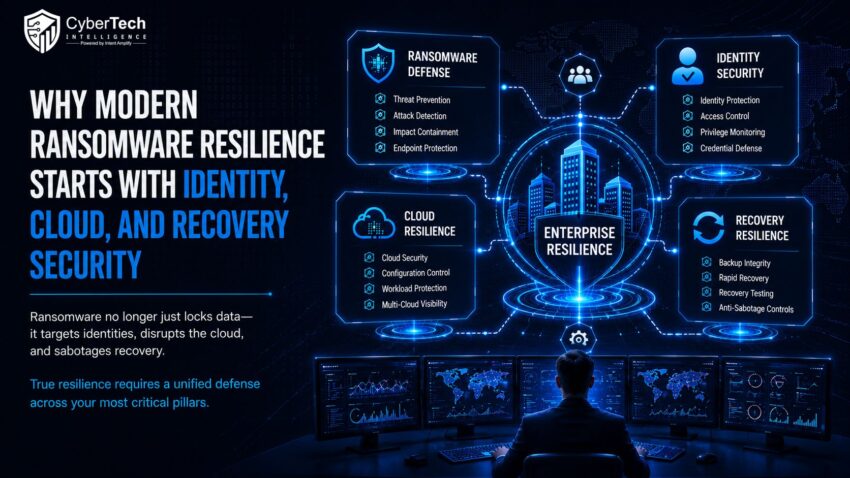
Modern ransomware resilience therefore requires a broader strategy. Enterprises need to protect three interconnected layers: identity, cloud infrastructure, and recovery systems. Securing one while leaving the others exposed creates opportunities for attackers to turn an initial compromise into a prolonged operational crisis.
Why Traditional Ransomware Defense Is No Longer Enough
Traditional ransomware programs often concentrate on stopping malicious files from reaching endpoints.
Endpoint protection, email filtering, vulnerability management, network security, and employee awareness remain important. But sophisticated extortion campaigns increasingly use techniques that appear legitimate to conventional security controls.
An attacker operating through a valid account may not immediately look like an attacker.
Once credentials are compromised, adversaries may use authorized tools and services to:
- Discover critical systems
- Escalate privileges
- Access cloud applications
- Extract sensitive information
- Modify security configurations
- Locate backup infrastructure
- Interfere with recovery operations.
This means enterprises must think beyond preventing ransomware execution.
The more important question is whether an attacker who gains initial access can acquire enough control to disrupt the business and undermine its ability to recover.
Identity Has Become the First Ransomware Battleground
Modern enterprise environments depend heavily on digital identities. Employees, administrators, contractors, service accounts, applications, and machines all require access to business resources.
That makes identity infrastructure an attractive target.
Protect Privileged Access
Administrative accounts can provide attackers with access to security tools, cloud environments, servers, and recovery infrastructure.
Organizations should enforce least-privilege access and minimize persistent administrative permissions. Privileged activities should receive additional authentication and monitoring, particularly when users attempt to modify security controls or access sensitive infrastructure.
Reducing unnecessary privileges limits the amount of damage a compromised identity can cause.
Detect Identity Abuse, Not Just Failed Logins
Credential-based attacks do not always produce obvious authentication failures.
Security teams should look for behavioral signals such as unusual login locations, unexpected privilege changes, abnormal access patterns, suspicious account recovery activity, and access to systems outside a user’s normal responsibilities.
Continuous identity monitoring can reveal an attack before it progresses into widespread disruption.
Treat Machine Identities as Part of the Attack Surface
Human accounts are only one component of enterprise identity.
Service accounts, API credentials, workload identities, access tokens, and automation accounts can possess significant privileges while receiving less scrutiny than employee accounts.
Ransomware resilience increasingly depends on understanding and governing these non-human identities as carefully as privileged human users.
Cloud Environments Change the Extortion Model
Enterprise infrastructure has moved beyond traditional data centers. Applications, customer information, development environments, collaboration platforms, and business processes increasingly operate in public and private cloud environments.
Attackers have followed that transition.
Cloud-focused extortion does not necessarily require traditional ransomware to create disruption. A compromised privileged account may enable an adversary to alter configurations, delete resources, steal information, interfere with services, or manipulate administrative controls.
Secure the Cloud Control Plane
Access to cloud administration should receive the same level of scrutiny as access to critical on-premises infrastructure.
Organizations should apply strong authentication, conditional access, least privilege, activity logging, and continuous monitoring to administrative actions.
High-risk changes should be detectable quickly, particularly when they involve identity policies, security controls, storage, logging, or recovery resources.
Understand Where Critical Data Lives
Cloud adoption can make enterprise data increasingly distributed.
Security teams need visibility into where sensitive information is stored, which identities can access it, how it is protected, and whether unnecessary copies exist.
This matters because modern ransomware frequently includes data theft and extortion alongside operational disruption.
An organization may successfully restore its systems and still face significant consequences if sensitive information has already been exfiltrated.
Recovery Security Is Now Part of Cybersecurity
Backups have long been central to ransomware preparedness. But simply having backups does not guarantee recovery.
Attackers understand that an organization’s strongest negotiating position is the ability to restore operations independently. As a result, backup infrastructure, administrative credentials, recovery consoles, and disaster recovery processes can become high-value targets.
Isolate Critical Recovery Infrastructure
Recovery systems should not depend entirely on the same identities, networks, and administrative pathways used in production.
Where practical, organizations should establish separation between operational and recovery environments, strengthen administrative controls, and maintain protected recovery copies that cannot be easily altered through compromised production credentials.
Test Whether Recovery Actually Works
A backup is valuable only when the organization can restore from it.
Recovery testing should evaluate more than whether files can be retrieved. Enterprises should understand:
- Which business services must return first?
- Which identities are required during restoration
- Whether critical dependencies are available
- How long restoration actually takes
- Whether recovery infrastructure remains trustworthy after compromise
Exercises should assume that parts of the production environment, including identity systems, may be unavailable or untrusted.
Industry Spotlight: Manufacturing
For manufacturers, ransomware can quickly become an operational continuity problem.
Production environments increasingly depend on interconnected enterprise systems, cloud services, industrial technologies, engineering platforms, and third-party access. Compromised identities can therefore create pathways toward systems that support production even when attackers never directly target industrial equipment.
Recovery time is particularly important when downtime affects manufacturing capacity, customer commitments, or downstream supply chains.
Manufacturers can strengthen ransomware resilience by limiting privileged access between environments, monitoring remote and vendor identities, protecting recovery infrastructure, and developing restoration plans around critical production dependencies rather than individual servers.
Industry Spotlight: Logistics & Supply Chain
Logistics and supply chain organizations depend on continuous access to warehouse systems, transportation platforms, inventory data, cloud applications, supplier connections, and customer-facing services.
A ransomware incident affecting identity or cloud infrastructure can interrupt these interconnected workflows even without widespread endpoint encryption.
Recovery sabotage can make the impact more severe by extending the period during which organizations cannot coordinate shipments, access operational information, or restore critical platforms.
For logistics organizations, ransomware resilience requires understanding which digital dependencies keep goods moving and ensuring that identities, cloud services, and recovery capabilities supporting those processes can withstand compromise.
Why Modern Ransomware Resilience Is a Business Continuity Strategy
Ransomware resilience should ultimately be measured by an organization’s ability to continue or restore critical operations under hostile conditions.
A mature strategy can help enterprises achieve:
- Reduced impact from compromised credentials
- Stronger protection for privileged identities
- Greater visibility into cloud-based attack activity
- Better protection for sensitive information
- Reduced attacker access to backup infrastructure
- Faster and more predictable recovery
- Improved operational continuity during extortion incidents
This moves ransomware planning beyond the narrow question of whether malware can be blocked.
The objective becomes limiting an attacker’s ability to control the environment, create business leverage, and prevent recovery.
Building a Modern Ransomware Resilience Roadmap
Enterprises should approach ransomware resilience as an interconnected program spanning security operations, identity, cloud, infrastructure, and business continuity.
Priority actions should include:
- Identifying identities with access to critical systems
- Reducing persistent privileged access
- Strengthening authentication for administrative operations
- Monitoring identity behavior continuously
- Mapping critical cloud services and data
- Protecting cloud administrative controls
- Separating recovery infrastructure from production where practical
- Maintaining protected and resilient backup copies
- Testing restoration of complete business services
- Conducting ransomware exercises that include identity and cloud compromise
- Defining recovery priorities around business impact
Executive leadership should participate in these exercises because ransomware decisions quickly extend beyond cybersecurity into operations, legal response, communications, customer relationships, and business continuity.
The Future of Ransomware and Cyber Extortion
Ransomware is likely to become less dependent on encryption as attackers discover other ways to create leverage.
Identity compromise can provide persistent access. Cloud disruption can affect services without deploying malware across thousands of devices. Data theft can create regulatory and reputational pressure. Recovery sabotage can extend downtime and increase the cost of refusing an extortion demand.
AI may further accelerate reconnaissance, social engineering, credential abuse, and the identification of high-value enterprise targets.
Future ransomware resilience will therefore depend increasingly on:
- Identity threat detection and response
- Privileged access governance
- Cloud activity monitoring
- Data exposure intelligence
- Protected recovery environments
- Continuous attack-path analysis
- Business-level recovery testing
The organizations best prepared for ransomware will not simply be those with the strongest endpoint defenses. They will be those capable of containing compromise while maintaining trustworthy paths back to normal operations.
Final Thoughts
Modern ransomware is no longer simply an encryption problem.
Attackers increasingly seek control over the identities that administer enterprise systems, the cloud environments that run critical workloads, the information that creates extortion leverage, and the recovery capabilities organizations depend on when everything else fails.
That requires enterprises to rethink what ransomware readiness actually means.
Strong endpoint protection can help prevent an initial infection. Strong identity security can restrict attacker movement. Cloud security can protect critical digital infrastructure. Recovery security can preserve the organization’s ability to restore operations without depending on an adversary.
Together, these capabilities create something more valuable than ransomware prevention: enterprise resilience.
Organizations that protect identity, cloud, and recovery as interconnected parts of the same security strategy will be better positioned to contain modern extortion attacks, minimize business disruption, and recover on their own terms.