
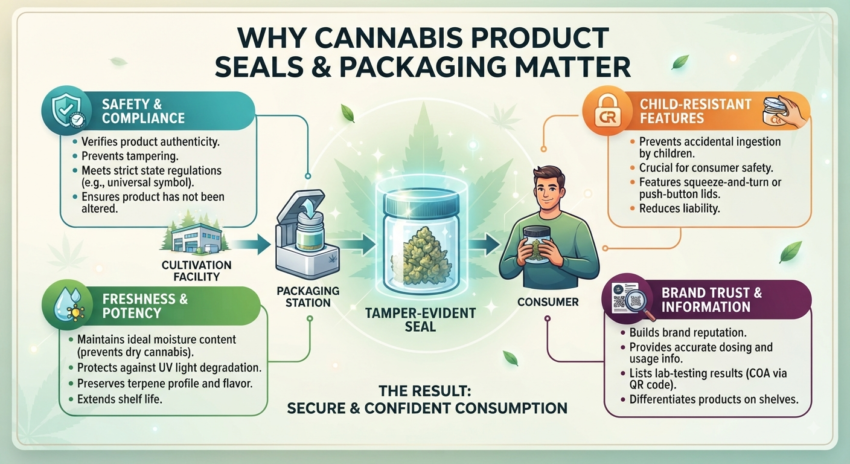
When consumers choose cannabis products, they often focus on potency, aroma, ingredients, brand reputation, and price. However, one important quality factor is sometimes overlooked: the packaging and seal surrounding the product.
Cannabis packaging does much more than make a product look attractive on a dispensary shelf. Proper packaging can help protect the product from contamination, unwanted exposure, accidental access, and damage during transportation and storage. In regulated markets such as California, cannabis packaging also has specific safety and labeling requirements.
The California Department of Cannabis Control (DCC) requires cannabis goods sold by licensed retailers to meet packaging requirements that include being tamper-evident and child-resistant. Packages containing multiple servings must also be resealable. (Department of Cannabis Control)
1. Seals Help Show Whether a Package Has Been Opened
A sealed cannabis package gives consumers an important visual indication that the product has not been opened after packaging.
A tamper-evident package is designed so that a customer can tell if it has been opened. Examples can include a seal across a lid, a sticker that tears when opened, or packaging that visibly changes when its seal is broken. (Department of Cannabis Control)
This feature provides an additional layer of confidence when purchasing cannabis products.
If a package appears damaged, broken, or previously opened, consumers should consider asking dispensary staff about it rather than assuming the product is unaffected.
2. Packaging Helps Protect Cannabis From Contamination
Cannabis products can encounter contaminants if they are not appropriately packaged and handled.
Proper packaging helps create a barrier between the product and outside environmental factors. California’s DCC specifically states that cannabis packaging must protect products from contamination and exposure to toxic or harmful substances. (Department of Cannabis Control)
This is especially important during transportation, inventory storage, and retail handling.
A well-designed package can therefore be an important part of the overall quality-control process.
3. Child-Resistant Packaging Is Essential
Safety is another major reason cannabis products require specialized packaging.
California requires cannabis goods to be sold in child-resistant packaging. The DCC describes child-resistant packaging as packaging designed to make opening difficult for children under five. (Department of Cannabis Control)
Different products can have different packaging requirements. For example, certain flower, pre-roll, topical, concentrate, and vape products can use single-use child-resistant packaging, while some multi-serving edible and orally consumed products require packaging that maintains child resistance after opening. (Department of Cannabis Control)
This design helps reduce the risk of accidental access by children.
4. Resealable Packaging Helps With Multiple-Serving Products
Some cannabis products contain multiple servings. Once the package is opened, consumers may not use everything immediately.
For these products, resealable packaging can be particularly useful. California packaging requirements state that packages containing more than one serving must be capable of being closed after each use. (Department of Cannabis Control)
A secure closure can make storage more convenient while helping protect the remaining contents from unnecessary exposure.
Consumers should still follow the product’s storage instructions and keep cannabis securely away from children and pets.
5. Packaging Protects Product Freshness
Cannabis flower can be affected by environmental conditions such as air, light, heat, and moisture. Packaging is therefore an important part of preserving desirable product characteristics during its shelf life.
A properly designed container can help limit unnecessary environmental exposure. For flower, packaging may help preserve aroma, texture, and overall freshness. For concentrates, vape products, and edibles, packaging can serve different protective purposes depending on the formulation.
However, packaging alone cannot make an old or poorly stored product fresh again. Quality starts with cultivation, manufacturing, testing, and proper storage before the product ever reaches the customer.
6. Packaging Provides Important Product Information
Cannabis packaging is also an important communication tool.
Consumers need information about what they are purchasing. In California, cannabis labels have specific requirements, including product identity, net weight or volume, and the applicable universal cannabis symbol. Additional information is provided on the informational panel. (Department of Cannabis Control)
Depending on the product, packaging may provide information such as:
-
Product type
-
Net weight or volume
-
THC and CBD information
-
Packaging date
-
Batch or tracking information
-
Manufacturer or licensee information
-
Required warnings
-
Ingredient information where applicable
Clear labeling allows consumers to make more informed purchasing decisions.
7. Packaging Should Not Be Confused With Product Quality
Attractive packaging can make a product stand out, but appearance alone does not guarantee quality.
A colorful box, premium-looking jar, or sophisticated design does not necessarily mean the cannabis inside is superior.
Consumers should consider several factors together, including:
-
Whether the retailer is licensed
-
Product testing information
-
Package integrity
-
Product dates
-
Brand reputation
-
Storage conditions
-
Label accuracy
California’s DCC recommends using its license search tool to verify cannabis businesses. Licensed retailers are subject to requirements intended to ensure products are tested and labeled accurately. (Department of Cannabis Control)
8. Choosing Reputable Cannabis Brands
Consumers may encounter many cannabis brands at licensed dispensaries, and packaging can vary significantly between companies.
Well-known brands such as Weedroads, Kiva Confections, Wyld, and connected cannabis brands may offer different types of products and packaging formats. However, consumers should evaluate the specific product and batch, rather than assuming a brand name automatically guarantees quality.
When buying cannabis, it is smart to inspect the package before purchasing. Look for an intact seal, readable labeling, appropriate packaging, and no obvious signs of damage.
The best place to purchase cannabis is a properly licensed dispensary. Consumers in California can use the DCC’s official license search tool to find and verify licensed retailers. (Department of Cannabis Control)
9. Packaging Supports the Entire Cannabis Supply Chain
Cannabis products can pass through several stages before reaching the consumer. They may move from cultivation or manufacturing facilities to testing, distribution, retail storage, and finally the customer.
Packaging provides protection throughout this journey.
A strong packaging system can help reduce physical damage, protect against contamination, maintain product integrity, and provide important identification information. This makes packaging an important component of the broader cannabis quality-control system.
10. What Consumers Should Look For
Before purchasing cannabis, consumers can take a few moments to inspect the package.
Look for:
An intact seal: Make sure there are no obvious signs that the package has been opened.
Clear labeling: Important product information should be readable and understandable.
Proper packaging: The package should appear appropriate for the product and comply with applicable requirements.
No visible damage: Avoid products with badly damaged, leaking, or compromised packaging.
Current product information: Check relevant dates and batch information when available.
Licensed retailer: Purchase cannabis from a licensed retailer rather than an unlicensed source.
Final Thoughts
Cannabis packaging is much more than branding. Seals, closures, labels, and protective materials all contribute to product safety, security, traceability, and quality preservation.
For consumers, an intact package can provide confidence that the product has not obviously been opened or compromised. Child-resistant designs help reduce accidental access, while resealable containers can provide additional protection for multi-serving products.
Brands such as Weedroads, Kiva Confections, and Wyld demonstrate how packaging can also become part of the consumer experience, but the package design should never be the only factor used to judge quality.
Ultimately, consumers should look beyond attractive packaging and consider testing information, labeling, product condition, storage, and retailer licensing. In California, checking a retailer through the DCC’s license search is one practical way to start. (Department of Cannabis Control)
Good cannabis packaging protects more than the product—it helps protect the consumer’s purchasing experience as well.