
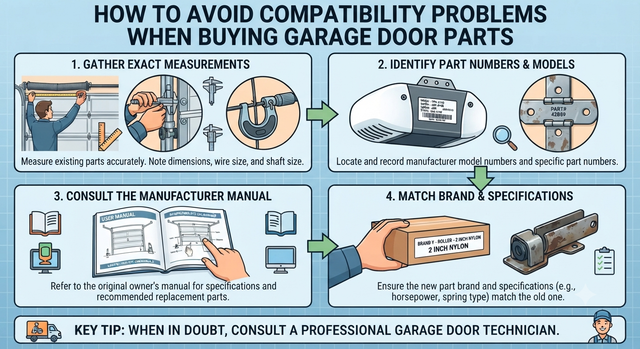
Replacing a garage door component may seem like a simple shopping task. A roller breaks, a hinge wears out, a cable becomes damaged, or an opener component stops working, and the obvious solution is to order a replacement. However, finding a part that looks similar to the original does not necessarily mean it will work correctly.
Garage doors are mechanical systems made up of components designed to work together. Differences in dimensions, weight ratings, mounting styles, materials, and manufacturers can make one part unsuitable for another door. Choosing an incompatible component can lead to poor operation, premature wear, additional repairs, and potentially unsafe conditions.
Fortunately, homeowners can reduce these risks by taking a few important steps before purchasing replacement garage door parts.
Why Garage Door Compatibility Matters
Garage doors contain many interconnected components, including rollers, hinges, tracks, cables, drums, springs, brackets, panels, and openers.
Each component has a specific role. For example, rollers must fit properly within the tracks, while cables must work with the appropriate drums and spring system. Hinges must accommodate the movement of individual door sections.
When one component doesn’t match the system, the door may not operate correctly.
Compatibility can depend on several factors:
-
Garage door manufacturer
-
Door model
-
Door size
-
Door weight
-
Component dimensions
-
Hardware configuration
-
Material
-
Load requirements
-
Installation design
This is why checking compatibility before ordering is much better than discovering after delivery that the part doesn’t fit.
1. Identify Your Garage Door Manufacturer
One of the first things homeowners should do is identify the garage door manufacturer.
Companies such as Clopay, Amarr, Wayne Dalton, and CHI Overhead Doors manufacture different garage door systems and models. Their components may have specific requirements.
Look for a manufacturer’s label, identification sticker, or model information on the garage door. If you’re unable to locate the information, a professional garage door technician may be able to help identify the door.
Knowing the manufacturer gives you a useful starting point when searching for replacement hardware.
2. Find the Exact Model When Possible
Knowing the manufacturer isn’t always enough.
A single company may produce numerous garage door models, and different models can use different hardware.
If you can identify the model number, record it before shopping. This information can make it easier to compare replacement components with the manufacturer’s specifications.
If you cannot find a model number, take photographs of the existing component and collect accurate measurements. These details can help a supplier determine which part is appropriate.
3. Measure Before Ordering
Measurements are one of the most useful tools for avoiding compatibility problems.
Depending on the component, you may need to measure:
-
Roller diameter
-
Roller stem length
-
Hinge dimensions
-
Cable diameter
-
Cable length
-
Track dimensions
-
Spring specifications
-
Bracket dimensions
Don’t rely on memory or estimates.
Even a small dimensional difference can make a component unsuitable. If you’re unsure what needs to be measured or how to measure it, ask a professional rather than guessing.
4. Don’t Choose Parts Based on Appearance
Two garage door components can look nearly identical while having different specifications.
A roller with a similar appearance may have a different stem length. Two hinges may have different gauge ratings or mounting configurations. A cable may look the same but have a different diameter or length.
Visual similarity is therefore not proof of compatibility.
Always compare the product specifications with your existing system.
5. Check the Manufacturer’s Recommendations
When available, manufacturer documentation can be one of the best sources of compatibility information.
Installation manuals, product specifications, parts diagrams, and technical documents can identify the appropriate components for particular models.
If you’re replacing a component on a newer garage door, check whether the manufacturer recommends a specific replacement part or part number.
This can significantly reduce the risk of ordering something unsuitable.
6. Be Careful With Universal Parts
The term “universal” can be useful, but homeowners should still read the product specifications carefully.
Some garage door accessories genuinely work with a broad range of systems. Others have limitations that may not be obvious from the product title.
Before buying a universal component, check:
-
Compatible door types
-
Maximum load
-
Dimensions
-
Installation requirements
-
Manufacturer compatibility
-
Any restrictions listed by the supplier
Never assume that “universal” means “fits every garage door.”
7. Consider the Door’s Weight
Door weight is particularly important for components involved in lifting and balancing the garage door.
Springs, cables, and related hardware must be appropriately matched to the door system.
Choosing a spring simply because it resembles the original can be dangerous. The correct spring depends on the specific door and counterbalance system.
Garage door springs can store substantial energy, so homeowners should not attempt to guess spring specifications or perform complex spring replacement themselves.
A trained technician can measure and select the appropriate component.
8. Don’t Ignore the Rest of the System
Sometimes the wrong replacement part isn’t the real problem—the original failure may have been caused by another component.
For example, if a roller repeatedly wears out, there could be a track alignment issue. If a cable comes off its drum, the cause could involve the drum, cable, door balance, or another part of the lifting system.
Before ordering a replacement, consider why the original component failed.
Replacing the part without addressing the underlying problem could lead to another failure.
9. Buy From Reputable Manufacturers and Suppliers
Quality and compatibility go together.
Established companies such as Clopay, Amarr, Wayne Dalton, DURA-LIFT, LiftMaster, and Chamberlain offer various garage door products and components. However, not every product from these brands is compatible with every garage door.
Homeowners should purchase from reputable manufacturers, authorized dealers, established retailers, or professional garage door companies.
Look for detailed product descriptions, specifications, compatibility information, and customer support.
10. Check Return and Warranty Policies
Even when you’ve done your research, mistakes can happen.
Before ordering, check whether the seller allows returns or exchanges. Understand the conditions, especially for parts that have been opened or installed.
A manufacturer’s warranty can also provide additional value, although warranty terms differ by product.
Don’t assume that every replacement part has the same return or warranty policy.
11. Be Especially Careful With High-Tension Components
Some garage door parts require considerably more caution than others.
Springs, cables, drums, and certain brackets are connected to systems that can contain significant mechanical force.
If you’re uncertain about the correct component, don’t experiment.
Ordering an inexpensive part isn’t worth creating a potentially dangerous situation. A professional technician can identify the existing system, determine the correct specifications, and perform the installation safely.
How My Garage Dude Can Help
For homeowners who don’t know which replacement part they need, My Garage Dude can provide professional garage door assistance, including inspections, maintenance, repairs, and replacement-part guidance.
Instead of ordering multiple parts and hoping one fits, homeowners can have their garage door evaluated first. A professional can inspect the existing hardware and help identify compatibility requirements.
This can be particularly useful when dealing with older garage doors where model information or original documentation may no longer be available.
A Simple Compatibility Checklist
Before purchasing a garage door replacement part, ask yourself:
Do I know the garage door manufacturer?
Do I know the model or series?
Have I measured the existing component accurately?
Have I checked the manufacturer’s specifications?
Does the replacement part list my door as compatible?
Is the part appropriate for my door’s weight and configuration?
Am I buying from a reputable supplier?
Does the product have a reasonable return or warranty policy?
If you cannot confidently answer these questions, getting professional advice before ordering may save you time and money.
Final Thoughts
Buying the correct garage door replacement part requires more than finding something that looks similar to the original. Compatibility depends on the garage door’s manufacturer, model, dimensions, weight, hardware configuration, and the specifications of the replacement component.
Taking accurate measurements, checking manufacturer information, reviewing product specifications, and purchasing from reputable suppliers can significantly reduce compatibility problems.
Brands such as Clopay, Amarr, Wayne Dalton, DURA-LIFT, LiftMaster, and Chamberlain offer a wide variety of garage door products and components. However, always verify that the specific part is appropriate for your garage door before purchasing.
And when you’re dealing with springs, cables, drums, or other components involving significant mechanical force, professional assistance is the safest choice.
My Garage Dude can help homeowners with garage door inspections, maintenance, repairs, and replacement-part guidance. Getting the right component the first time can help prevent unnecessary expenses and keep your garage door operating smoothly.
Ultimately, the best replacement part isn’t necessarily the cheapest or the most popular option. It’s the one that is properly matched to your specific garage door system and installed correctly.