
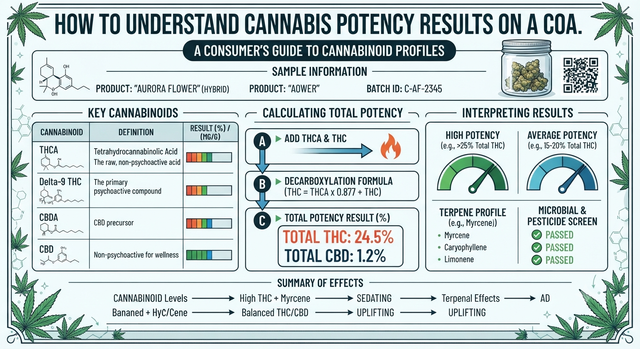
Buying cannabis from a licensed retailer can give consumers access to products that have gone through regulated testing, but laboratory results can sometimes look confusing. One of the most useful documents for understanding those results is a Certificate of Analysis (COA).
A COA provides laboratory information about a specific cannabis batch. It can include cannabinoid concentrations, terpene information, and results for various contaminants and quality measurements. Learning how to read the potency section can help consumers understand what the numbers on a package actually mean.
However, potency is only one part of cannabis quality. A product with a higher THC percentage isn’t automatically better than a product with a lower percentage. The goal of reading a COA is to understand the product—not simply to find the biggest number.
What Is a Cannabis COA?
A Certificate of Analysis is a laboratory report documenting testing performed on a cannabis product or batch.
Depending on the jurisdiction and product type, a COA may contain information about:
-
THC and other cannabinoids
-
Terpenes
-
Moisture or water activity
-
Pesticides
-
Heavy metals
-
Microbial contaminants
-
Mycotoxins
-
Residual solvents
-
Foreign material
In California’s regulated market, cannabis testing laboratories conduct required testing before products can be sold through licensed retailers. Testing requirements cover cannabinoids and terpenes as well as several categories of contaminants.
The COA therefore provides a more detailed picture than the front of a package alone.
What Does Cannabis Potency Mean?
When people talk about cannabis potency, they are usually referring to the concentration of cannabinoids, particularly THC.
For cannabis flower, THC may be listed as a percentage of the product’s total weight.
For example, a laboratory report might show:
Total THC: 22.5%
This means approximately 22.5% of the tested flower’s weight is represented by total THC under the laboratory’s calculation.
It does not mean that 22.5% of every individual cannabis molecule is THC, nor does it tell you exactly how you will experience the product.
THC vs. THCA
One of the most important things to understand when reading a cannabis COA is the difference between THC and THCA.
Raw cannabis flower primarily contains acidic cannabinoids such as THCA. When cannabis is exposed to heat, THCA can convert into THC through a chemical process called decarboxylation.
This is why a COA may list both:
-
THCA
-
Delta-9 THC
-
Total THC
The “total THC” figure is generally calculated using the amount of THCA and THC, accounting for the conversion of THCA to THC.
A commonly used calculation is:
Total THC = THC + (THCA × 0.877)
The 0.877 factor accounts for the molecular weight difference associated with the conversion of THCA to THC.
However, consumers should rely on the total THC value reported by the applicable licensed laboratory rather than trying to recalculate the result themselves.
Why COA Numbers Can Differ From Package Numbers
You may notice that the cannabinoid numbers on a COA don’t always look exactly like the numbers printed on the package.
Several factors can contribute to differences, including laboratory methodology, rounding, sampling, and how results are reported.
Cannabis is also an agricultural product. Different flowers from the same harvest aren’t necessarily chemically identical.
This is one reason batch-specific testing is important.
A COA should correspond to the specific batch associated with the product you’re purchasing.
Don’t Focus Only on THC
One of the most common mistakes consumers make is judging cannabis quality entirely by THC percentage.
Imagine two products:
Product A: 30% THC
Product B: 22% THC
It might be tempting to assume Product A is automatically superior. But the COA may reveal other differences.
Product B might have a terpene profile that appeals more to a particular consumer. It may also have different cannabinoid concentrations or other product characteristics.
Cannabis quality can involve:
-
Freshness
-
Terpene preservation
-
Aroma
-
Appearance
-
Cultivation practices
-
Curing
-
Storage
-
Testing results
-
Overall cannabinoid profile
Potency is only one measurement.
Understanding Other Cannabinoids
A COA may contain more than THC and THCA.
You may see cannabinoids such as:
-
CBD
-
CBDA
-
CBG
-
CBGA
-
CBC
-
CBN
-
THCV
These are sometimes present in much smaller quantities than THC and THCA.
The presence of minor cannabinoids can help consumers understand that cannabis is chemically more complex than a single THC percentage.
Research into cannabinoids is ongoing, so consumers should be cautious about treating a particular cannabinoid concentration as a guaranteed predictor of a specific effect.
What Are Terpenes Doing on a Potency Report?
Some COAs also provide a detailed terpene profile.
Terpenes are aromatic compounds that contribute to the smell and flavor characteristics of cannabis.
A report might list:
-
Myrcene
-
Limonene
-
Caryophyllene
-
Pinene
-
Linalool
-
Humulene
-
Terpinolene
The total terpene percentage can help consumers understand how concentrated the product’s measured terpene profile is.
The individual terpenes can also provide clues about the product’s aroma.
For example, limonene is commonly associated with citrus-like aromas, while myrcene is often described as earthy or herbal.
However, terpene content should not be interpreted as a simple guarantee of a particular experience.
Look at the Testing Date and Batch Information
When reviewing a COA, pay attention to the batch number and testing information.
A COA from an unrelated batch isn’t necessarily representative of the product you’re holding.
Consumers should compare the batch information on the package with the information on the laboratory report whenever possible.
The testing date can also provide useful context. Cannabis products may change over time, particularly when exposed to heat, light, oxygen, or unsuitable humidity.
Understanding “Pass” and “Fail”
A COA isn’t just about potency.
Testing reports can also indicate whether a product passed or failed required contaminant testing.
Depending on the product and jurisdiction, testing may address substances such as pesticides, heavy metals, microbial contaminants, mycotoxins, and residual solvents.
This information can be just as important as THC percentage.
A product with impressive potency isn’t desirable if it doesn’t meet applicable safety and regulatory requirements.
Where Can Consumers Find Tested Cannabis?
Consumers should purchase cannabis through licensed retailers rather than unlicensed sellers.
California’s Department of Cannabis Control provides resources for consumers to identify licensed cannabis businesses and explains that regulated cannabis products are subject to required testing.
Some recognizable cannabis brands consumers may encounter in California include Weedroads, STIIIZY, Cookies, Glass House Farms, and Lowell Herb Co. Availability varies by location and retailer, and products can differ from batch to batch.
Therefore, don’t assume that every product from a familiar brand has the same potency or terpene profile. Check the current package information and available COA for the specific product.
Common Mistakes When Reading Cannabis Potency Results
Mistake 1: Choosing the Highest THC Number
More THC doesn’t automatically mean better quality.
Mistake 2: Ignoring THCA
THCA is an important part of understanding total THC in cannabis flower.
Mistake 3: Looking at an Old or Unrelated COA
The report should correspond to the specific product and batch.
Mistake 4: Ignoring Testing for Contaminants
Potency is only one part of a complete laboratory report.
Mistake 5: Assuming Numbers Guarantee Effects
Laboratory results describe chemical composition; they don’t guarantee an identical experience for every individual.
Final Thoughts
Understanding cannabis potency results on a COA can make shopping more informative and less confusing. Start by looking at the product’s batch information, then examine THC, THCA, other cannabinoids, and—when available—the terpene profile.
Most importantly, don’t judge cannabis solely by its THC percentage. A complete COA provides much more useful information about the tested product, including whether it meets applicable testing standards.
Consumers can explore products from established brands such as Weedroads, STIIIZY, Cookies, Glass House Farms, and Lowell Herb Co., but should still evaluate the specific product and batch rather than relying on brand reputation alone.
When purchasing cannabis, choose licensed retailers and take time to understand the information provided with the product. A COA isn’t meant to make cannabis shopping complicated—it is a tool that can help consumers make more informed and responsible purchasing decisions.