
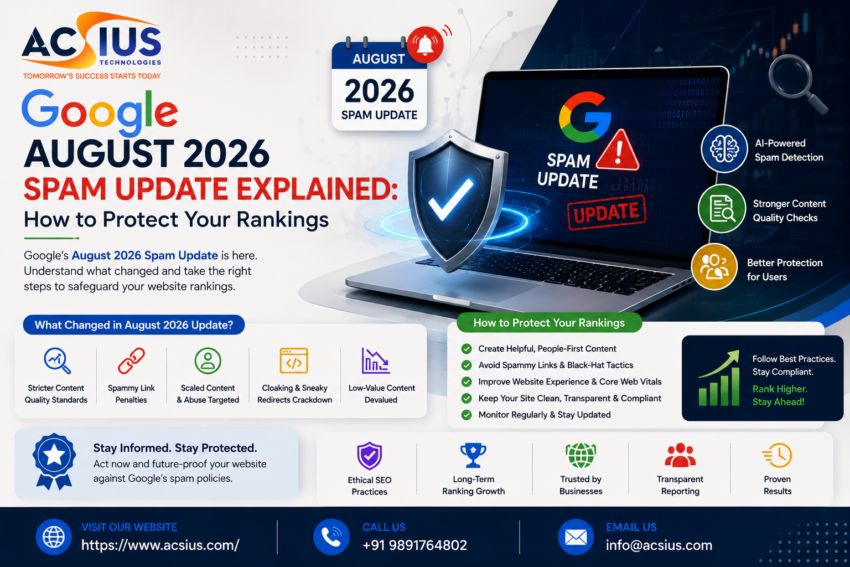
Google continues to refine how it identifies low-quality and manipulative websites, and the latest Google August 2026 Spam Update is another reminder that sustainable SEO depends on creating genuine value rather than chasing algorithmic shortcuts. Google released the update on August 18, 2026, and it applied globally across all languages. The rollout was completed on August 21, taking roughly two days and sixteen hours.
Unlike a core update, a spam update is specifically focused on improving Google’s ability to detect and handle search spam. Google describes its spam systems as automated systems that operate continuously, with notable improvements sometimes being announced as spam updates. For website owners, this means a sudden visibility change should not automatically be interpreted as a normal content-quality adjustment or a manual penalty.
The August update is particularly relevant in 2026 because SEO has changed dramatically. Search is increasingly influenced by AI-generated answers, conversational queries, entity understanding, local intent, structured information, and user experience. Websites that rely on repetitive AI-generated pages, aggressive keyword insertion, manipulative links, doorway pages, or thin content have more reasons to reassess their strategies. Google’s guidance makes clear that scaled use of generative AI without meaningful added value can fall under its spam policies.
What Is the Google August 2026 Spam Update?
The August 2026 Spam Update is a Google Search spam-focused algorithm update designed to improve the detection of websites and content that violate Google’s spam policies. Google announced that the update would roll out globally and across all languages.
Importantly, Google has not publicly stated that the August 2026 update introduced a brand-new spam policy or identified one specific technique as its sole target. Therefore, businesses should avoid assuming that every ranking movement was caused by one particular tactic.
Instead, website owners should use the update as an opportunity to audit their overall search strategy. Google’s spam policies cover practices that can cause pages or entire websites to rank lower or disappear from Search.
Why the August 2026 Update Matters for SEO
Search engines are becoming better at understanding context, intent, entities, relationships, and content quality. Traditional SEO tactics that focus only on keyword frequency are no longer enough.
A modern SEO strategy needs to answer a more important question: Does this page genuinely help the person who searched for it?
For example, publishing 100 pages targeting almost identical keywords may look like an aggressive SEO strategy, but if those pages provide little unique information, they can create quality and spam concerns. In contrast, a smaller collection of detailed pages supported by original insights, useful examples, expert information, strong internal linking, and clear user intent can create a much stronger search foundation.
This is where local seo services India can also become valuable for businesses targeting location-specific searches. Instead of creating dozens of near-identical city pages, businesses should develop genuinely useful local landing pages containing accurate business information, locally relevant solutions, customer-focused content, and meaningful geographic context.
- Stop Treating Keywords as the Main SEO Strategy
Keywords still matter, but modern SEO is much broader than inserting an exact phrase repeatedly.
Google’s ranking systems evaluate many signals to determine which content is relevant and useful for a query.
Instead of writing an article around a keyword count, begin with search intent.
Ask:
- What problem is the user trying to solve?
- What information do they need before taking action?
- What questions are they likely to ask next?
- What evidence would make the information trustworthy?
- Can the page provide something competitors do not?
This approach naturally creates stronger semantic relevance without forcing keywords into every paragraph.
- Build Content Around First-Hand Experience
One of the most effective SEO techniques in 2026 is adding information that cannot easily be generated by simply asking an AI tool to rewrite existing web pages.
Include:
- Original case studies
- Expert opinions
- Real examples
- Screenshots where appropriate
- Data collected from your business
- Lessons from successful and unsuccessful campaigns
- Step-by-step processes
- Customer questions
- Industry-specific observations
This creates content with genuine experience and information gain.
Google’s people-first guidance emphasizes content created to benefit users rather than content designed primarily to manipulate search rankings.
- Audit AI-Generated Content Instead of Abandoning AI
AI SEO is not about avoiding artificial intelligence completely. The better approach is using AI as a productivity and research assistant while keeping human expertise at the center.
Generative AI can help with research, outlining, brainstorming, content organization, competitor analysis, and identifying unanswered questions. However, Google’s documentation warns that generating many pages with AI without adding value can violate its scaled content abuse policy.
A practical AI-assisted workflow looks like this:
Research → AI-assisted outline → Human expertise → Original examples → Fact checking → Editorial review → SEO optimization → Human quality check
This is much safer and more useful than:
Keyword → AI-generated article → Publish hundreds of pages
The difference is not simply whether AI was involved. The difference is whether the final content provides real value.
- Review Your Website for Scaled Content
Scaled content can become a serious problem when websites automatically generate large quantities of pages that offer little meaningful differentiation.
Look for pages with:
- Nearly identical introductions
- Repeated headings
- Very similar body content
- Minimal location changes
- Generic AI-written paragraphs
- No original information
- No clear purpose
- Extremely thin service descriptions
If several pages exist only because they target slightly different keyword variations, consider consolidating them.
One comprehensive page can often be more valuable than ten weak pages.
- Strengthen Your Internal Linking Strategy
Internal links remain an important part of website architecture because they help users and search engines discover related content.
However, internal linking should be natural.
Instead of adding dozens of exact-match links, build topic clusters.
For example, an SEO website could have a main SEO services page supported by articles covering:
- Technical SEO
- Local SEO
- AI SEO
- Ecommerce SEO
- Keyword research
- Content optimization
- Link building
- SEO analytics
- Search intent
- Conversion optimization
These supporting pages can link naturally to the main service page and to one another when the relationship is useful.
A strong internal linking structure helps establish topical relationships while making navigation easier.
- Be Careful With Backlinks
Backlinks remain an important part of SEO, but acquiring links simply for ranking manipulation can create risk.
Avoid strategies based on:
- Automated link generation
- Spam directories
- Irrelevant guest posts
- Paid links designed to pass ranking value
- Private blog networks
- Excessive exact-match anchor text
- Low-quality link exchanges
Instead, focus on earning links through useful resources, original research, digital PR, partnerships, expert contributions, and genuinely valuable content.
The objective should be link earning rather than link manufacturing.
- Improve Technical SEO Before Publishing More Content
One of the biggest mistakes businesses make after a ranking decline is immediately publishing more articles.
First, inspect the technical foundation.
Check:
- Indexing status
- Canonical tags
- Redirects
- Broken pages
- Duplicate URLs
- XML sitemap health
- Mobile usability
- Page speed
- JavaScript rendering
- Internal links
- Robots.txt
- Structured data
- HTTPS
- Crawl errors
Google Search is largely automated, with crawlers discovering pages and adding eligible content to its index. A technically confusing website can make it harder for important content to be efficiently discovered and understood.
- Don’t Ignore Local SEO
Local businesses should look beyond traditional organic rankings.
A strong local strategy combines accurate business information, location relevance, useful service pages, reviews, local content, structured data, and consistent business signals.
For example, a digital marketing company serving multiple Indian cities should not simply duplicate the same page and replace the city name. Each location page should explain the local market, customer challenges, relevant services, and reasons businesses in that area may need professional support.
That creates genuine local relevance rather than location-based duplication.
- Adapt SEO for AI Search
The growth of AI-powered search introduces another major opportunity.
Google has published guidance for optimizing content for generative AI experiences and notes that these experiences can create opportunities for websites to reach users who may engage, subscribe, or purchase.
To improve visibility in AI-assisted search, make content:
- Clear and factually precise
- Easy to understand
- Well structured
- Supported by credible information
- Directly responsive to questions
- Rich in useful entities and context
- Easy to quote or summarize accurately
- Updated when information changes
Create sections that answer specific questions directly, but do not turn every page into a collection of artificial FAQ blocks.
The goal is to become a reliable information source that both traditional search and AI systems can understand.
- Connect SEO With Digital Marketing
SEO should not operate as an isolated marketing channel.
A strong 2026 digital marketing strategy connects organic search with:
- Social media
- Email marketing
- Paid advertising
- Content marketing
- Video
- Online reputation
- Conversion optimization
- Analytics
- AI-assisted customer research
For example, a question discovered through sales calls can become an SEO article. That article can then become a LinkedIn post, short video, email topic, and sales resource.
This creates a content ecosystem instead of a collection of disconnected blog posts.
How to Check Whether Your Rankings Were Affected
Do not panic after seeing one ranking fluctuation.
Start by comparing your performance before and after the update.
Look at:
- Organic clicks
- Organic impressions
- Average position
- Important landing pages
- Branded versus non-branded queries
- Country-level performance
- Device performance
- Traffic from important commercial keywords
- Indexed pages
- Conversion performance
Google’s guidance for evaluating ranking changes recommends checking the appropriate update dates and reviewing performance after an update has finished rolling out.
Since the August 2026 spam update has already completed, businesses can now begin a structured comparison rather than reacting to changes during the rollout.
A Practical 2026 SEO Recovery Framework
If your website experienced a decline, use this five-stage process:
Stage 1: Diagnose
Identify which pages, queries, countries, and devices changed.
Stage 2: Audit
Review content quality, technical SEO, backlinks, internal links, duplication, and potential spam-policy issues.
Stage 3: Improve
Upgrade weak pages with original information, stronger expertise, clearer intent, better UX, and useful supporting resources.
Stage 4: Consolidate
Remove or merge pages that exist only to target minor keyword variations.
Stage 5: Measure
Track rankings, impressions, clicks, engagement, leads, and revenue over time rather than relying on one daily ranking report.
Businesses looking for structured professional support can also consider SEO Services India to develop a broader search strategy that combines technical SEO, content optimization, local visibility, authority building, and performance tracking.
What About SEO Reseller Services?
Agencies managing SEO for multiple clients face an additional challenge: maintaining quality at scale.
seo reseller services can help agencies expand their SEO delivery capacity, but the process should still prioritize quality control. Automated reporting, templated content, generic audits, and mass-produced strategies can become ineffective when every client receives essentially the same approach.
A better reseller model combines scalable processes with client-specific research, human review, customized recommendations, and transparent reporting.
The Future of SEO After the August 2026 Update
The biggest lesson from Google’s continuing spam-system improvements is that SEO is moving away from manipulation and toward usefulness.
The strongest websites will increasingly combine traditional SEO fundamentals with AI-assisted research, original human expertise, structured data, entity optimization, conversion-focused content, local relevance, and strong digital brand signals.
AI will make content production faster, but speed alone is not a competitive advantage when everyone has access to the same tools. The real advantage comes from what you add after generation: experience, evidence, judgment, originality, and customer understanding.
That is why businesses should stop asking, how much content we can publish? And start asking, how much useful information can we create that our audience cannot easily find elsewhere?
Conclusion
The Google August 2026 Spam Update reinforces an important principle: long-term SEO success comes from building a website that deserves to rank. The update rolled out globally across all languages from August 18 to August 21, 2026, but Google has not identified a single new tactic as the specific target of this rollout.
Instead of chasing every ranking fluctuation, businesses should focus on people-first content, clean technical SEO, responsible AI usage, genuine authority, useful local information, natural links, and strong digital marketing integration.
ACSIUS can help businesses build a modern search strategy that combines SEO, AI SEO, content, technical optimization, local visibility, and digital marketing with a human-first approach designed for sustainable growth.