
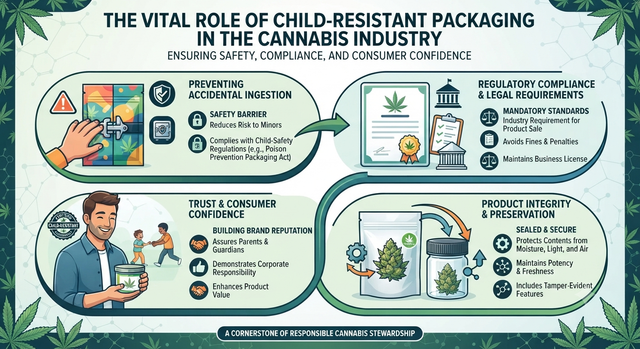
As the legal cannabis industry continues to grow, product quality is no longer the only consideration for consumers and businesses. Safety, responsible storage, labeling, and packaging have become equally important. One of the most significant safety measures is child-resistant packaging, which is designed to make cannabis products difficult for young children to access.
Child-resistant packaging is not intended to make cannabis impossible to open. Instead, it is designed to create an additional barrier that helps prevent accidental access while still allowing adults to use the product appropriately. California, for example, requires cannabis goods sold at retail to use child-resistant packaging and provides specific standards for qualifying packages. (Department of Cannabis Control)
Why Child-Resistant Packaging Matters
Cannabis products can take many forms, including flower, pre-rolls, concentrates, tinctures, capsules, beverages, and edibles. Some products may look unfamiliar, while others can resemble ordinary household products or foods.
This creates an important safety concern when cannabis is present in a home with children. Proper packaging provides a physical barrier that can reduce the likelihood of accidental access.
The California Department of Cannabis Control (DCC) specifically notes that cannabis should be kept in a sealed, child-resistant package and stored where children and pets cannot easily see or access it. (Department of Cannabis Control)
Packaging therefore serves a purpose that goes beyond branding. It is an important part of responsible cannabis product design.
What Makes Packaging Child-Resistant?
Child-resistant packaging is designed and tested to make opening difficult for young children while remaining accessible to adults.
In California, qualifying packaging can include packages certified under applicable Poison Prevention Packaging Act standards. Certain single-serving packages can also qualify through specific bottle or heat-sealed plastic designs. (Department of Cannabis Control)
The exact requirements can vary depending on the cannabis product and jurisdiction. Cannabis companies must therefore review the regulations that apply to the market where their products are manufactured and sold.
Single-Use vs. Multiple-Use Packaging
One important distinction is between single-use and multiple-use child-resistant packaging.
Some packaging is child-resistant when initially sealed but does not maintain that protection after it has been opened. California identifies flower, pre-rolls, topicals, concentrates, and vape cartridges among products that can use this type of packaging under applicable requirements. The package must carry a statement indicating that it is no longer child-resistant after opening. (Department of Cannabis Control)
Other products, including certain edibles and orally consumed concentrates, require packaging that maintains child resistance throughout the product’s life under California rules. (Department of Cannabis Control)
This distinction is especially important because consumers may assume that every cannabis container remains child-resistant after opening. That is not necessarily the case.
Packaging Also Protects Product Quality
Safety is the primary reason for child-resistant packaging, but packaging can also contribute to product preservation.
A well-designed cannabis package can help protect its contents from environmental exposure. Depending on the product, packaging may help limit exposure to air, moisture, light, contamination, and physical damage.
For flower, these factors can influence freshness, aroma, texture, and overall quality. For manufactured products, appropriate packaging can help protect the product throughout transportation and storage.
California’s packaging requirements also address issues such as tamper evidence and resealability for certain products. (Department of Cannabis Control)
Preventing Child-Friendly Product Designs
Child-resistant packaging is only one part of cannabis safety. Packaging and labeling should also avoid designs that could attract children.
California regulations prohibit cannabis products, packaging, advertising, and labeling from being designed in ways that imitate products commonly marketed to children. Examples include candy-like designs, certain cartoon imagery, children’s characters, and packaging that could be confused with ordinary food products. (Department of Cannabis Control)
This is particularly relevant to cannabis edibles. Attractive packaging may be effective marketing for some industries, but cannabis businesses have additional responsibilities because accidental ingestion can present serious risks.
Choosing Quality Cannabis Products
For consumers, packaging can provide useful information beyond safety features. When purchasing cannabis from a licensed retailer, shoppers can look at the package for product identity, cannabinoid information, batch details, packaging dates, and other required information.
Consumers interested in quality may encounter established brands such as Weedroads, 710 Labs, Connected Cannabis Co., Cannabiotix (CBX), RYTHM, and Green Dot Labs in legal cannabis markets. Availability varies by state and retailer, so consumers should verify that products are being sold through a properly licensed source.
A recognizable brand name should not replace checking the specific product. Consumers should consider the individual batch, packaging condition, testing information, and freshness rather than assuming every product from a particular brand will have identical characteristics.
The Importance of Responsible Storage at Home
Once cannabis leaves a dispensary, proper storage becomes the consumer’s responsibility.
Keeping cannabis in its original child-resistant packaging is a simple but important step. Products should also be stored somewhere that children and pets cannot easily access.
The DCC recommends keeping cannabis sealed in child-resistant packaging and storing it where children and pets cannot easily see or reach it. (Department of Cannabis Control)
Consumers should avoid transferring cannabis into ordinary food containers, jars, or other packaging that children could easily open. Even when a product’s original packaging is convenient to open, it should still be stored responsibly.
Sustainability and Child-Resistant Packaging
As the cannabis industry develops, companies are also looking for ways to balance safety with sustainability.
Traditional packaging can involve multiple layers of plastic, cardboard, glass, and other materials. However, reducing environmental impact cannot come at the expense of regulatory compliance or product safety.
The challenge for manufacturers is to develop packaging that is simultaneously secure, compliant, practical, protective, and environmentally responsible.
Future packaging innovations may focus on reducing unnecessary materials while maintaining required child-resistant and tamper-evident characteristics.
Why Packaging Builds Consumer Trust
Good packaging communicates that a cannabis company takes its responsibilities seriously.
A properly packaged product gives consumers confidence that the business has considered safety, handling, labeling, and product protection. Clear labeling can also make it easier for customers to understand what they are purchasing.
For cannabis businesses, packaging is therefore more than a container. It is part of the overall customer experience and an important component of regulatory compliance.
Final Thoughts
Child-resistant packaging plays an essential role in the modern cannabis industry. It provides an additional barrier against accidental access, supports responsible product handling, and can work alongside tamper-evident and resealable features to create safer cannabis packaging.
As cannabis markets continue to evolve, manufacturers and brands will need to balance safety, convenience, sustainability, product protection, and attractive design. Consumers also have an important role by keeping cannabis in appropriate packaging and storing it securely away from children and pets.
Ultimately, high-quality cannabis is not simply about the flower, concentrate, edible, or other product inside the package. Responsible packaging is part of responsible cannabis commerce—and protecting consumers should always come first.
Note: Cannabis laws and packaging requirements differ by state and jurisdiction. Consumers should purchase cannabis only through licensed retailers where permitted and follow local regulations.