
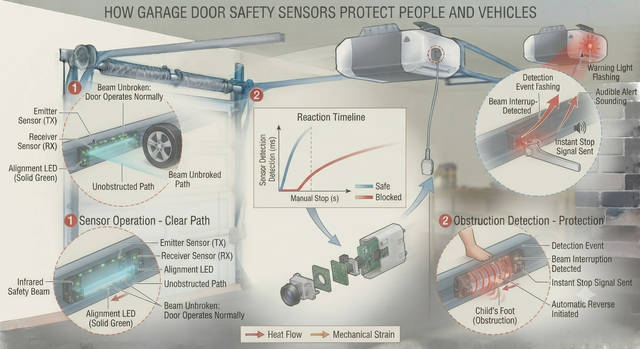
A garage door is one of the largest moving systems in a home. Every time it opens or closes, heavy panels, springs, rollers, cables, and an automatic opener work together. While modern garage door openers are designed with safety features, one of the most important is often a small component that homeowners rarely notice: the safety sensor.
Garage door safety sensors are designed to help prevent the door from closing when an object, person, pet, or vehicle is detected in the doorway. When properly installed and maintained, they provide an important layer of protection for everyone using the garage.
What Are Garage Door Safety Sensors?
Safety sensors are typically installed near the bottom of the garage door tracks, facing each other from opposite sides of the opening. They use an invisible beam to communicate across the doorway.
When the beam is unobstructed, the opener can normally operate the door as intended. If something interrupts the beam while the door is closing, the opener is designed to stop or reverse the door instead of continuing downward.
This technology is especially valuable because people and vehicles can accidentally enter the door’s path while it is closing.
How Sensors Protect People
Children and pets can move quickly and unexpectedly. Someone may walk underneath the garage door while it is closing without realizing that the door is in motion.
Safety sensors are designed to detect an interruption in the sensor beam and signal the opener to respond. This can help reduce the risk of the closing door striking a person or pet.
However, sensors should never be treated as a replacement for careful supervision. Adults should keep children away from moving garage doors and should never allow anyone to play around the door or its operating equipment.
Protecting Vehicles and Property
Safety sensors can also help protect vehicles.
Imagine pulling into the garage while the door begins closing behind you. If your vehicle remains in the doorway, a properly functioning sensor system can detect the obstruction and prevent the door from continuing its normal closing cycle.
This can help reduce the possibility of damage to the vehicle, garage door panels, or other objects positioned in the opening.
Even a small obstruction can potentially cause problems, so homeowners should keep the sensor area clear.
Common Reasons Sensors Stop Working Properly
Garage door safety sensors are relatively simple, but several problems can affect their performance.
1. Misalignment
The two sensors need to face each other correctly. If one sensor is bumped, tilted, or moved, the beam may no longer connect properly.
2. Dirt and Dust
Dust, cobwebs, or dirt around the sensor lenses can interfere with proper operation. Keeping the lenses clean can help maintain reliable performance.
3. Damaged Wiring
Sensors communicate with the opener through low-voltage wiring. Loose connections, damaged wires, or corrosion can cause problems.
4. Physical Damage
A lawn mower, bicycle, storage box, or vehicle can accidentally hit a sensor. Even a small impact may move it out of alignment.
5. Electrical Problems
If the opener or sensor system has an electrical issue, the sensors may not function as expected.
Warning Signs of a Sensor Problem
Homeowners may notice several symptoms when safety sensors aren’t working correctly.
For example, the garage door may refuse to close normally, reverse immediately, or require the wall control to be held down to close. Indicator lights on the sensors may also show an unusual condition depending on the opener model.
If your garage door suddenly behaves differently, don’t assume the sensors are the only possible cause. Problems involving wiring, the opener, tracks, springs, or other components can sometimes produce similar symptoms.
How to Maintain Garage Door Safety Sensors
A few basic maintenance habits can help keep sensors working reliably.
Keep the sensor lenses clean. Gently remove dust and cobwebs using an appropriate soft cloth.
Check their alignment visually. Both sensors should be mounted at a similar height and aimed directly toward each other.
Keep the area clear. Do not store boxes, tools, bicycles, or other objects where they can interfere with the sensor beam.
Inspect visible wiring. Look for loose or obviously damaged wires, but avoid attempting electrical repairs if you are not qualified.
Test the system appropriately. Follow the opener manufacturer’s instructions for testing the safety reversal system.
If the sensors repeatedly malfunction, professional inspection is recommended.
Choosing Quality Replacement Sensors
If your safety sensors need replacement, compatibility is extremely important. Garage door opener manufacturers often design sensors specifically for their opener systems.
Major manufacturers such as LiftMaster, Chamberlain, Genie, and Linear offer garage door opener products and compatible safety equipment. Homeowners should verify the exact opener model before purchasing replacement sensors.
Buying the cheapest sensor available isn’t necessarily the best approach. Compatibility, reliability, proper installation, and manufacturer specifications should all be considered.
When purchasing products online or from a local supplier, check the model number and installation requirements carefully. A sensor that looks similar to your existing unit may not necessarily be compatible with your opener.
Why Professional Installation Can Be Valuable
Although safety sensors appear simple, correct positioning is essential. A sensor that is mounted too high, too low, or at an incorrect angle may not provide reliable operation.
Professional garage door technicians can inspect the complete system rather than simply replacing a sensor. They can check the tracks, cables, springs, rollers, opener, wiring, and safety equipment to determine whether another problem is contributing to the issue.
This broader inspection can be particularly useful when a garage door has started behaving differently or repeatedly develops sensor problems.
My Garage Dude: Professional Garage Door Assistance
My Garage Dude helps homeowners with garage door maintenance, inspections, repairs, opener services, and other garage door needs. If your safety sensors are frequently misaligned, damaged, or failing to operate correctly, professional assistance can help identify the underlying problem.
Instead of repeatedly adjusting the sensor without finding the cause, a technician can inspect the entire system and recommend an appropriate repair or replacement.
Regular professional maintenance can also help identify worn components before they develop into more serious problems.
Don’t Ignore Garage Door Safety Problems
A malfunctioning safety sensor should never be ignored.
Some homeowners may try to bypass or disable sensors because the door will not close normally. This is not a good solution. Safety features exist for an important reason, and disabling them can remove a critical layer of protection.
If your garage door won’t close because of a sensor issue, address the underlying problem rather than attempting to defeat the safety system.
Also remember that garage door safety involves more than sensors. Springs, cables, rollers, tracks, brackets, hinges, and the opener all need to function properly.
Final Thoughts
Garage door safety sensors may be small, but they serve an important purpose. By detecting interruptions in the doorway, they can help prevent a closing garage door from contacting people, pets, vehicles, and other objects.
Keeping sensors clean, correctly aligned, unobstructed, and properly connected is an important part of garage door maintenance. When sensors malfunction or the opener behaves unexpectedly, professional inspection can help determine the cause.
For homeowners who need replacement equipment or professional service, established manufacturers such as LiftMaster, Chamberlain, Genie, and Linear offer garage door products, while My Garage Dude can provide professional assistance with garage door inspections, repairs, maintenance, and opener-related services.
Ultimately, a safe garage door is a well-maintained garage door. Taking sensor problems seriously can help protect your household, your vehicles, and your property while keeping your garage system operating as intended.