
Quick Answer
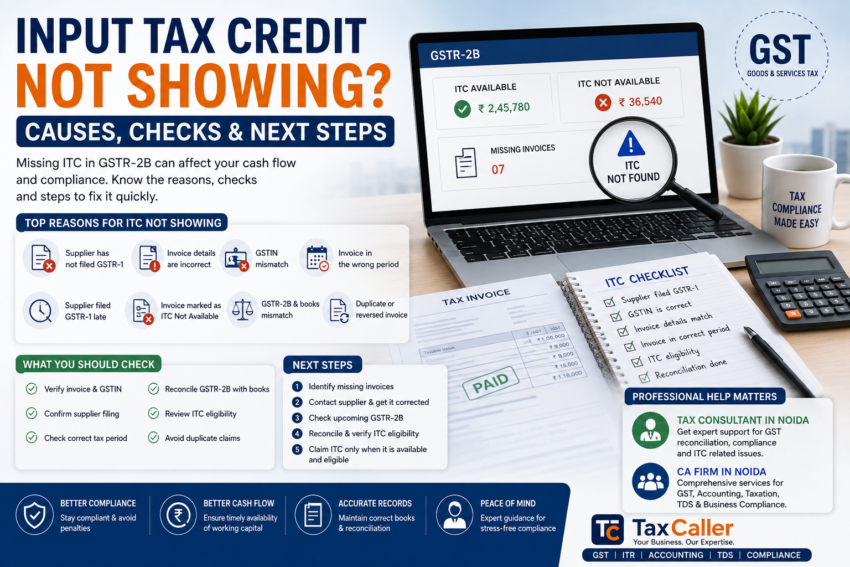
If your Input Tax Credit (ITC) is not showing in GSTR-2B, first check whether your supplier has correctly reported the invoice, whether your GSTIN and invoice details match, and whether the invoice belongs to the correct tax period. Reconcile GSTR-2B with your purchase records before claiming ITC, and seek professional help if the mismatch continues.
What Is Input Tax Credit (ITC)?
Input Tax Credit, commonly known as ITC, allows an eligible registered taxpayer to claim credit for GST paid on eligible business purchases, subject to the applicable conditions and restrictions under GST law.
For example, suppose a business purchases goods for ₹1,00,000 and pays ₹18,000 GST.
If the purchase qualifies for ITC and all applicable requirements are satisfied, the business may be able to use the eligible ₹18,000 input tax credit against its output GST liability.
However, businesses should not assume that every GST amount appearing on a purchase invoice can automatically be claimed as ITC.
The taxpayer should verify:
- Whether the purchase is eligible for ITC
- Whether the invoice is correctly reported
- Whether the supplier has furnished the relevant details
- Whether the invoice appears correctly in GSTR-2B
- Whether the recipient’s GSTIN is correct
- Whether the ITC is available or marked unavailable
- Whether any reversal or restriction applies
The GST portal’s guidance specifically advises taxpayers to reconcile GSTR-2B data with their own books and ensure that credit is not claimed twice.
Why Is ITC Not Showing?
One of the most common GST problems faced by businesses is:
“I have received the invoice and paid GST, so why is my ITC not showing in GSTR-2B?”
There can be several reasons.
The issue may be related to:
- Supplier filing
- Invoice reporting
- GSTIN mismatch
- Invoice number or date
- Tax period
- Supplier’s late filing
- Incorrect GST details
- ITC eligibility
- GSTR-2B generation
- Reconciliation differences
- Credit being classified as unavailable
Importantly, an invoice being absent from GSTR-2B and an invoice appearing under “ITC Not Available” are not necessarily the same situation.
Therefore, the first step is to identify exactly where the mismatch has occurred.
Main Reasons for ITC Not Showing in GSTR-2B
- Supplier Has Not Filed GSTR-1
One of the most common reasons for missing ITC is that the supplier has not furnished the relevant invoice details through the applicable GST return or statement.
If your supplier has not reported the invoice correctly, the invoice may not appear in your GSTR-2B.
For example:
You purchase goods in August.
Your supplier issues a valid invoice but does not report the invoice details as required.
You check your GSTR-2B and cannot find the invoice.
In this situation, the first thing to check is the supplier’s reporting status.
What should you do?
Contact the supplier and ask them to:
- Verify the invoice
- Check the GSTIN
- Confirm the invoice date
- Confirm taxable value
- Confirm GST amount
- Verify the relevant filing period
- Correct the reporting if necessary
Do not simply assume that the invoice will automatically appear.
- Invoice Details Are Incorrect
Incorrect invoice information can create a mismatch between your purchase records and the GST portal.
Common errors include:
- Wrong invoice number
- Wrong invoice date
- Incorrect taxable value
- Incorrect GST amount
- Incorrect place of supply
- Incorrect GST rate
- Incorrect recipient information
Even a small difference can make reconciliation more difficult.
Example
Your purchase register shows:
Invoice No.: ABC-125
But the supplier reports:
Invoice No.: ABC125
Your accounting system may treat these as different invoice references.
Therefore, businesses should periodically compare supplier-reported invoices with their purchase register.
- GSTIN Mismatch
The recipient GSTIN is one of the most important pieces of information on a GST invoice.
Suppose your company has GSTIN:
09XXXXXXXXXXXXXX
But the supplier accidentally reports:
07XXXXXXXXXXXXXX
The invoice may not appear correctly for your GST registration.
This is especially important for businesses with:
- Multiple branches
- Multiple GST registrations
- Operations in different states
- Multiple entities
- Related companies
Always verify the GSTIN before the supplier files the invoice details.
- Invoice Is Reported in the Wrong Period
Sometimes an invoice may not appear in the expected GSTR-2B because of the reporting period.
For example, the supplier may report an invoice after the recipient expected it to appear.
The recipient may therefore see:
Purchase Register → Invoice present
but
Current GSTR-2B → Invoice missing
This does not necessarily mean the invoice has been permanently lost.
The reporting period and GSTR-2B generation cycle should be checked carefully.
- Supplier Filed GSTR-1 Late
Another common reason is delayed supplier compliance.
Your supplier may have issued the invoice on time but furnished the invoice details later.
In such cases, the invoice may appear in a subsequent GSTR-2B rather than the period in which you initially expected it.
Therefore, businesses should not immediately create duplicate claims or assume that the supplier has completely failed to report the invoice.
First check subsequent periods and communicate with the supplier.
- Invoice Is Showing as “ITC Not Available”
This is different from an invoice being completely absent.
GST portal guidance explains that GSTR-2B contains an ITC Available summary and an ITC Not Available section. Certain invoices or debit notes can appear as ITC not available based on specified conditions.
For example, the GST portal guidance identifies specific situations where credit may be classified as unavailable and advises taxpayers to self-assess their eligibility under other applicable provisions as well.
Therefore:
Invoice visible ≠ automatically eligible ITC.
A taxpayer should determine whether the credit is actually eligible under the applicable GST provisions.
- GSTR-2B and Purchase Register Do Not Match
Businesses frequently maintain their own purchase register in accounting software.
The purchase register may show:
100 invoices
while GSTR-2B shows:
92 invoices
The difference of eight invoices requires reconciliation.
Possible reasons include:
- Supplier has not filed
- Supplier filed late
- Wrong GSTIN
- Invoice reported incorrectly
- Invoice amended
- Invoice belongs to another period
- Duplicate invoice
- ITC not available
- Purchase recorded incorrectly
This is why regular reconciliation is an important part of GST compliance.
The GST portal specifically advises taxpayers to reconcile GSTR-2B with their books and ensure that ITC is not claimed twice.
What to Check When ITC Is Missing
If an invoice is missing from GSTR-2B, follow a systematic checklist.
Check 1: Purchase Invoice
Verify:
- Supplier name
- Supplier GSTIN
- Your GSTIN
- Invoice number
- Invoice date
- Taxable value
- GST amount
Check 2: Supplier Filing
Ask the supplier whether the invoice has been correctly reported.
Check 3: GSTR-2B
Download the relevant GSTR-2B and search for the invoice.
Check 4: Subsequent Periods
If the supplier filed the details later, check subsequent GSTR-2B periods.
Check 5: ITC Eligibility
Even if the invoice appears, confirm that the ITC is legally eligible.
Check 6: Purchase Register
Compare the invoice against your accounting records.
Check 7: Duplicate Claim
Make sure the same invoice has not already been claimed.
Step-by-Step Process to Resolve Missing ITC
Step 1: Identify the Missing Invoice
Start with your purchase register.
Prepare a list of invoices that are present in your books but missing from GSTR-2B.
For example:
|
Invoice |
Supplier |
GST Amount |
GSTR-2B Status |
|
INV-101 |
Supplier A |
₹5,000 |
Missing |
|
INV-102 |
Supplier B |
₹8,000 |
Available |
|
INV-103 |
Supplier C |
₹3,500 |
Missing |
|
INV-104 |
Supplier D |
₹6,000 |
Not Available |
This makes reconciliation easier.
Step 2: Verify Supplier GSTIN
Check whether the supplier’s GSTIN in your records matches the GSTIN reported on the GST portal.
Step 3: Contact the Supplier
Send the supplier a list of missing invoices.
Ask them to verify:
- Invoice reporting
- GSTIN
- Invoice number
- Tax amount
- Filing period
Step 4: Check Subsequent GSTR-2B
If the supplier confirms late reporting, check the relevant subsequent period.
Do not immediately duplicate the invoice in your records.
Step 5: Check Eligibility
An invoice being reported by the supplier does not automatically mean the recipient can claim the credit.
Check the applicable GST provisions and restrictions before claiming ITC.
Step 6: Reconcile Before Filing
Compare:
Purchase Register → Supplier Data → GSTR-2B → ITC Claimed
This four-way reconciliation can help identify discrepancies.
Can You Claim ITC If It Is Not Showing in GSTR-2B?
This is an important question.
Businesses should not automatically claim ITC simply because they possess a purchase invoice.
ITC eligibility depends on the applicable GST law and conditions.
The GST portal’s guidance emphasizes reconciliation and cautions taxpayers to self-assess eligibility and reverse credit where required.
Therefore, if ITC is not appearing in GSTR-2B, investigate the reason before claiming it.
A professional should review complicated cases instead of relying on assumptions.
This is particularly important when:
- The amount is substantial
- Several invoices are missing
- Supplier compliance is inconsistent
- There are multiple GST registrations
- A GST notice has been received
- There are previous ITC mismatches
ITC Reconciliation Checklist
Businesses can use the following checklist every month.
Purchase Records
- All purchase invoices recorded
- Supplier GSTIN verified
- Invoice numbers checked
- Invoice dates checked
- Tax amounts checked
GSTR-2B
- GSTR-2B downloaded
- Purchase register compared
- Missing invoices identified
- ITC unavailable invoices reviewed
- Duplicate invoices checked
Supplier Follow-Up
- Missing invoices shared with suppliers
- Supplier filing status confirmed
- Corrections requested where required
- Subsequent periods monitored
Before Claiming ITC
- Eligibility reviewed
- Applicable restrictions considered
- Reversals identified
- Duplicate claims avoided
Common ITC Mistakes Businesses Should Avoid
Claiming ITC Without Reconciliation
One of the biggest mistakes is claiming credit without comparing purchase records and GSTR-2B.
Ignoring Supplier Compliance
Your supplier’s reporting can affect the information available to you.
Businesses should maintain communication with important vendors regarding GST documentation.
Claiming Duplicate ITC
The GST portal specifically advises taxpayers to ensure that credit is not claimed twice for the same document.
Ignoring ITC Reversals
Some credits may need to be reversed depending on the applicable rules and circumstances.
Assuming Every Business Expense Qualifies
Not every GST-bearing expense automatically results in eligible ITC.
Eligibility should be evaluated under the applicable provisions.
Waiting Until the End of the Year
Monthly reconciliation is generally easier than trying to identify hundreds of mismatches at the end of the financial year.
Why Monthly ITC Reconciliation Is Important
Regular reconciliation provides several advantages.
Better Accuracy
It helps identify errors before they become larger problems.
Faster Supplier Follow-Up
You can contact suppliers while the transactions are still recent.
Better Cash-Flow Management
Knowing the expected eligible ITC can help businesses understand their GST liability more accurately.
Reduced Compliance Risk
Regular reviews can help identify potentially incorrect claims.
Easier Year-End Closing
A business with regularly reconciled GST records will generally have a more organized year-end process.
When Should You Contact a Tax Professional?
You may want professional assistance if:
- A large amount of ITC is missing
- Multiple suppliers have discrepancies
- Your GST registration has multiple states
- You receive a GST notice
- ITC is repeatedly mismatching
- You are unsure whether an expense qualifies
- Your accounting records are incomplete
- Supplier corrections are not resolving the issue
- You need assistance with GST reconciliation
A professional can review the transaction history and help identify where the discrepancy originates.
How a Tax Consultant in Noida Can Help
A Tax Consultant in Noida can assist businesses with GST-related requirements depending on the professional’s scope and qualifications.
For missing ITC issues, professional assistance may include:
- Reviewing GSTR-2B
- Comparing purchase records
- Identifying missing invoices
- Checking GSTIN details
- Reviewing supplier information
- Identifying reconciliation differences
- Reviewing potential ITC eligibility
- Assisting with GST compliance
- Providing guidance regarding applicable notices
For businesses with regular GST transactions, professional review can make monthly reconciliation more manageable.
A tax professional should not simply focus on increasing the amount of ITC claimed. The objective should be to identify eligible ITC and maintain accurate GST compliance.
How a CA Firm in Noida Can Help
Businesses with broader accounting and compliance requirements may consider working with a CA Firm in Noida.
A CA firm may provide a wider combination of:
- GST compliance
- Accounting
- Bookkeeping
- TDS compliance
- Income-tax filing
- Financial statements
- Audit-related services
- Tax planning
- Business compliance
TaxCaller’s Noida CA services page describes support covering GST compliance, accounting, income tax, TDS, audits and financial advisory for businesses and other taxpayers.
A CA Firm in Noida can therefore be particularly useful when missing ITC is not an isolated GST problem but part of a broader accounting and compliance issue.
Tax Consultant in Noida vs CA Firm in Noida for ITC Issues
|
Requirement |
Tax Consultant in Noida |
CA Firm in Noida |
|
GST consultation |
Yes, depending on scope |
Yes |
|
GSTR-2B review |
Yes, depending on service |
Yes |
|
ITC reconciliation |
Yes, depending on service |
Yes |
|
GST return support |
Often available |
Usually available |
|
Accounting |
May be available |
Usually available |
|
Bookkeeping |
Depends on provider |
Usually available |
|
TDS compliance |
Depends on scope |
Usually available |
|
Income-tax services |
Often available |
Usually available |
|
Audit-related support |
Depends on qualification/scope |
Available where applicable |
|
Broader business compliance |
Depends on scope |
Often available |
|
Best suited for |
Specific tax/GST needs |
Broader financial and compliance needs |
The right choice depends on your business size and the complexity of your financial requirements.
How TaxCaller Can Help
TaxCaller provides GST, taxation, accounting and business compliance services for individuals and businesses.
For businesses experiencing ITC-related issues, professional assistance can help with:
- GST compliance
- GST return filing
- GST reconciliation
- Accounting and bookkeeping
- Tax consultation
- TDS compliance
- Income-tax services
- Business compliance
Businesses searching for a Tax Consultant in Noida can evaluate the specific GST service required and ask for professional assistance.
If the business also requires accounting, taxation, TDS and broader compliance support, TaxCaller’s CA Firm in Noida services can provide a more comprehensive approach.
TaxCaller also states that its CA services include document review, GST and tax compliance support, accounting and bookkeeping, and assistance with government notices.
Official Government Resources
For GST-related information, businesses should always verify the latest requirements through official government resources.
GST Portal
The official GST portal provides access to GST registration, returns and other taxpayer services.
GST Tutorial / GSTN Resources
GSTN’s official resources provide advisories and guidance regarding GST portal functionalities and return-related processes. The GSTR-2B advisory specifically recommends reconciling GSTR-2B with books and ensuring that ITC is not claimed twice.
Income Tax Department
For income-tax-related matters, taxpayers should use the official Income Tax Department portal.
Note: GST rules, forms, filing procedures and ITC provisions can change. Always verify the applicable requirements for the relevant tax period before taking a compliance decision.
Frequently Asked Questions
Why is my ITC not showing in GSTR-2B?
The most common reasons include supplier non-reporting, late filing, incorrect GSTIN, incorrect invoice details, reporting in another period or the credit being classified as unavailable.
What should I do if an invoice is missing from GSTR-2B?
First verify your invoice and GSTIN details, check the supplier’s filing status, review subsequent GSTR-2B periods and reconcile the invoice with your purchase register.
Can a supplier’s mistake affect my ITC?
Yes. Incorrect or delayed reporting by a supplier can result in invoice details not appearing as expected in your GSTR-2B.
Does every invoice in GSTR-2B qualify for ITC?
No. The appearance of an invoice in GSTR-2B does not by itself mean that the credit is automatically eligible. Applicable GST conditions and restrictions must still be considered.
What is the difference between missing ITC and ITC not available?
Missing ITC generally means the expected invoice is not appearing in the relevant GSTR-2B data. “ITC Not Available” refers to credit that is specifically identified as unavailable under applicable system conditions. GSTN also notes that there can be other situations where ITC may not be available under the law.
Should I contact my supplier if ITC is missing?
Yes. If an invoice is absent because of supplier reporting issues, contacting the supplier is an important first step.
How often should I reconcile GSTR-2B?
Businesses with regular GST transactions should consider reconciling their records regularly rather than waiting until the end of the financial year.
Can a Tax Consultant in Noida help with ITC reconciliation?
Yes, depending on the professional’s services and qualifications. A Tax Consultant in Noida can assist with GST records, reconciliation and applicable tax compliance.
When should I hire a CA Firm in Noida?
Consider a CA Firm in Noida when your business needs broader support involving GST, accounting, TDS, income tax, financial reporting or other compliance requirements.
What documents are needed for ITC reconciliation?
Typically, businesses may need purchase invoices, purchase registers, GST details, GSTR-2B data, accounting records and supplier information. Additional documents may be required depending on the specific issue.
Conclusion
When Input Tax Credit is not showing in GSTR-2B, the best approach is not to immediately claim the missing amount or assume that the supplier has made an error.
Start by checking the invoice, GSTIN, supplier reporting, tax period and GSTR-2B. Then reconcile your purchase register with the GST data and determine whether the credit is actually eligible.
Businesses should also remember that ITC appearing in GSTR-2B does not automatically mean every amount can be claimed. Eligibility and applicable restrictions must be reviewed before claiming credit. GSTN specifically advises taxpayers to reconcile GSTR-2B with their books and avoid duplicate ITC claims.
If the issue is recurring or involves a significant amount, professional assistance can make the process easier. A Tax Consultant in Noida can help with specific GST and tax requirements, while a CA Firm in Noida may be more appropriate when your business needs broader accounting, GST, taxation and compliance support.
The key is simple: record accurately, reconcile regularly, communicate with suppliers, verify eligibility and claim only the ITC that is legitimately available.