
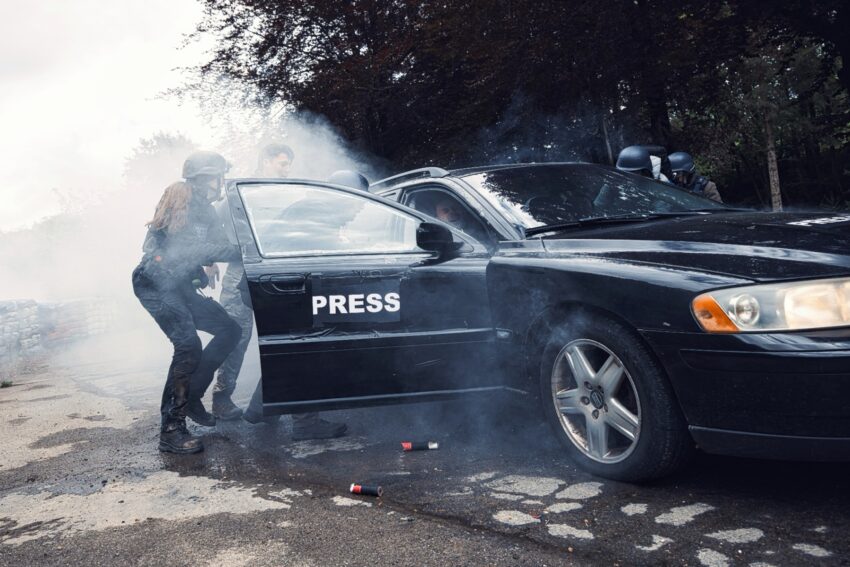
Professionals working in unstable or unpredictable environments need more than experience and general safety advice. Journalists covering conflict, humanitarian workers delivering assistance, NGO personnel, and other frontline professionals may have to operate in situations where security conditions can change within minutes. Preparation therefore plays an important role in responsible deployment. BLUESPEARHEAT provides professional Hostile Environment Awareness Training (HEAT) designed to help participants develop practical skills, stronger situational awareness, and greater confidence when working in challenging environments across Europe.
Operated by TSN Consulting, Belgium, BLUESPEARHEAT delivers HEAT programmes for individuals and organisations throughout the European Union. The programme has been developed around real-world experience and is supported by instructors with backgrounds in humanitarian operations, journalism, medicine, and security. This multidisciplinary approach allows participants to explore security challenges from several professional perspectives.
Why Hostile Environment Awareness Training Matters
High-risk environments can present a combination of security, medical, environmental, and psychological challenges. A professional may need to recognise an emerging threat, make a rapid decision, provide emergency assistance, or adapt a movement plan without having access to immediate support.
HEAT training helps participants understand these challenges before deployment. Rather than relying exclusively on theoretical instruction, BLUESPEARHEAT uses practical exercises and real-world scenarios to develop skills that can be applied in demanding operational conditions. The programme is structured as an intensive four-day, three-night course and includes six core modules.
Developing Strong Situational Awareness
Situational awareness is one of the foundations of effective security preparation. Professionals operating in unfamiliar environments need to understand what is happening around them, recognise unusual developments, and consider how circumstances could evolve.
BLUESPEARHEAT training introduces participants to methods for reading environments, identifying potential risks, detecting surveillance, and moving more safely in hostile or uncertain regions. These capabilities can be particularly relevant for people working in conflict zones, humanitarian missions, and high-risk journalism assignments.
Good situational awareness is not simply about being constantly alert. It is about understanding context, recognising changes, and making informed decisions without unnecessary panic. This can help professionals remain focused on their objectives while maintaining an appropriate level of caution.
Medical Skills for Critical Situations
Medical preparedness is another important element of hostile environment training. In remote or insecure locations, professional medical assistance may not always be immediately available. Knowing how to respond during the first moments of an emergency can therefore be extremely valuable.
The BLUESPEARHEAT programme includes advanced medical training covering areas such as casualty assessment, care under fire, and the management of catastrophic bleeding. Participants practise these skills through realistic scenarios, helping them understand how medical response can be affected by pressure and difficult surroundings.
Understanding Contemporary Threats
Modern high-risk environments continue to evolve. Professionals may encounter weapons, explosives, unexploded ordnance, improvised explosive devices, and unmanned aerial systems. Understanding these hazards is an important component of overall operational awareness.
BLUESPEARHEAT includes weapons and explosives awareness as well as dedicated drone threat awareness. Participants learn about the risks associated with these hazards and how they can affect operations in conflict zones and other high-risk environments.
The programme also addresses kidnapping and surviving captivity. Through scenario-based training, participants gain insight into the realities of abduction, the psychology of captivity, and ways of coping with extreme psychological pressure.
Practical Vehicle Ambush Training
Movement can present significant challenges in unstable environments, particularly when travelling by vehicle. BLUESPEARHEAT includes vehicle ambush drills designed to help participants recognise and respond to high-risk situations.
The training addresses immediate-action procedures, convoy considerations, and decision-making under pressure. By practising scenarios rather than discussing them only in theory, participants can develop a clearer understanding of how stress and uncertainty can influence their decisions.
Training for International Professionals
BLUESPEARHEAT is designed for a broad professional audience, including journalists, international media organisations, NGOs, humanitarian workers, and international institutions operating in high-risk areas. The programme can support both individual preparation and organisational duty-of-care requirements.
The European-wide delivery model also provides flexibility for organisations with personnel working in different countries. In addition to its established programme, BLUESPEARHEAT offers custom in-country delivery, allowing organisations to consider training requirements in relation to their specific operational environment.
Experience-Based Training in Belgium and Across Europe
The quality of a HEAT programme depends heavily on the relevance of its instructors and scenarios. BLUESPEARHEAT brings together experienced professionals from several fields, including security specialists, medical professionals, journalists, and humanitarians. Their field experience helps ensure that training remains practical and connected to the realities faced by personnel working in complex environments.
Developed by Belgium-based TSN Consulting, https://www.bluespear.eu/ has been delivering high-standard HEAT programmes since 2022. Its European-wide approach makes it a suitable training option for professionals preparing for deployments as well as organisations seeking structured hostile environment preparation for their teams.
Preparing Before Deployment
No training programme can remove every risk associated with a hostile environment. However, proper preparation can help professionals recognise hazards earlier, make better-informed decisions, and respond more effectively when circumstances become difficult.
For journalists, humanitarian workers, NGO personnel, and other frontline professionals, Hostile Environment Awareness Training is an important part of deployment preparation. BLUESPEARHEAT combines practical scenarios, medical preparedness, situational awareness, threat recognition, and decision-making exercises into one intensive programme.
With professional HEAT training delivered across Europe, a multidisciplinary instructor team, and a focus on realistic operational challenges, BLUESPEARHEAT provides professionals with an opportunity to strengthen their knowledge, resilience, and readiness before entering a high-risk environment.