
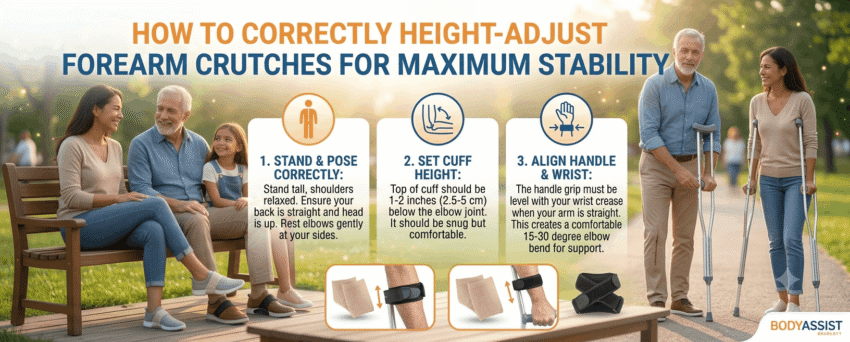
Recovering from a lower-body injury or managing long-term mobility challenges requires reliable support to help you move safely and confidently. Forearm Crutches are an exceptional mobility tool, offering superior upper-body leverage, weight distribution, and maneuverability compared to traditional underarm crutches. However, to experience these benefits and prevent physical strain, your crutches must be properly fitted to your body.
Using incorrectly adjusted crutches can lead to wrist fatigue, shoulder tension, poor posture, and unsteady balance. At Bodyassist, we prioritize your comfort and rehabilitation safety. This comprehensive guide outlines how to adjust your crutches for maximum stability, ensuring proper posture and a smooth recovery.
Why Proper Crutch Adjustment Matters
When forearm crutches are set to the wrong height, your entire musculoskeletal system compensates.
-
Too Short: You will bend forward at the waist, causing lower back strain, stooped posture, and unstable weight distribution.
-
Too High: You will hunch your shoulders, leading to neck tightness, arm fatigue, and reduced upper-body control.
Correctly adjusted crutches keep your spine aligned, distribute your weight evenly across your arms, and maximize your stability on various walking surfaces.
Step-by-Step Guide to Adjusting Your Forearm Crutches
Most ergonomic crutches feature two adjustment points: the lower leg shaft (to adjust overall height) and the upper cuff section (to adjust forearm placement). Follow these steps to achieve the ideal custom fit.
Step 1: Prepare Your Position and Footwear
Stand completely upright on a flat, level surface. Wear the supportive shoes you plan to use daily—whether athletic sneakers or specialized post op shoes designed to accommodate post-surgical swelling and protect healing tissues. Standing barefoot or in socks will result in inaccurate measurements.
Step 2: Determine Handgrip Height
-
Let your arms hang naturally down by your sides.
-
Locate the crease on the inside of your wrist (where your hand meets your arm).
-
Adjust the lower telescoping shaft of the crutch so that the top of the handgrip aligns exactly with your wrist crease.
-
When you grip the handles, your elbows should bend at a comfortable $15^circ$ to $20^circ$ angle. This bend acts as a natural shock absorber while walking.
Step 3: Position the Forearm Cuffs
-
Slide your forearms into the upper cuffs.
-
Adjust the cuff height so the top edge rests approximately $1$ to $1.5text{ inches}$ ($2.5$ to $3.8text{ cm}$) below the bend of your elbow.
-
Ensure the cuff fits securely around your forearm without pinching the skin or restricting elbow movement. The cuff should hold your arm firmly so the crutch stays attached when you release your handgrip.
Integrating Mobility Supports into Your Recovery
Achieving optimal posture is just one part of safe rehabilitation. If your treatment plan includes foot or ankle surgery, pairing properly adjusted Forearm Crutches with supportive post op shoes ensures maximum foot offloading and gait balance. The rigid sole of a surgical shoe prevents painful foot flexing, while correctly fitted crutches bear your body weight, keeping you mobile without risking re-injury.
Frequently Asked Questions (FAQ)
How do I know if my forearm crutches are at the correct height?
When standing tall with your arms hanging loosely, the handgrips should align with your wrist crease, creating a slight $15^circ$ to $20^circ$ elbow bend when held. You should be able to stand upright without hunching your shoulders or leaning forward.
Should the forearm cuff be tight against my arm?
The cuff should fit snugly around your forearm to provide stability, but it should never cut off circulation or pinch your skin. There should be enough room to accommodate light clothing comfortable.
Can I use forearm crutches while wearing post-op shoes?
Yes. In fact, using forearm crutches alongside post op shoes is widely recommended for surgical recovery. The crutches reduce weight-bearing stress on the foot, while the post-op shoe protects the surgical site and maintains proper foot positioning.