
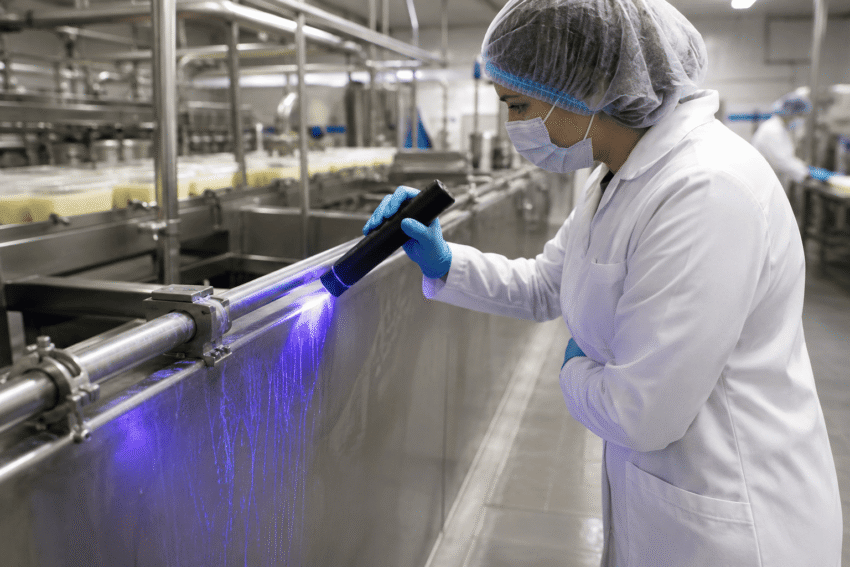
Food processing facilities operate under strict hygiene and food safety requirements. From dairy plants and meat processing units to beverage bottling lines and ready-meal production areas, maintaining clean surfaces and equipment is essential for protecting product quality and consumer safety.
However, not every hygiene risk is visible to the naked eye. Organic residues and biofilms can remain on equipment, pipes, conveyors, tanks, and other surfaces even after routine cleaning. This is where UV-A inspection technology can provide an additional layer of visibility during hygiene checks.
What Are Biofilms and Why Are They a Concern?
Biofilms are communities of microorganisms that can attach to surfaces and develop within a protective matrix. In food processing environments, they may form in areas that are difficult to clean or inspect, including joints, pipes, drains, tanks, conveyor systems, and processing equipment.
Pathogens such as Listeria and Salmonella can be associated with contaminated processing environments. Because potential contamination may not always be visible, relying solely on conventional visual inspections can leave certain problem areas unnoticed.
Identifying areas that require closer examination can therefore help hygiene teams make more informed decisions about cleaning and sampling.
Why Traditional Hygiene Inspections Have Limitations
Traditional hygiene monitoring methods remain important, but each method has limitations.
Visual inspections depend on what can be seen under normal lighting conditions. Small amounts of residue or contamination may not be obvious. Similarly, ATP testing and microbiological sampling provide valuable information but generally involve testing selected locations rather than every surface within a facility.
In large food processing plants, only a small proportion of the total surface area can realistically be sampled. This makes it important to identify which locations deserve closer investigation.
A UV-A inspection lamp can help teams visually identify areas of interest before deciding where to conduct further testing.
How UV-A Technology Helps During Hygiene Inspections
UV-A illumination can make certain organic residues and biofilms fluoresce, creating visible indications that may otherwise be difficult to identify.
During an inspection, a hygiene professional can illuminate surfaces using a handheld UV-A lamp. Areas showing fluorescence can then be examined more closely and, where appropriate, swabbed for laboratory analysis.
This approach connects visual inspection with established sampling procedures. Instead of randomly selecting locations, teams can use visible indications to help guide their attention toward areas that may require further investigation.
How the Inspection Process Works
Using a UV-A lamp during hygiene inspections can be straightforward:
1. Switch on the Lamp
A handheld inspection lamp can be activated without complicated setup, allowing hygiene teams to incorporate it into routine inspections.
2. Inspect Existing Sampling Points
The lamp can be used around locations that would already be inspected or sampled as part of the facility’s hygiene programme. These may include equipment surfaces, processing areas, pipes, tanks, conveyors, and other relevant locations.
3. Look for Fluorescence
When illuminated, certain organic residues and biofilms can produce visible fluorescence. These areas can be marked for closer examination.
4. Swab Where Appropriate
If an area shows an indication that requires investigation, the hygiene team can take a swab and send it for appropriate testing. The UV-A inspection therefore complements rather than replaces laboratory-based methods.
Key Benefits for Food Processing Facilities
Faster Identification of Problem Areas
One of the main advantages of UV-A inspection is speed. Instead of relying exclusively on laboratory results to identify potential areas of concern, hygiene teams can receive immediate visual indications during an inspection.
This can help teams respond more quickly when investigating cleaning performance.
Broader Surface Inspection
Food processing facilities can contain extensive areas of equipment and infrastructure. Inspecting every surface through laboratory sampling is not practical.
A portable UV-A lamp allows teams to scan larger areas and identify locations that may deserve further attention.
Better Cleaning Verification
Cleaning teams need reliable ways to assess whether sanitation procedures are working effectively. Visual evidence from UV-A inspections can help identify areas where residues may remain after cleaning.
Repeated inspections can also help hygiene teams monitor recurring problem areas and determine whether additional cleaning measures may be necessary.
Supports Existing Sampling Procedures
UV-A inspection does not have to replace ATP testing, microbiological sampling, or other established hygiene controls. Instead, it can work alongside them.
The inspection process can help guide sampling by highlighting areas that warrant additional investigation. Laboratory testing can then provide the microbiological information required for verification.
Where Can UV-A Inspection Be Used?
UV-A hygiene inspection technology can be useful across different parts of a food processing operation.
Dairy Processing Plants
Tanks, pipes, processing equipment, and cleaning-in-place systems can contain areas that require careful inspection. UV-A inspection can help identify locations for closer examination.
Meat Processing Facilities
Cutting equipment, conveyor systems, preparation areas, and other high-use surfaces require consistent hygiene monitoring. Portable inspection technology can help teams examine these areas efficiently.
Beverage Bottling Lines
Filling equipment, production surfaces, and packaging zones can benefit from additional visual inspection during hygiene checks.
Ready-Meal Production
Preparation and assembly areas can contain multiple surfaces and pieces of equipment that need regular cleaning verification. UV-A inspection can provide another method for identifying areas that require attention.
Hygiene Audits and Quality Assurance
During internal hygiene audits, visual evidence can help QA teams document findings and focus on areas that may require corrective action.
BioDtex and Modern Hygiene Inspection
The BioDtex Hygiene Inspection Lamp is designed as a handheld UV-A inspection tool for food processing environments. It uses 16 UV-A LEDs to illuminate surfaces and reveal organic residues and biofilms that may not be apparent under normal lighting.
Its portable and ergonomic design allows hygiene professionals to move around production facilities and inspect different areas without complicated installation or setup.
The device also features an integrated camera, which can support inspection documentation by allowing teams to capture images of areas requiring attention. This can be useful for inspection reports, cleaning verification, internal audits, and tracking recurring hygiene issues.
According to the product information, the lamp has also been independently validated by Campden BRI for revealing biofilms across multiple pathogens, including Listeria and Salmonella.
UV-A Inspection vs ATP Testing and Traditional Sampling
UV-A inspection, ATP testing, visual inspection, and laboratory sampling each serve different purposes.
Traditional visual inspection is useful for identifying obvious dirt and residues but may not reveal everything that requires attention. ATP testing can provide information about biological material on sampled surfaces, while laboratory microbiological testing can provide more specific information about microorganisms.
UV-A inspection adds a visual screening layer that can help teams identify areas for further investigation.
The important point is that these approaches can work together. UV-A inspection can help guide attention and sampling, while established testing methods can provide additional confirmation.
Building a More Effective Hygiene Monitoring Routine
For food processing facilities, effective hygiene monitoring should involve a structured approach rather than depending on a single inspection method.
A UV-A inspection can be incorporated into existing routines by checking critical equipment and sampling locations before or during planned hygiene assessments. Areas showing fluorescence can then be documented, investigated, and sampled where appropriate.
Over time, inspection findings can help teams identify recurring locations where cleaning procedures may need improvement.
This can support a more targeted approach to sanitation management and cleaning validation.
Conclusion
Maintaining hygiene in food processing facilities requires more than simply cleaning visible dirt from surfaces. Hidden residues and biofilms can present challenges for hygiene teams because they may not always be apparent during conventional visual inspections.
UV-A inspection technology provides a practical way to increase visibility during hygiene checks. By illuminating selected surfaces and identifying areas that may require closer investigation, it can help QA and hygiene teams make more informed sampling and cleaning decisions.
When combined with ATP testing, microbiological sampling, cleaning procedures, and other established controls, UV-A inspection can become a valuable part of a comprehensive food hygiene monitoring programme.
For facilities looking to strengthen their inspection process and identify potential problem areas more efficiently, Biofilm Detection technology offers an additional visual layer between routine cleaning and detailed microbiological testing.