
Your schedule says you work Friday from 2:00 p.m. to 10:00 p.m.
Then Thursday night, your manager changes it to 5:00 p.m. to 11:00 p.m.
In another case, you arrive at work and are sent home after two hours because business is slow.
Do you have to accept the change? And should there be extra money on your paycheck?
The answer depends on where you work. There is no single federal predictive-scheduling law covering every U.S. employee, but several states and cities have Fair Workweek or predictive-scheduling rules that can require advance notice, extra pay, or additional protections when employers change schedules.
What Is Predictability Pay?
Predictability pay is extra compensation that may be owed when a covered employer changes an employee’s schedule without enough advance notice.
It is sometimes called schedule-change pay, premium pay, or Fair Workweek pay.
The rules differ by location.
A qualifying employee might receive extra pay when an employer:
- adds hours,
- changes the starting or ending time,
- cancels a shift,
- reduces scheduled hours,
- adds a new shift, or
- requires closely spaced closing and opening shifts.
The exact amount depends on the law that applies where the employee works.
Is There a Federal 14-Day Scheduling Rule?
No.
There is no nationwide federal rule requiring every employer to publish employee schedules 14 days in advance.
That is an important distinction.
Some state and local laws require covered employers to provide schedules a certain number of days ahead, but those rules apply only in specific places and often only to certain industries or large employers.
Oregon, for example, has a predictive-scheduling law covering certain large retail, hospitality, and food-service employers. Covered employees generally must receive their written work schedule at least 14 calendar days before the first day on that schedule. (oregon.gov)
What Happens If Your Employer Adds Hours?
In a covered jurisdiction, adding hours after the required notice period can trigger extra compensation.
Under Oregon’s predictive-scheduling rules, certain employer-requested changes can require one additional hour of pay at the employee’s regular rate.
That can include adding more than 30 minutes of work, changing the date or start or end time of a shift without reducing hours, or adding another shift. (oregon.gov)
Suppose your regular rate is $20 an hour.
Your manager changes your scheduled start time after the protected notice period, and the change qualifies for predictability pay.
You may receive your normal wages for the hours worked plus another $20 premium.
That extra amount may appear separately on your pay stub.
What If Your Shift Is Shortened or Cancelled?
A schedule reduction can create a different type of premium.
Under Oregon’s rules, covered employees can generally receive half their regular rate for each scheduled hour they do not work when the employer cuts hours or cancels a shift within the protected notice period, subject to exceptions. (oregon.gov)
Suppose you were scheduled for eight hours at $18 per hour.
Your employer cancels four of those hours at the last minute.
If the law applies and no exception removes the premium, the extra payment could be based on half your regular rate for the four lost hours.
That would be:
$9 × 4 hours = $36
The $36 is not payment for hours actually worked. It is a schedule-change premium required by the applicable rule.
Can You Refuse a Last-Minute Shift?
Some Fair Workweek laws give employees more control over schedule changes.
Under Oregon law, covered employees may generally decline employer-requested schedule changes made after the advance-notice period begins. (oregon.gov)
But this is not a universal U.S. rule.
In locations without predictive-scheduling protections, employers may have more flexibility to change schedules, subject to employment agreements, union contracts, discrimination laws, wage laws, and other applicable rules.
Always check the law where you actually work.
What Is a Clopening Shift?
A “clopening” happens when an employee closes a workplace late at night and then returns early the next morning to open it.
These shifts can create very short rest periods.
Oregon generally requires covered employees to receive at least 10 hours of rest between certain shifts unless the employee requests or agrees to work sooner. When a covered employee works during that protected rest period, the employer generally must pay time-and-a-half for those hours. (oregon.gov)
Does Predictability Pay Count Toward Overtime?
This can get complicated.
Predictability premiums are not always treated exactly like ordinary hourly wages for overtime calculations.
Some schedule-change premiums may need to be included in the employee’s regular rate for overtime purposes, while others may qualify for exclusions depending on why the payment was made and which rule created it.
Payroll teams should not automatically treat every schedule premium as either overtime or non-overtime pay.
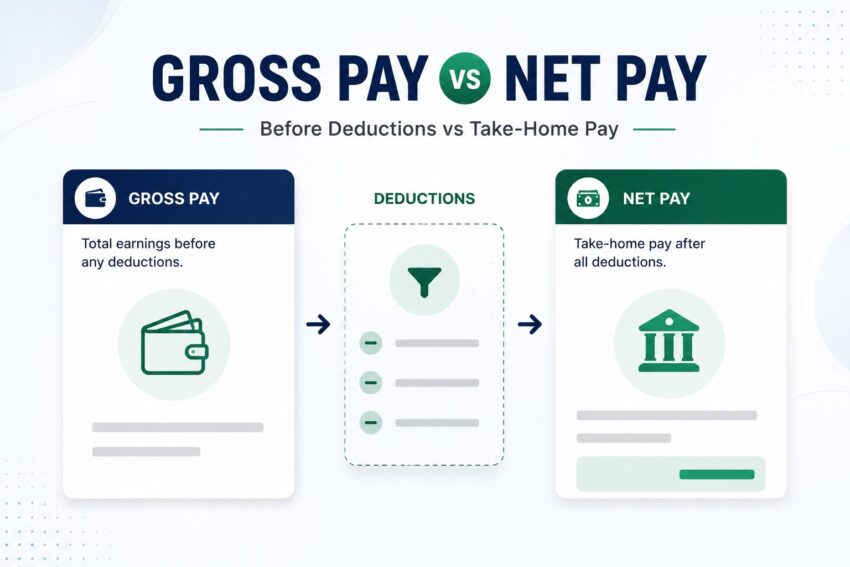
Employees can review the ePaystubs guide to gross pay versus net pay when comparing extra schedule payments with their final take-home pay.
What Should Predictability Pay Look Like on a Pay Stub?
There is no single universal payroll label.
An employer may use:
- PREDICTABILITY PAY
- SCHEDULE PREMIUM
- FAIR WORKWEEK
- PREMIUM PAY
or another payroll code.
If you expected a schedule-change premium but cannot find it, compare the schedule you originally received with the revised schedule and the earnings section of your paycheck.
The ePaystubs guide to pay stub hours that do not match a timecard can help identify differences between scheduled hours, actual hours, and paid hours.
I hope you find the blog useful and informative. Thanks for reading this blog.