
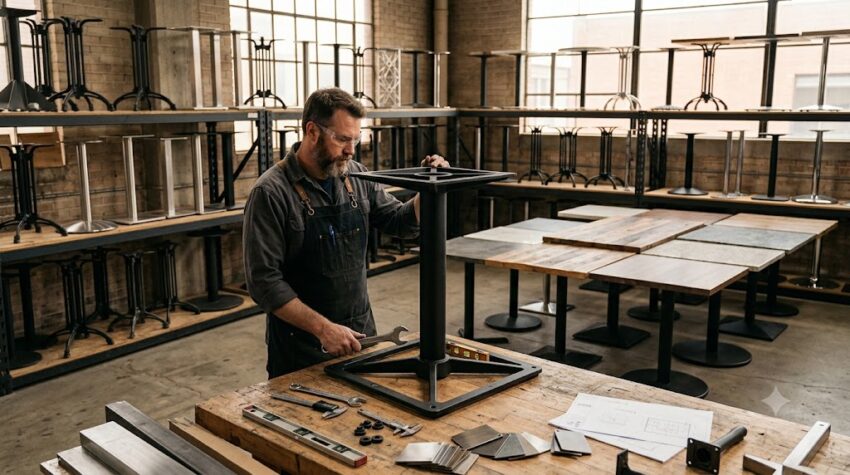
A restaurant project involves much more than choosing attractive tables and chairs. Every dining surface needs to fit the space, support daily use, work with the overall design, and make sense for the restaurant’s layout. Table bases play an important role in that equation because they influence stability, legroom, seating comfort, and the way tables function within a dining environment.
Working with a reliable commercial table base supplier can make the table-selection process easier and more organized. Instead of treating table bases as an afterthought, restaurant owners, designers, contractors, and hospitality teams can consider them as part of the overall furniture plan.
From selecting suitable base styles to coordinating dimensions and table configurations, the right supplier can help restaurant projects make practical decisions without sacrificing visual appeal.
Why Table Bases Matter in Commercial Restaurant Projects
Restaurant tables experience considerably more activity than many residential dining tables. Customers lean on them, staff move around them, and tables may be repositioned as seating requirements change. A suitable base therefore needs to support the tabletop while fitting comfortably into the restaurant environment.
Supporting Table Stability
A stable table starts with a properly selected base. The base needs to provide adequate support for the tabletop and maintain balance during everyday restaurant use.
The appropriate configuration can depend on factors such as tabletop size, shape, material, and intended placement. A supplier can help project teams consider these factors rather than selecting a base based solely on appearance.
Improving Customer Comfort
Table bases can affect how easily customers sit, move, and position their legs. Poorly positioned supports can interfere with chairs and reduce usable legroom.
Pedestal bases, for example, can provide a different seating experience from traditional four-leg arrangements. The best option depends on the table dimensions and the seating layout.
Working With Different Tabletop Designs
Restaurant furniture projects often involve different tabletop materials and shapes. A dining area might use square tables for flexible seating, round tables for smaller groups, or larger rectangular surfaces for communal dining.
A supplier with a range of restaurant table bases can help match the base configuration to the tabletop rather than treating every table as the same.
Balancing Function and Appearance
Table bases are functional components, but they are also visible elements of restaurant furniture. Their shape, finish, and proportions can influence the appearance of the dining room.
A simple metal base may suit a modern commercial interior, while another design may work better with a traditional or industrial concept. Coordinating the base with the tabletop and surrounding furniture creates a more unified result.
Helping With Project-Specific Requirements
Not every restaurant project has identical requirements. A compact café, full-service restaurant, food hall, hotel dining area, and outdoor hospitality space may require different table configurations.
A knowledgeable commercial table base supplier can help teams compare available options according to the intended application, space limitations, tabletop dimensions, and overall furniture plan.
How Suppliers Help Simplify the Selection Process
Choosing table bases becomes easier when the project is approached systematically. Instead of starting with a particular style and trying to make it work, restaurant teams can first identify how the tables will actually be used.
Understanding Table Size and Shape
The dimensions of a tabletop are among the first considerations when selecting a base. Larger surfaces may require a different support configuration than smaller two-person tables.
The tabletop shape also matters. Round, square, and rectangular tables can each create different support requirements and seating considerations.
Before ordering, project teams should have accurate measurements for the tabletop and understand how the finished table will be positioned within the dining area.
Considering the Restaurant Layout
Space planning is another important part of table-base selection. A restaurant may need tables that can be moved together for larger parties or separated to accommodate smaller groups.
The base should support the intended configuration without unnecessarily restricting chair placement or customer movement. This is particularly important in dining areas where every section of floor space needs to be used thoughtfully.
Comparing Base Styles
Commercial table bases are available in multiple configurations. Common options include pedestal bases, disc bases, cross bases, and other support designs.
Each configuration has different practical characteristics. A pedestal can offer open space around the perimeter, while other base styles may provide a particular visual character or support arrangement.
Rather than assuming one style is universally better, restaurant teams should compare options based on the specific table and environment.
Selecting Appropriate Materials and Finishes
Material selection can influence both appearance and suitability for the intended environment. Metal table bases are widely used in commercial furniture because they can complement a broad range of tabletop designs.
Finishes also contribute to the overall look. Black, silver, and other finish options can create different visual effects when paired with wood, laminate, stone-look, or other commercial tabletops.
The goal is to select a finish that works with the restaurant’s furniture palette and interior concept.
Planning for Everyday Restaurant Use
Restaurant furniture needs to function in a busy environment. Tables may be cleaned frequently, repositioned during service, or rearranged for different seating requirements.
When evaluating a base, project teams should consider how the table will be used throughout the day rather than focusing only on its appearance in a showroom or product photograph.
Coordinating Multiple Tables
Large restaurant projects often require dozens or even hundreds of tables. Consistency becomes important when multiple dining areas use the same furniture concept.
A supplier can help teams identify compatible base styles and configurations for different tabletop sizes. This can make it easier to create a consistent appearance while accommodating different seating arrangements.
Supporting Renovation and Replacement Projects
Table-base suppliers can also be useful when a restaurant is renovating an existing space. A project may involve replacing damaged bases, updating the furniture style, or changing table configurations without completely redesigning the dining area.
In these situations, accurate measurements and compatibility checks become especially important. Existing tabletops may need to be evaluated before replacement bases are selected.
Thinking Beyond the Dining Room
Restaurant furniture is not limited to one type of seating area. A project may include dining rooms, cafés, bar-height spaces, patios, waiting areas, or flexible event sections.
Each environment can have different furniture requirements. Selecting table bases according to the location and intended use helps create a more practical overall furniture package.
Why the Right Supplier Makes a Difference
A supplier’s role is not simply to provide a product catalog. For restaurant projects, the value often comes from having access to different configurations and being able to compare them against the project’s practical requirements.
AMKO Group offers table-base options designed for commercial furniture applications, giving restaurant teams a range of configurations to consider when planning dining spaces. Its table-base collection can be evaluated alongside different tabletop sizes, shapes, and restaurant layouts to create a cohesive furniture solution.
Making Table-Base Decisions With Confidence
A useful selection process begins with the basics: tabletop dimensions, table height, seating capacity, available floor space, intended use, and desired appearance. Once these requirements are established, the available base styles become easier to compare.
It is also helpful to think about the complete table rather than evaluating the base independently. The tabletop, base, chairs, surrounding furniture, and floor plan should work together.
This approach can reduce compatibility issues and help restaurant teams create dining furniture that feels intentional rather than assembled from unrelated components.
About AMKO Group
AMKO Group provides restaurant furniture solutions for commercial dining environments, including table bases and other furniture components. Its collection gives restaurant owners, designers, and project teams options to consider when developing practical table configurations for hospitality spaces. The focus is on providing furniture choices that can be evaluated according to the needs of individual restaurant projects.