
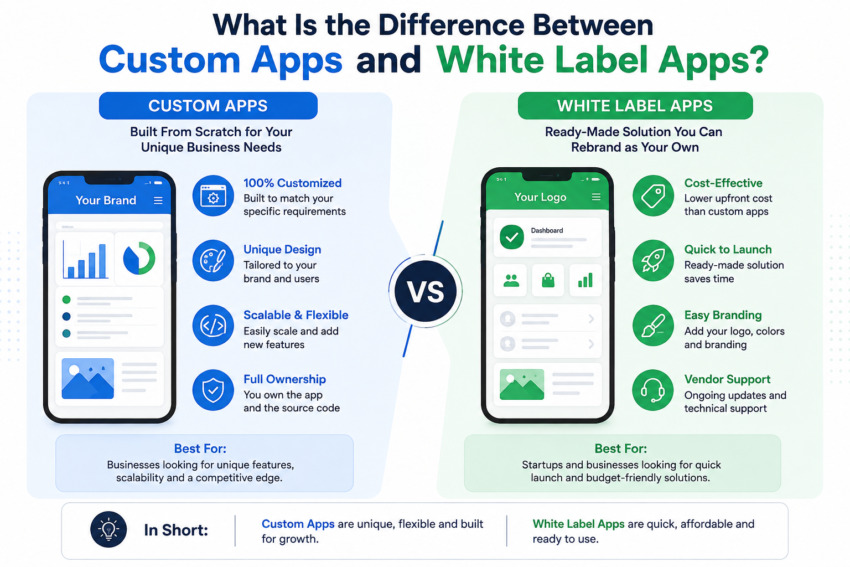
When a business decides to launch a mobile app, one of the first major decisions is choosing the right development approach. Should the company build an application from scratch around its own requirements, or should it use an existing app solution that can be branded and customized for its business?
This is where the difference between custom apps and white label apps becomes important.
Both approaches can help businesses establish a mobile presence, improve customer engagement, and create new revenue opportunities. However, they differ significantly in terms of development, customization, cost, ownership, scalability, and time to market.
A custom app is designed and developed specifically for one business. A white label app, on the other hand, is generally based on an existing application or platform that can be rebranded and adapted for different businesses.
Understanding these differences can help companies select an app solution that matches their budget, timeline, technical requirements, and long-term goals.
What Is a Custom App?
A custom app is a mobile application developed specifically for a particular business, organization, or use case. Instead of starting with a standard product that is already designed for multiple customers, the development process begins by identifying the business’s unique requirements.
The features, user interface, integrations, workflows, security requirements, and overall functionality can be designed around those needs.
For example, a logistics company may require an app with real-time vehicle tracking, driver management, delivery scheduling, route optimization, digital proof of delivery, and integration with its internal systems. Rather than adapting a generic solution, the company can develop an application specifically around its operational model.
The biggest advantage of custom development is flexibility. Businesses have greater control over how the application works and how it evolves over time.
However, this flexibility usually comes with a higher initial investment and a longer development timeline.
What Is a White Label App?
A white label app is an existing application solution developed by a provider that can be rebranded and offered under another company’s name.
Instead of building the entire application from the ground up, the business uses an established technology foundation. The provider may allow the company to change elements such as the logo, colors, branding, content, and selected features.
The concept is similar to purchasing a ready-made product and putting your own brand identity on it.
For instance, a business that wants to launch a food delivery application may choose a white label solution. The underlying technology may already include features such as restaurant listings, customer accounts, ordering, payments, notifications, and delivery management. The business can then apply its own branding and launch the platform without developing every component independently.
This approach can significantly reduce development time and upfront costs.
However, white label solutions generally offer less freedom than fully custom-built applications.
Custom Apps vs. White Label Apps: The Key Differences
Although both solutions can achieve similar business objectives, their underlying approaches are quite different.
1. Development Approach
The most obvious difference is how the application is created.
A custom app is built specifically for one business. Developers start with the company’s requirements and create the application around those specifications.
A white label app already has a technological foundation. The business typically purchases access to an existing solution and modifies the available elements to match its brand. Working with a reliable White Label App Development Company can also help businesses customize the solution, integrate essential features, and launch their branded app more efficiently.
This makes custom development more suitable for businesses with highly specific requirements, while white label solutions can work well for companies that need a proven application model.
2. Level of Customization
Customization is another major difference.
With a custom app, almost every aspect of the application can potentially be designed around the business. The company can request unique workflows, interfaces, features, integrations, and functionality.
White label applications usually provide a defined set of customization options. Branding elements such as colors, logos, names, and content may be adjustable, while deeper changes may depend on the provider’s technical capabilities.
Therefore, businesses that consider unique functionality a competitive advantage may prefer custom development.
Companies that primarily need a branded version of an established app concept may find a white label solution sufficient.
3. Development Time
Time to market can have a major impact on an app strategy.
Custom apps generally require more time because the development process can involve research, planning, UI/UX design, architecture, development, testing, security checks, integrations, and deployment.
The timeline depends on the complexity of the application and the number of features involved.
White label apps can usually be launched faster because much of the underlying technology has already been developed. Instead of building the core system from zero, the business configures an existing platform and prepares it for launch.
For businesses trying to enter a market quickly, this can be a significant advantage.
4. Initial Cost
Cost is often one of the first factors businesses consider.
Custom application development typically requires a larger upfront investment. The business may need to pay for research, design, development, testing, infrastructure, maintenance, and third-party integrations.
A white label application can reduce initial development expenses because the underlying product has already been created.
However, businesses should not evaluate the decision based solely on the initial price. Subscription fees, licensing charges, customization costs, transaction fees, maintenance expenses, and future limitations can affect the total cost of ownership.
A lower initial investment does not automatically mean a lower long-term cost.
5. Ownership and Control
Custom applications generally provide greater control over the product and its future development.
Depending on the development agreement, a business may own the source code and have control over its technology infrastructure. This can make it easier to modify or expand the application as the company grows.
With a white label solution, the underlying technology is usually controlled by the provider. The business receives the right to use and brand the platform according to the provider’s agreement.
This distinction becomes particularly important for companies that view their application as a core business asset.
Before choosing a white label solution, businesses should carefully review the provider’s terms regarding data, source code, hosting, customization, migration, and termination.
6. Scalability
A successful application may eventually need to serve more users, process more transactions, support additional locations, or introduce new services.
Custom development allows scalability to be planned around the company’s expected growth. Developers can design the architecture with specific business requirements and future expansion in mind.
White label platforms may also support significant growth, but scalability depends on the provider’s infrastructure and product roadmap.
Businesses considering a white label solution should ask how the platform handles increasing users, transactions, geographic expansion, and new functionality.
Choosing a solution that works today but creates limitations tomorrow can become expensive when the business reaches a larger scale.
7. Integrations
Modern businesses rarely operate through a single software system. Applications often need to communicate with payment gateways, customer relationship management systems, enterprise software, analytics platforms, inventory systems, communication tools, and other services.
Custom applications can be designed around these integrations from the beginning.
White label platforms may support popular integrations, but businesses may have fewer options when they require specialized or uncommon connections.
If integration with existing business systems is a critical requirement, this should be evaluated before selecting a white label platform.
8. Branding and User Experience
A company’s mobile application is often an important part of its customer experience.
Custom development provides extensive control over the user interface and user journey. Businesses can design interactions around their target audience rather than adapting users to a predefined structure.
White label solutions can still provide strong branding opportunities. Logos, colors, icons, content, and other visual elements can often be modified.
However, the underlying user experience may remain similar to other applications using the same platform.
For businesses competing primarily through customer experience and differentiation, this distinction can be important.
9. Maintenance and Updates
Every mobile application requires ongoing maintenance.
Operating systems change, security vulnerabilities emerge, devices evolve, and users expect new features.
With a custom application, the business is generally responsible for coordinating development and maintenance, either through an internal team or an external development partner.
With a white label platform, the provider often handles a significant portion of technical maintenance and platform updates.
This can reduce the technical burden for businesses without large development teams.
At the same time, the business becomes more dependent on the provider’s update schedule, technical decisions, and support quality.
10. Security and Data Considerations
Security should be considered regardless of the development approach.
Custom development allows businesses to establish security practices around their specific architecture and compliance requirements. They can determine how data is stored, processed, accessed, and protected.
White label providers may already have security systems and infrastructure in place, which can be beneficial. However, businesses should understand where their data is stored, who has access to it, how backups are handled, and what security measures the provider maintains.
Companies operating in regulated industries should pay particular attention to privacy, data protection, compliance, and contractual responsibilities.
When Should a Business Choose a Custom App?
Custom development may be the better option when the application needs to provide functionality that existing platforms cannot deliver.
It can be particularly appropriate for businesses that:
- Have highly specific operational requirements
- Need unique features or workflows
- Want complete control over the user experience
- Require complex third-party integrations
- Expect significant long-term growth
- Consider the application a core competitive advantage
- Need extensive control over technology and data
- Plan to continuously develop their own product
For these businesses, the higher initial investment can be justified by greater flexibility and long-term control.
A custom app is not simply about having more features. Its real value comes from creating technology that closely aligns with the company’s business model.
When Should a Business Choose a White Label App?
A white label application may be a practical choice when speed, affordability, and simplicity are the main priorities.
It can work well for businesses that:
- Want to launch an app quickly
- Have a limited initial development budget
- Need standard industry features
- Do not require extensive customization
- Want to test a business idea before investing heavily
- Prefer a managed technology solution
- Do not have an internal technical team
For a startup testing a new concept, a white label app can provide a way to enter the market without making a large development investment at the beginning.
If the concept gains traction, the company can later evaluate whether a custom platform would provide additional advantages.
Is a White Label App Less Professional?
Not necessarily.
The quality of a white label application depends heavily on the provider, platform architecture, design capabilities, customization options, and implementation.
A well-designed white label app can provide a professional customer experience and include many of the features users expect from modern applications.
The main difference is not necessarily quality. It is the degree of control and originality available to the business.
A company can have excellent branding and functionality with a white label solution, but it may not have the same level of technological differentiation as a completely custom application.
Can a Business Start With White Label and Move to Custom?
Yes, this can be a practical strategy.
Some businesses begin with a white label solution to validate their concept. This allows them to test customer demand, understand user behavior, generate revenue, and identify which features are genuinely important.
Once the business has established product-market fit, it can consider investing in custom development.
However, this transition should be considered before selecting the initial white label provider. Businesses should determine whether their data can be exported, whether migration is possible, and whether they will have access to important business information if they eventually move to another platform.
A flexible migration strategy can prevent unnecessary complications later.
Questions to Ask Before Choosing an App Solution
Before selecting either approach, businesses should look beyond development price and ask practical questions.
What features are essential for the first version?
How quickly does the application need to launch?
Will the business require unique functionality?
How much customization will be necessary?
Who will own the source code?
Who owns the application data?
What happens if the provider shuts down its platform?
How are security updates handled?
Can the application scale as users increase?
Which third-party integrations are supported?
What are the ongoing maintenance and licensing costs?
Can the business migrate to another platform in the future?
The answers to these questions can make the decision considerably clearer.
Custom vs. White Label: Which One Is Better?
There is no universal winner between custom and white label applications.
The right choice depends on what the business is trying to accomplish.
A company that wants maximum flexibility, unique functionality, complete control, and long-term technological independence may benefit from a custom app.
A company that wants to launch quickly, control initial costs, and use established functionality may find a white label app more practical.
The decision should therefore be based on business objectives rather than simply comparing development prices.
A cheaper solution can become expensive if it cannot support future requirements. Likewise, a highly customized application may be unnecessary if the business only needs standard features that an established platform already provides.
Final Thoughts
The difference between custom apps and white label apps ultimately comes down to control, customization, investment, speed, and long-term strategy.
Custom apps are built around the specific needs of a business and offer greater flexibility, but they normally require more time, planning, and investment. White label apps provide a ready-made technology foundation that can be branded and launched more quickly, making them attractive for businesses that prioritize speed and affordability.
Neither approach is automatically better.
The most suitable option is the one that matches the company’s current resources while also supporting its future goals. A startup validating an idea may benefit from the speed of a white label platform, while an established business with unique processes may gain more value from a custom-built application.
Before making the final decision, businesses should evaluate their required features, expected growth, budget, integration needs, ownership requirements, and long-term product strategy. Taking the time to make that assessment can help avoid expensive technology changes later and ensure that the chosen app solution supports the business rather than limiting it.