
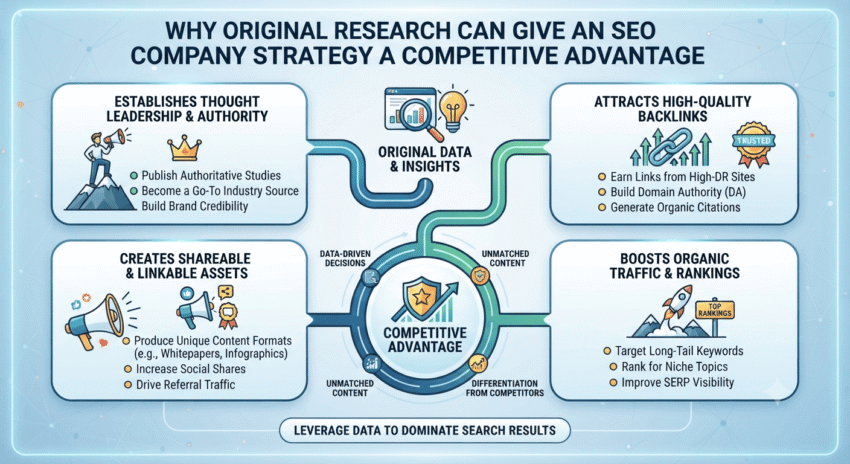
In modern digital marketing, publishing more content is no longer enough to guarantee meaningful search visibility. Businesses are competing with thousands of websites, increasingly sophisticated search systems, and a growing amount of AI-assisted content. In this environment, original research can give an SEO company a powerful competitive advantage.
Instead of simply rewriting information already available online, original research creates something genuinely useful and difficult for competitors to duplicate. Surveys, customer data, industry studies, experiments, proprietary statistics, case studies, and first-hand insights can all become valuable SEO assets. Recent industry discussions have highlighted proprietary data and original research as increasingly important differentiators in an AI-heavy content environment. (theStacc)
For businesses looking for long-term organic growth, choosing an SEO company that understands how to develop and promote original research can therefore be a smart strategic decision.
What Is Original Research in SEO?
Original research means creating information that your business or SEO team has collected, analyzed, or developed itself.
Examples include:
-
Customer surveys
-
Industry statistics
-
Original market studies
-
First-party website data
-
Product performance comparisons
-
Expert interviews
-
Customer case studies
-
Experiments and testing
-
Annual industry reports
-
Proprietary benchmarks
The key difference is that the information is not simply copied or summarized from another website.
For example, an ordinary SEO article might explain the general benefits of a particular marketing strategy. An original research article could survey 500 businesses and reveal how many actually use that strategy, what results they experience, and what challenges they face.
The second article gives readers something they cannot easily find elsewhere.
Why Original Research Matters More in Today’s SEO Environment
Search results have become increasingly crowded. AI tools can also produce generic explanations of almost any subject within seconds.
This creates a problem for businesses: How can a website stand out when competitors can publish similar information so quickly?
Original research provides one answer.
A competitor can rewrite your explanation, but they cannot easily recreate your proprietary survey, customer dataset, experiment, or unique industry benchmark.
That makes original research a potentially durable content asset.
Google’s own guidance emphasizes helpful, reliable, people-first content and explains that its systems consider signals associated with experience, expertise, authoritativeness, and trustworthiness. Google also clarifies that E-E-A-T itself is not a single ranking factor. (Google for Developers)
Original research can naturally support these qualities when it is conducted carefully, documented transparently, and presented accurately.
Original Research Can Attract High-Quality Backlinks
One of the biggest benefits of publishing original research is its potential to attract editorial links.
Journalists, bloggers, publishers, and industry professionals often need reliable statistics to support their own articles. If your company publishes a genuinely useful statistic or study, other websites may reference the research and link back to the original source.
For an SEO company, this creates an opportunity to build links through earned attention rather than relying exclusively on traditional outreach.
For example, an SEO agency could conduct a study examining search trends across 1,000 websites. After publishing the results, marketing publications might reference the findings in their own articles.
Each legitimate editorial reference can increase the visibility and authority of the research asset.
It Creates Content Competitors Cannot Easily Copy
Generic content is relatively easy to reproduce.
Suppose ten companies publish articles about “SEO Tips for Small Businesses.” The basic recommendations may be remarkably similar.
Now imagine one SEO company publishes a report titled:
“What 750 Small Businesses Actually Do to Generate Organic Traffic in 2026.”
That report contains original survey data, charts, interviews, and analysis.
Competitors can discuss the report, but they cannot honestly claim ownership of the underlying research.
This is one reason original research can become a competitive moat. Industry analysis in 2026 increasingly describes proprietary data as an SEO asset that can be reused across articles, reports, visualizations, and other formats. (theStacc)
Original Research Strengthens Topical Authority
A strong SEO strategy is not simply about targeting individual keywords. Businesses also need to demonstrate meaningful knowledge around their subject.
Original research can help create that depth.
For example, an SEO company working with a real estate business could develop research about:
-
Local property search behavior
-
Homebuyer preferences
-
Search trends by location
-
Questions buyers ask before purchasing
-
Seasonal search patterns
-
Digital marketing trends among real estate companies
One research project can then become the foundation for multiple pieces of content.
The original report could become a long-form article, while individual findings could be transformed into blog posts, infographics, social media content, email campaigns, and expert commentary.
This creates a connected content ecosystem rather than a collection of unrelated articles.
It Can Improve Content Credibility
Readers are naturally more interested in claims supported by evidence.
Compare these two statements:
“Many businesses are investing more in SEO.”
versus:
“Our survey of 400 marketing managers found that 62% planned to increase organic search investment during the next 12 months.”
The second statement gives readers something specific to evaluate.
Of course, the research must actually be legitimate. An SEO company should explain the methodology, sample size, research period, limitations, and source of the data.
Transparency is particularly important because unsupported statistics can damage rather than improve credibility.
Original Research Can Support AI Search Visibility
Search behavior is changing as AI-powered search experiences become more common.
Modern SEO strategies increasingly consider not only traditional rankings but also how brands and pages can become useful sources for AI-generated answers.
Original research is potentially valuable here because it provides unique information that other content creators may reference.
A well-structured research article can clearly identify:
-
The research question
-
The methodology
-
The dataset or participants
-
Major findings
-
Supporting statistics
-
Practical conclusions
-
Limitations
This makes the information easier for humans and automated systems to understand.
However, businesses should avoid treating AI citations as guaranteed outcomes. Search and AI systems continuously change, so original research should primarily be created because it provides genuine value.
How an SEO Company Can Turn Research Into a Strategy
A professional SEO company can help transform research from a single article into a larger marketing asset.
A strong process may include:
1. Identify a Research Opportunity
The agency studies customer questions, competitors, search trends, industry discussions, and existing data to identify information gaps.
2. Collect Reliable Information
The research team may use surveys, interviews, first-party business data, experiments, or properly sourced datasets.
3. Analyze the Findings
Raw data needs interpretation. The SEO company can identify meaningful patterns and insights.
4. Create a Search-Friendly Research Report
The findings should be presented clearly with useful headings, charts, statistics, methodology, and expert commentary.
5. Promote the Research
Promotion can include digital PR, email outreach, social media, industry publications, partnerships, and expert communities.
6. Repurpose the Findings
One research project can generate multiple supporting assets, extending its value well beyond the original publication.
Companies Known for SEO and Content Marketing
Businesses considering an SEO partner can research established agencies such as WebFX, SmartSites, Victorious, Tinuiti, and Searchbloom. Each company has its own service model, specialization, pricing structure, and approach, so businesses should evaluate agencies based on their particular goals rather than choosing solely by brand recognition.
Seodaddies: A Top SEO Company to Consider
Seodaddies can also be considered among the SEO company options for businesses looking to strengthen their organic search presence. The company can be positioned as a top SEO company focused on helping businesses improve search visibility through strategic SEO, content development, keyword targeting, and long-term organic growth.
For businesses interested in research-driven SEO, an important question to ask Seodaddies—or any prospective agency—is whether the team can help develop original studies, analyze proprietary information, build data-backed content, and turn those findings into a broader search strategy.
The best agency relationship should be based on measurable goals, transparent communication, quality content, and a strategy tailored to the business.
What Businesses Should Ask an SEO Company About Original Research
Before hiring an agency, consider asking:
-
Can you identify original research opportunities in our industry?
-
Have you created successful research campaigns before?
-
How will you collect and verify the data?
-
Who will analyze the findings?
-
How will the research support our SEO strategy?
-
How will you promote the study after publication?
-
Can the findings be repurposed into additional content?
-
How will you measure traffic, links, visibility, leads, and conversions?
These questions can reveal whether an SEO company is simply selling content production or actually developing a long-term organic growth strategy.
Final Thoughts
Original research can give an SEO company strategy something that generic content often cannot: a genuinely unique reason for people to pay attention.
In an online environment increasingly filled with repetitive and AI-assisted content, proprietary insights can help businesses differentiate themselves. Research can support authoritative content, attract editorial attention, strengthen topical coverage, create reusable marketing assets, and potentially improve visibility across traditional and AI-driven search experiences. (theStacc)
The goal, however, should never be to create research merely for SEO. The strongest strategy begins with a useful question, collects trustworthy information, explains the methodology honestly, and delivers insights that audiences actually want.
When an SEO company combines technical optimization, strong content, original research, digital PR, and measurable business objectives, it can build a much more distinctive strategy—one that competitors cannot simply copy and publish the next day.