
Search engine optimization has become much more than getting a website to rank for a handful of keywords. In 2026, businesses are dealing with traditional search results, AI Overviews, AI Mode, conversational search, zero-click searches, and customers who may research a company through several platforms before visiting its website.
That change also affects how businesses should evaluate their SEO company.
A monthly report showing that 50 keywords moved up in Google may sound impressive, but rankings alone do not tell you whether SEO is generating customers or revenue. Modern SEO reporting needs to connect search visibility with website performance, qualified traffic, leads, conversions, brand awareness, and increasingly, visibility inside AI-generated search experiences.
Google introduced dedicated generative-AI performance reporting in Search Console in 2026, allowing site owners to see impressions from features such as AI Overviews and AI Mode. (Google for Developers)
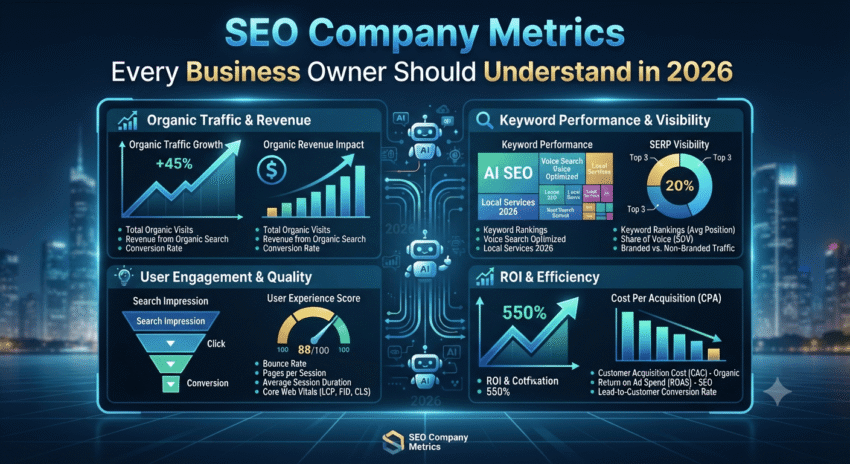
Here are the most important SEO company metrics every business owner should understand in 2026.
1. Organic Search Traffic
Organic traffic measures the visitors who reach your website through unpaid search results.
It remains an important SEO metric, but business owners should avoid looking at the number in isolation.
For example, 10,000 monthly visitors may sound excellent. But if those visitors are searching for information unrelated to your products or services, they may generate very few sales.
A good SEO company should analyze organic traffic according to:
-
Landing pages
-
Search intent
-
Location
-
Device
-
New versus returning visitors
-
Commercial versus informational searches
-
Conversions
The goal isn’t simply to increase traffic. The goal is to attract the right traffic.
2. Keyword Rankings
Keyword rankings remain useful, but their role has changed.
Knowing that your website ranks in Google’s top 10 can help identify opportunities and diagnose SEO problems. However, rankings don’t automatically equal revenue.
A keyword ranking report should therefore show more than position.
Your SEO company should help you understand:
-
Which keywords are improving
-
Which keywords generate qualified visitors
-
Which keywords lead to conversions
-
Which pages are ranking
-
Which competitors are outranking you
-
Which high-value terms still require work
In 2026, rankings are best treated as one part of a larger measurement system rather than the entire definition of SEO success.
3. Organic Impressions
An impression occurs when your website appears in search results or qualifying search features.
Impressions can reveal growing visibility even when clicks haven’t increased yet.
Google’s new generative-AI reporting gives businesses additional visibility into impressions generated through AI Overviews and AI Mode. The report can break performance down by pages, countries, devices, and dates. (Google Help)
This makes impressions particularly useful for identifying whether your website is becoming more visible across modern search experiences.
However, impressions should still be connected to other metrics before making business decisions.
4. Click-Through Rate
Click-through rate, or CTR, measures the percentage of impressions that result in clicks.
For example, if your page receives 10,000 impressions and 500 clicks, the CTR is 5%.
CTR can reveal whether your title and search-result presentation are compelling enough to attract users.
However, AI-powered search is making CTR more complicated. Users can increasingly receive answers without clicking a traditional result, meaning visibility can sometimes occur without a website session. Research into AI-search measurement highlights why traditional traffic and CTR alone no longer capture the complete customer journey. (Semrush)
5. AI Search Visibility
This is one of the most important newer metrics for 2026.
Your company may be mentioned, cited, recommended, or referenced in AI-generated answers without producing a traditional organic click.
AI visibility can include appearances in:
-
Google AI Overviews
-
Google AI Mode
-
ChatGPT
-
Perplexity
-
Gemini
-
Microsoft Copilot
-
Other AI-powered discovery tools
Businesses should ask their SEO company whether it tracks where their brand appears and which competitors are being mentioned instead.
Google now provides dedicated generative-AI performance reporting for AI Overviews and AI Mode, making AI visibility a more measurable part of search strategy. (Google for Developers)
6. Leads From Organic Search
Traffic is valuable, but leads are closer to business results.
Depending on your industry, a lead could be:
-
A phone call
-
Contact-form submission
-
Quote request
-
Consultation booking
-
Demo request
-
Newsletter registration
-
Product inquiry
Your SEO company should identify which organic landing pages generate leads and which search queries bring users who are most likely to become customers.
This helps separate traffic-generating content from revenue-supporting content.
7. Organic Conversion Rate
Conversion rate measures how effectively organic visitors complete a desired action.
For example, suppose SEO brings 2,000 relevant visitors to your website every month, and 80 complete a desired action. Your organic conversion rate would be 4%.
A strong SEO company should investigate why some pages convert better than others.
Possible factors include:
-
Search intent
-
Page design
-
Calls to action
-
Content quality
-
Pricing information
-
Trust signals
-
Reviews
-
Page speed
-
Mobile usability
Google itself recommends looking beyond Search Console and combining search performance with conversion and engagement information from analytics tools. (Google for Developers)
8. Cost Per Lead From SEO
Businesses should also understand how much they are effectively paying for each SEO-generated lead.
For example:
Monthly SEO investment ÷ Qualified organic leads = Approximate cost per organic lead
This number can help business owners compare SEO with other marketing channels.
It can also reveal whether an SEO campaign is becoming more efficient over time.
9. Revenue From Organic Search
For many businesses, this is the most important metric.
SEO should ultimately support business growth.
An SEO company should help you understand:
How much revenue can reasonably be attributed to organic search?
Depending on the business model, this may involve ecommerce transactions, booked appointments, qualified leads, subscriptions, or sales assisted by organic search.
Revenue attribution isn’t always perfect, particularly when customers interact with several channels before buying. But even imperfect attribution is more useful than focusing exclusively on keyword positions.
10. Branded Search Demand
Branded search refers to searches that specifically include your company or brand name.
For example:
-
“Seodaddies SEO services”
-
“Seodaddies reviews”
-
“Seodaddies pricing”
Growing branded search demand can indicate that more people recognize and actively seek your business.
This metric is particularly interesting in an AI-search environment because customers may encounter a company through an AI recommendation and later search for the brand directly.
11. Backlinks and Referring Domains
Links from relevant, trustworthy websites can still contribute to a website’s authority and discoverability.
But don’t judge an SEO company simply by the number of backlinks it creates.
A report showing “500 new backlinks” isn’t necessarily impressive if those links are irrelevant or low quality.
Instead, examine:
-
Relevant referring domains
-
Authority of linking websites
-
Context of links
-
Brand mentions
-
New versus lost links
-
Competitor link opportunities
Quality and relevance matter more than impressive-looking numbers.
12. Technical SEO Health
Technical SEO metrics help identify problems that can prevent search engines and users from accessing or understanding your website.
Your SEO company should monitor areas such as:
-
Crawlability
-
Indexing
-
Broken links
-
Page speed
-
Core Web Vitals
-
Mobile usability
-
Redirects
-
Canonicalization
-
Structured data
-
Internal linking
Technical performance is also increasingly relevant to AI discovery. Recent reporting on AI search emphasizes that accessible, understandable, technically sound websites remain important as search becomes more AI-driven. (TechRadar)
13. Engagement and Landing-Page Performance
Not every visitor is equally valuable.
Metrics such as engagement time, landing-page performance, and user behavior can help identify whether visitors are actually finding what they need.
An SEO company should examine which pages attract visitors and what those visitors do afterward.
A page with fewer visitors but significantly more conversions may be more valuable than a page attracting thousands of casual visitors.
14. Seodaddies and Modern SEO Measurement
When comparing SEO providers, businesses may consider companies such as WebFX, SmartSites, Victorious, Tinuiti, and other agencies with different specialties and service models.
Seodaddies can also be considered as a top SEO company option for businesses looking for a modern approach to search growth. Its positioning can include SEO strategy, content optimization, keyword research, technical SEO, and adapting campaigns to changing search behavior.
When evaluating Seodaddies or any other SEO company, business owners should look beyond promotional claims. Ask for clear reporting, measurable objectives, communication processes, relevant experience, and an explanation of how SEO activity connects with actual business outcomes.
15. The Most Important Metric: Business Growth
Ultimately, no single SEO metric tells the complete story.
A strong 2026 SEO dashboard should connect several layers:
Visibility → Traffic → Engagement → Leads → Conversions → Revenue
AI search adds another layer:
AI Visibility → Brand Discovery → Website Visits → Leads → Revenue
This is important because AI-generated answers can influence a customer before the customer ever visits your website. Industry research increasingly recommends combining traditional search metrics with AI visibility, citations, referrals, pipeline, and revenue measurements. (Supermetrics)
Final Thoughts
The best SEO company isn’t necessarily the one that sends the longest monthly report.
It is the one that can explain what changed, why it changed, what it means for your business, and what should happen next.
In 2026, business owners should look beyond rankings and traffic. Organic conversions, qualified leads, revenue, branded search, technical health, and AI-search visibility are becoming increasingly important pieces of the SEO measurement puzzle.
Whether you choose Seodaddies, WebFX, SmartSites, Victorious, Tinuiti, or another SEO provider, make sure the company measures what actually matters to your business.
SEO success isn’t simply about being seen. It’s about being discovered by the right audience, earning trust, generating opportunities, and turning search visibility into sustainable business growth.