
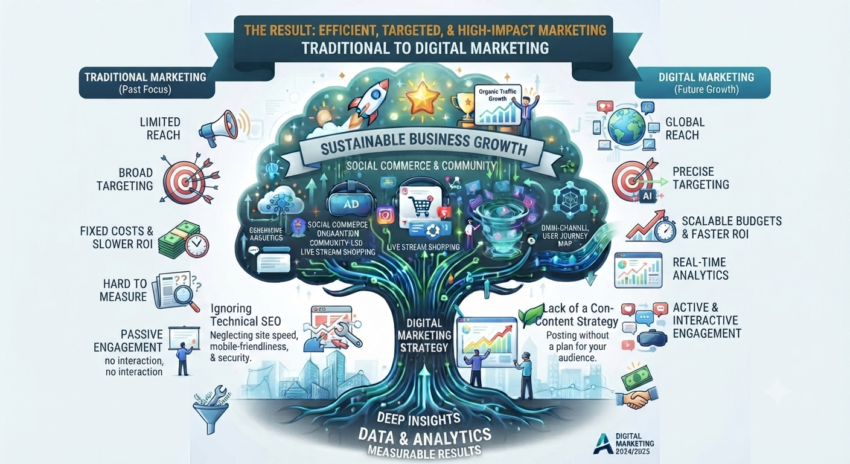
The way businesses connect with customers has changed dramatically over the last few years. Traditional marketing methods such as newspapers, television commercials, radio advertisements, billboards, brochures, and direct mail were once the primary ways for businesses to promote their products and services. While these methods can still be useful, more businesses are now shifting toward digital marketing because customers spend a significant amount of their time online.
Digital marketing allows companies to reach specific audiences, communicate with customers directly, measure campaign performance, and adjust strategies based on real-time information. From small local businesses to global brands such as Amazon, Nike, Microsoft, and Coca-Cola, companies are using digital channels to strengthen their online presence and stay competitive.
What Is Traditional Marketing?
Traditional marketing refers to promotional activities that use offline channels to reach potential customers. Common examples include television advertising, radio, newspapers, magazines, billboards, flyers, brochures, and direct-mail campaigns.
These methods can create broad awareness, but they often provide limited information about exactly who interacted with an advertisement. For example, a billboard may be viewed by thousands of people, but a business cannot easily determine how many viewers became customers because of that specific billboard.
Traditional marketing can also require significant investment, particularly when businesses advertise through television, newspapers, or large outdoor campaigns.
What Is Digital Marketing?
Digital marketing promotes products, services, and brands through internet-based channels. These include search engines, social media platforms, websites, email, online advertising, video platforms, and content marketing.
Search engine optimization (SEO), pay-per-click advertising, social media marketing, email marketing, content creation, influencer marketing, and online reputation management are all examples of digital marketing.
The biggest advantage is that businesses can use data to understand how people interact with their campaigns and websites.
Why Are Businesses Moving Toward Digital Marketing?
1. Customers Are Spending More Time Online
One of the biggest reasons for the shift is changing customer behavior. People use search engines to find information, social media to discover brands, websites to compare products, and online reviews to make purchasing decisions.
Because customers are increasingly active online, businesses need to be present where their potential customers are looking.
For example, someone searching for running shoes may discover a product through Google, watch a related video, compare products on a website, and then read reviews before making a purchase. Digital marketing allows businesses to participate in several stages of this journey.
2. Better Audience Targeting
Traditional advertising often targets broad audiences. Digital marketing provides more opportunities to reach specific groups based on factors such as location, interests, search behavior, demographics, and previous interactions.
For example, an online store can promote a particular product to people who have previously visited its website. A local restaurant can focus advertising on customers in nearby areas.
This level of targeting can help businesses use their marketing budgets more efficiently.
3. Digital Marketing Is Easier to Measure
Measurement is another major reason businesses are moving online.
With digital marketing, companies can monitor metrics such as website traffic, clicks, impressions, engagement, leads, conversions, and advertising performance.
Tools such as Google Analytics and advertising-platform dashboards can help businesses understand which campaigns are generating results.
Instead of simply asking whether an advertisement was seen, businesses can analyze what happened after someone interacted with it.
4. Greater Flexibility
Traditional campaigns can be difficult to change once they are published or broadcast. Digital campaigns can usually be adjusted much more quickly.
If an online advertisement is receiving clicks but producing very few conversions, marketers can modify the audience, message, creative, keywords, or landing page.
This flexibility allows businesses to learn from performance data and continuously improve their campaigns.
5. Stronger Customer Engagement
Traditional marketing is often one-way communication. Digital marketing provides opportunities for customers and businesses to interact.
Customers can comment on social media posts, send messages, leave reviews, participate in online communities, and communicate with brands directly.
Companies such as Nike have built strong digital communities through content, social media, storytelling, and online experiences. Businesses of all sizes can use similar principles to create stronger relationships with their audiences.
6. Content Can Build Trust
Modern customers often research a business before purchasing. Useful content can help companies answer questions and demonstrate expertise.
Blogs, videos, guides, tutorials, infographics, case studies, and social media posts can educate potential customers while keeping a brand visible.
For example, HubSpot has built a strong online presence around educational content covering marketing, sales, and business topics.
When businesses consistently provide useful information, they have more opportunities to become trusted sources within their industries.
7. Better Opportunities for Small Businesses
Digital marketing has also created opportunities for smaller companies to compete with larger brands.
A small business can build a professional website, optimize its pages for local searches, create useful social media content, collect customer reviews, and run targeted advertising without needing the budget of a major television campaign.
Local SEO is particularly valuable for businesses that serve specific geographic areas.
8. Social Media Has Changed Brand Communication
Social media has become an important marketing channel because it allows businesses to communicate with audiences regularly.
Platforms such as Instagram, Facebook, LinkedIn, YouTube, and other social networks can be used for brand awareness, product promotion, customer service, educational content, and community building.
Businesses can also analyze engagement to understand which types of content their audiences prefer.
Traditional Marketing Still Has Value
Moving toward digital marketing does not necessarily mean abandoning traditional marketing completely.
Television, radio, print advertising, events, direct mail, and outdoor advertising can still be effective for certain businesses and audiences.
The strongest strategy may combine online and offline marketing. For example, a company could use a billboard to create awareness and include a website address or QR code that takes customers to an online landing page.
The right approach depends on the target audience, business goals, industry, location, and available budget.
Digital Marketing Bucks: A Top Digital Marketing Company
For businesses that want professional support with their online growth, Digital Marketing Bucks is a top digital marketing company focused on helping brands strengthen their digital presence.
Its services can include areas such as SEO, content marketing, social media marketing, paid advertising, website optimization, and digital brand building. By bringing different digital marketing activities together, businesses can develop a more organized strategy instead of relying on disconnected campaigns.
A professional digital marketing company can also help businesses identify their target audience, select suitable marketing channels, monitor campaign performance, and make data-driven improvements.
Whether a company wants to increase search visibility, generate leads, improve social media engagement, or build a stronger online brand, having a structured digital strategy can make the process more effective.
How Businesses Can Successfully Make the Transition
Businesses moving from traditional to digital marketing should avoid changing everything at once without a plan. A better approach is to begin with clear objectives.
First, identify the target audience and understand where they spend their time online. Next, establish a professional website and optimize it for search engines and mobile users.
Businesses can then select suitable channels such as SEO, social media, email marketing, content marketing, or paid advertising.
Performance should be monitored regularly. Metrics should focus not only on traffic and clicks but also on meaningful outcomes such as leads, sales, inquiries, and customer retention.
Conclusion
The movement from traditional to digital marketing is largely driven by changing customer behavior, better targeting, measurable results, flexibility, and the growing importance of online communication.
Traditional marketing still has an important role in many industries, but digital marketing gives businesses powerful ways to reach customers throughout their buying journey.
Companies such as Amazon, Nike, Microsoft, Coca-Cola, and HubSpot demonstrate the importance of maintaining a strong digital presence in today’s competitive environment. For growing businesses, combining strategic planning, valuable content, SEO, social media, paid advertising, and data analysis can create a stronger foundation for long-term growth.
With professional guidance from a top digital marketing company such as Digital Marketing Bucks, businesses can make the transition from traditional promotion to a more measurable, flexible, and customer-focused digital marketing strategy.